As we enter the weekend here’s a great quote sent to me by Brian Denker.
“What we become depends on what we read after all the professors have finished with us. The greatest university of all is the collection of books.”
–Thomas Carlyle
As we enter the weekend here’s a great quote sent to me by Brian Denker.
“What we become depends on what we read after all the professors have finished with us. The greatest university of all is the collection of books.”
–Thomas Carlyle
As we labor for the renewal of the Church, for a return to Biblical thinking and practice, it is easy to get discouraged. The progress is often slow, people sometimes oppose, we see our own weakness and failures, and we can begin to wonder if we are doing anything worthwhile. We can be tempted to think that this guy may be doing something worthwhile, or that pastor over there, but we are simply spinning our wheels, wasting our time, stuck in a place of contempt. What’s more no one seems to notice our hard work. No one seems to be applauding our efforts. We can be tempted to give it all up. Of course we know better. God is in control, He loves His church more than we do, His approval is all that matters- but in spite of our orthodoxy the tempting, self-centered, discouraging thoughts still assail us.
Does our labor matter? We must speak forcefully to ourselves and say, “Yes, our labor most certainly matters- not because of us but because of God. God is at work whether I see him or not. Do we not walk by faith rather than sight? It is God’s job to see how and where things will develop mine is simply to be faithful in the place he has put me. And in doing so I may one day see the part I have played…. One of the most encouraging passages I have read in some time on this is Haggai 2:1-9. I would encourage you to check out Lee Tankersley’s sermon on this text. Much more could be said on this topic, and I hope to return to it. But in closing here is a poem I have also found helpful on this topic.
SAY not the struggle naught availeth,
The labour and the wounds are vain,
The enemy faints not, nor faileth,
And as things have been they remain.
If hopes were dupes, fears may be liars;
It may be, in yon smoke conceal’d,
Your comrades chase e’en now the fliers,
And, but for you, possess the field.
For while the tired waves, vainly breaking,
Seem here no painful inch to gain,
Far back, through creeks and inlets making,
Comes silent, flooding in, the main.
And not by eastern windows only,
When daylight comes, comes in the light;
In front the sun climbs slow, how slowly!
But westward, look, the land is bright!
Arthur Hugh Clough
p.s. This poem also nicely speaks to those who in essence say, “Once you’ve got it worked out I’ll join you,” or the naysayers who while professing their agreement with the need for such work continue to say it is hopeless and so never put their hand to the plow, or those who for fear of failure never step into the fray.

Robertson is probably the most prominent New Testament scholar to emerge from Southern Baptist ranks. He was not an ivory tower academician, however. His concern that study be translated into good preaching for the building up of the church is evident throughout his work. In fact on my count, his published works fall primarily into two camps: Greek grammar and helps for preachers. Here is an excerpt from his book, The Minister and His Greek New Testament:
It ought to be taken for granted that the preacher has his Greek Testament. This statement will be challenged by many who excuse themselves from making any effort to know the Greek New Testament. I do not say that every preacher should become an expert in his knowledge of the New Testament Greek. That cannot be expected. I do not affirm that no preacher should be allowed to preach who does not possess some knowledge of the original New Testament. I am opposed to such a restriction. But a little is a big per cent on nothing, as John A. Broadus used to say. This is preeminently true of the Greek New Testament.
…
We excuse other men for not having a technical knowledge of the Bible. We do not expect all men to know the details of medicine, law, banking, railroading. But the preacher cannot be excused from an accurate apprehension of the New Testament. This is the book that he undertakes to expound. It is his specialty, and this he must know whatever else he does or does not know. Excuses for neglecting the New Testament are only excuses after all. Dwight L. Moody made himself at home in the English Bible, and he shook the world. Spurgeon made himself efficient in Greek and Hebrew in spite of insufficient schooling. John Knox studied Greek when over fifty. Alexander Maclaren’s Expositions of Holy Scripture are the wonder of modern preachers because he steadily throughout a long life pursued his Hebrew and Greek studies. He had consummate genius and he added to it fullness of knowledge by means of laborious scholarship…. A popular preacher like Dr. G. Campbell Morgan is a close and laborious student of Greek New Testament grammar.
The full chapter from which this quote comes can be read online here.
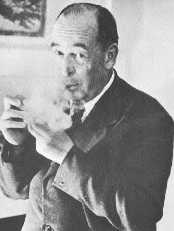
To follow the previous post, here is a quote from C. S. Lewis where he is making the point that the worst sins are often not the obvious ones, but can often be masked in religiosity. Lewis specifically mentions the pleasure of power, which is a good warning to anyone in leadership. This quote is also a good reminder of the heart of the problem and our need of the gospel, not just moral renovation:
“A cold, self-righteous prig who goes regularly to church may be far nearer to hell than a prostitute. But, of course, it is better to be neither.”
Mere Christianity, 95.
He had a way with words didn’t he. 🙂
On our recent vacation I read Letters of Geerhardus Vos . I will be posting a full review soon, but I wanted to go ahead and make one observation from the book. The biographical sketch and letters show Vos concerned about churches who retained a conservative profession but whose preaching consisted merely of moralisms. Liberalism might be rebuked, sin would be denounced, and a good life commended but there was no gospel. Vos wrote:
“Now I do not mean to affirm that in all cases there need be the preaching of false doctrine which involves an open and direct denial of the evangelical truth. It is quite possible that both to the intention and the actual performance of the preacher any departure from the historical faith of the church may be entirely foreign. And yet there may be such a failure in the intelligent presentation of the gospel with the proper emphasis upon that which is primary and fundamental as to bring about a result almost equally deplorable as where the principles of the gospel are openly contradicted or denied. There can be a betrayal of the gospel of grace by silence. There can be disloyalty to Christ by omission as well as by positive offence against the message that he has entrusted to our keeping. It is possible, Sabbath after Sabbath and year after year, to preach things of which none can say that they are untrue and none can deny that in their proper place and time they may be important, and yet to forgo telling people plainly and to forgo giving them the distinct impression that they need forgiveness and salvation from sin through the cross of Christ” (Grace and Glory, 237-238). (82, footnote 211)
This has parallels to churches today. We might even have tacked on calls for people to “ask Jesus in their lives” but still the gospel is too often absent. We may pride ourselves in our conservatism but too much of our preaching consists merely of instructions and admonitions on being good people. The gospel begins with the fact that we are not good (and thus strips away our smug assurance) and then points us not to a victorious culture warrior but to a crucified Messiah as the answer to our plight. Of course we must have teaching on living morally, but this instruction must be rooted in the gospel (see Paul’s letters), not extracted as a few points on good living.
Recently I was sent the following quote from Oswald Sander’s Spiritual Leadership.
“If a man is known by the company he keeps, so also his character is reflected in the books he reads. A leader’s reading is the outward expression of his inner hungers and aspirations.” (104)
How true it is! It is for this reason that in interviews (for pastors, professors, and other jobs) I always want to hear the man list authors he likes to read and books that have been influential to him. If one’s reading is a steady diet of growth technique books (for example), you likely do not have a theologian shepherd- which is what a church needs. One’s reading may be (indeed should be) broad, but there ought to be a clear theme of thinking deeply on the truths of Scripture.

Here is a great quote from Luther’s preface to his commentary on Romans on the nature of true faith. This is such a needed truth in our day, when people think they have saving faith because they have walked an aisle, prayed a prayer or even been baptized but there are no active results to this faith. Luther of all people clearly believed that salvation is by faith apart from works, but here he clearly shows that he (following Paul!) believes that true faith must issue in works. The problem is that we, like those in Luther’s day, conceive of faith as “human figment” rather than as he says “a divine work.” The full quote is very worthwhile.
Faith is not the human notion and dream that some people call faith. When they see that no improvement of life and no good works follow – although they can hear and say much about faith – they fall into the error of saying, “Faith is not enough; one must do works in order to be righteous and be saved.” This is due to the fact that when they hear the gospel, they get busy and by their own powers create an idea in their heart which says, “I believe”; they take this then to be a true faith. But, as it is a human figment and idea that never reaches the depths of the heart, nothing comes of it either, and no improvement follows.
Faith, however, is a divine work in us which changes us and makes us to be born anew of God, John 1[:12-13]. It kills the old Adam and makes us altogether different men, in heart and spirit and mind and powers; and it brings with it the Holy Spirit. O it is a living, busy, active, mighty thing, this faith. It is impossible for it not to be doing good works incessantly. It does not ask whether good works are to be done, but before the question is asked, it has already done them, and is constantly doing them. Whoever does not do such works, however, is an unbeliever. He gropes and looks around for faith and good works, but knows neither what faith is nor what good works are. Yet he talks and talks, with many words, about faith and good works.
Faith is a living, daring confidence in God’s grace, so sure and certain that the believer would stake his life on it a thousand times. This knowledge of and confidence in God’s grace makes men glad and bold and happy in dealing with God and with all creatures. And this is the work which the Holy Spirit performs in faith. Because of it, without compulsion, a person is ready and glad to do good to everyone, to serve everyone, to suffer everything, out of love and praise to God who has shown him this grace. Thus it is impossible to separate works from faith, quite as impossible as to separate heat and light from fire. Beware, therefore, of your own false notions and of the idle talkers who imagine themselves wise enough to make decisions about faith and good works, and yet are the greatest fools. Pray God that he may work faith in you. Otherwise you will surely remain forever without faith, regardless of what you may think or do.
(HT: Kairos Journal)
When the Morning Came, by Piet Prins
Struggle For Freedom Series 1
(Neerlandia, Canada: Inheritance Publications, 1989), pb. 158 pp.
Trans from original Dutch
I was greatly and pleasantly surprised by this book. The combination of our previous experience with translations from Dutch, little experience with this publisher and being a bit behind schedule, I almost skipped this book. My boys and I, however, are very glad I did not. This is an excellent book on many accounts. It is the best book we have read in connection with the history of the Reformation. I have commended other books sometimes commenting that they were not exactly great stories, but they got the point across. This book, however, would be a great story even if it did not also communicate important truths. It rises just about to the level of the Allen French novels which are among our favorites. I have been amazed at how good this book is.
The story is set in late 16th century Netherlands during the persecution of Reformed Christians. Martin, the main character, is a 12 year old boy whose family gets caught up in the persecution. Separated from his parents who have been arrested for their faith, Martin and Boudewyn, the brave, strong blacksmith, make daring rescue attempts, and must risk a harrowing flight for freedom across lands hostile to their faith hoping to reunite with Martin’s parents.
The first kudos to this book come simply because it is a compelling story. So many books fail at this point being merely sufficient stories and conveying a good point. This one though was compelling. I found myself on edge waiting to see what would happen next. The author masterfully moves from adventure to adventure. This was certainly an action-packed tale. Quite often adults can see where things are going in these stories, but I was kept guessing in this one.
Secondly, there is a good presentation of the faith here in various ways. On the one hand, in the midst of the action, the characters are ever mindful of their reliance on God and pray regularly for His aid. Often in action-packed stories this is missing. Or, if it is not missing, it is presented in an awkward or cheesy way. In this book it came out very naturally which then provided a good example for my boys and provided a platform for good discussion. The characters brave many dangers and are able to do so clearly because they believe God is in control. If God wills he can deliver them, and if not they will go down bravely. This is the sturdy stuff I want to put before my boys.
Developing the second point further, the key characters here are real men (it does seem to be targeted primarily at boys). These Christians are not the weak-kneed sort so often presented in our culture. Martin’s Dad hides a seller of Protestant tracts knowing the danger and then refuses to give him up in spite of the fact that it will likely cost him and his wife their lives. At the same time they will not lie to save themselves. Boudewyn is a blacksmith who knows the Bible well and shares it freely and boldly. He is also a giant of a man who takes on large groups of the enemy when they come against Boudewyn, Martin and company. Since he has no wife or children Boudewyn will be the last man behind so that the others may escape. Then there is Hinne the hunter, Frank Abels the sailor and others. This element again comes across naturally and not forced.
There is even a conversion account. It is not the pre-packaged sort however. It simply comes as Boudewyn boldly asserts the place of Scripture and reads it. Another man then begins to read the Bible and eventually finds himself believing the truths found there, trusting God, and being freed of his bitterness towards his persecutors.
Lastly, the suffering of the people of God is clearly presented. This book probably communicated this more effectively to my boys than any of the other Reformation books we have read so far. Our prayer after reading often dealt with thanksgiving for our religious freedom, our access to the Scripture, and our local church.
We strongly recommend this book. This is not one to endure but one to relish. The inside cover of this book suggests this was to be part one of five. We have volume two and have eagerly begun reading it already. Apparently volume three is also available, but I have not found so far any evidence that volumes four and five ever appeared. Apparently Piet Prins is now deceased. He created a great story in this one, one that even comes through well in the translation.
Update: I just received word from the publisher that vol. 3 is indeed available and volume 4 is expected to be available in April 2008.
On the first day of our vacation I finished reading Perelandra, the second book in C. S. Lewis’ space trilogy. Since I commented on the first book (Out of the Silent Planet), I thought I’d comment briefly on this one as well.
I thought Perelandra was a significantly different type of story from Out of the Silent Planet. It took just a bit to adjust therefore. However, it is a great story. Perhaps one of the most beneficial aspects is the compelling description of the fall. Lewis is not describing the fall of Adam and Eve but the temptation and potential fall of the “Eve” of another planet (Venus). Lewis is masterful in places I thought in portraying the allurement of sin, the trickery of half truths, and finally the ugliness of sin- especially in contrast to the purity of this new world as he describes it. In fact, as I was reading this book I found myself more repulsed by sin than normal. Going along one day, I encountered a typical (for me) tempting thought. I am accustomed to the struggle but on this day, I found myself more disgusted with sin than usual. I was glad for this but surprised. I began to ask myself why this was so. As I thought about it, I traced the increased repugnance back to the reading of Perelandra. Without me consciously thinking about it, the portrayal of sin and evil in the book and helped me to strip away the veneer of sin. Anything which does this is to be appreciated and commended!
This past Sunday my fellow pastor, Lee Tankersley, preached on Psalm 78 emphasizing the terribleness of sin and then the greatness of God’s mercy. As the Psalm seeks to remind us of just how bad sin is, I was reminded of an exhortation I wrote several years ago for myself on this topic. It has been helpful to me along the way to re-read this, in the vein of the Puritan idea of preaching to oneself. So I thought it might be beneficial to post it here. Here it is:
Do you hate sin already this morning? I mean do you seethe with hatred and disgust against it, loathing it in its every manifestation in your own soul and character? If not you had best pause for a moment to look sin in the face long enough for its mirage of beauty to pass away so that you may be shocked and horrified anew at what you see. Do not flirt with sin today! Sin is a whore, and she seeks to seduce you and to destroy you. Think for a moment how quickly sin can wreck your life, your family, your ministry, even the reputation of your LORD. You dare not risk this. Do not walk even close lest you fall in.There is no room for toleration, no place for compromise. Every sin weakens your character and paves the way for larger sin. Sin is not passive; it is an aggressive cancer eating away at your soul.
Take up your weapons then and resist today. Do not let up. Do not give in. Spare not! Though you are weary do not surrender. You will have rest in the peace of purity, in the calm of a clean conscience.