
My family and I will be away this week on vacation. My boys are especially excited. My four year old kept commenting with amazement that we would be on “cation” for 5 days. When I told him that actually we would be gone 6 days he remarked with amazement, “That more fingers than I have on my hand!”
I may post something during the week if I come across something in reading and if we have good connection, but I probably will not.
What is pastoral Ministry?
I am currently reading (slowly, along the way) James W. Thompson’s new book, Pastoral Ministry According to Paul (Baker, 2006). I have a hunch that I will see things a bit differently than Thompson, but as far as diagnosing the problem I think he is “spot on.” Here are some key quotes from his first chapter where he details the shifting ideas on what a pastor is supposed to be and the lack of theological basis to these ideas.
“Congregations continue to assume that the minister will maintain the traditional roles of marrying and burying, but they believe that the ultimate goal of the minister is to take the congregation to a new level of growth. The minister must be both an effective communicator and an administrator. In a competitive religious marketplace, the task of the minister is to ensure that the congregation maintains its place among religious consumers. Often search committees no longer look for someone who conforms to one of these models. Instead they seek someone who is a combination of, for instance, Jay Leno, Lee Iacocca, and Dr. Phil.
These often unstated assumptions indicate that the missing dimension in the conversation about ministry is a theologically coherent understanding of the purpose of ministry that incorporates the numerous roles of the minister.” (9)
“Without a theological foundation, the minister too easily becomes the one who ensures the church’s competitive edge in the marketplace of consumer religion.
Despite the pressures that often come from the church and society to define the minister’s role in pragmatic terms as the maintenance and growth of the institution, the answer to the question of ministerial identity . . . is a theological one.” (11)
I also really appreciate his approach to an answer. What he describes here is exactly what I have attempted in my Pastoral Ministry course. Thompson writes:
“Others have challenged us to renew this theological dimension by returning to the classical texts concerning ministry. Although engagement with the classical texts is a valuable exercise, I propose that we consider going beyond these ancient texts to a reconsideration of the significance of Pauline theology for defining the goals of ministry.” (11)
A Children’s Bio of John Calvin
The River of Grace: A Life of John Calvin, by Joyce McPherson
(Greenleaf Press, 1998), pb., 159 pp.
This Was John Calvin, Thea B. Van Halsema
(I.D.E.A. Ministries, 1959), pb., 221 pp.
In a previous post I commented on Beza’s life of Calvin which I recommended as background reading for parents. We had two other biographies of Calvin which were directed at children. I examined the two briefly in order to decide which one to read to my boys at this time. This was John Calvin seems to be very accurate and the endorsement from Roger Nicole speaks volumes. However, with my quick glance through the two books, The River of Grace seemed to be the most engagingly written of the two so we went with it.
I was very pleased with Mrs. McPherson’s retelling of Calvin’s life. Unlike some other children’s bio’s we have read this one covered the whole of the subject’s life which was really good. It was also very nicely written. The book opens with a very engaging scene of Calvin as a boy playing soldier with his friend. This is nicely woven into the story as the reader follows Calvin through his childhood, to the university, into his first contact with the Reformation, along his growing unease with the church and attraction to the Reformation, to his conversion, ultimately to Geneva, Strasbourg, and Geneva again. McPherson pays much attention to Calvin’s time in France as he came to embrace the Reformation. Though our knowledge of this time period is not complete, she creates a very plausible order of events emphasizing the danger of the time and the adventure of clandestine Bible studies, secret work of translating the Bible and eluding the authorities. I think this portion of the book helped my boys to grasp the tenor of the time, the danger of just studying the Bible, and the bravery of those who did so more than anything else we have read so far.
I am actually amazed that the Mrs. McPherson was able to cover so much of Calvin’s life in this short of a book. Of course many things are not covered, but that is to be expected. Of the wide range of doctrinal matters that could be covered, the book appropriately focuses on the centrality of Scripture and the true Gospel. Regarding Calvin himself there is particular focus on his role as pastor, his care for his people, his hard work and care for the broader church as well as his role in advising Reformation churches and leaders all over Europe. I will simply provide one example from the book, where Calvin goes to answer some questions from a church member named Jean Stordeur. Stordeur who had fled to Geneva from elsewhere has been affected by more radical views (which gained some hold at the time) which pitted the Spirit against the Scripture allowing private subjective impressions “from the Spirit” to trump Scripture (this ideas continues today!). I don’t know if we have actual accounts of this conversation or if the author is simply providing a typical conversation on this topic (which did occur), but she has captured well the sort of advice one would expect from this Reformer. After explaining that the Scripture and the Spirit will never be in conflict since the Spirit inspired the Scriptures, McPherson has Calvin continuing with these words:
Jean, if you want the Holy Spirit to be active in your life, you must be all the more diligent to study the Scriptures. Read your Bible. Listen to the reading of Scripture at church. Every time you attend to God’s Word, God is at work in you.” (111)
With some frequency I have to teach this same lesson to adults today. Reading this to your children then is a great blessing and another reminder that in encouraging parents to read good books to their children, the parents will learn as well!
Three other features of the book require mention. First, each chapter has a quote above the chapter title. Early on the quotes come from various places, but as the book moves on they are primarily taken from Calvin’s writings. Many of these are real gems, particularly on the topic of suffering. Secondly, there is a three page appendix providing an alphabetical list of other famous people in the book and a brief description of who the person was. This is a great resource for helping the reader keep track of characters and also could serve as a primer on key characters of this time period. Lastly, a nice two page bibliography is also included listing other helpful books (many of the key works) on Calvin.
We would heartily recommend this book.
Insights from Out of the Silent Planet
I am not posting much just now because I am focusing on making progress with a writing project. However I wanted to go ahead and post a lengthy quote from C.S. Lewis’ Out of the Silent Planet. I have just recently begun reading Lewis’ science fiction, and I really enjoyed this book. Lewis’ views on life emerge naturally in his stories. I have found this reading to be a good example of the value of reading a wide range of sorts of books.
In this scene, the protagonist (man or “hman”) is talking with a being on Malacandra (Mars). The ideas here on the value of memory, holistic view of life, the value of poetry, and even realistic appreciation of the place of danger in life are all helpful.
“‘But it takes his whole life. When he is young he has to look for his mate; and then he has to court her; then he begets young; then he rears them; then he remembers all this, and boils it inside him and makes it into poems and wisdom’ . . . . ‘A pleasure is full grown only when it is remembered. You are speaking, Hman, as if the pleasure were one thing and the memory another. It is all one thing. The seroni could say it better than I say it now. Not better than I could say it in a poem. What you call remembering is the last part of the pleasure, as the crah is the last part of a poem. When you and I met, the meeting was over very shortly, it was nothing. Now it is growing something as we remember it. But still we know very little about it. What it will be when I remember it as I lie down to die, what it makes in me all my days till then – that is the real meeting. The other is only the beginning of it. You say you have poets in your world. Do they not teach you this?’
…
‘And indeed,’ he continued, ‘the poem is a good example. For the most splendid line becomes fully splendid only by means of all the lines after it; if you went back to it you would find it less splendid than you thought. You would kill it. I mean in a good poem.'” (73)
“And how could we endure to live and let time pass if we were always crying for one day or one year to come back – if we did not know that every day in a life fills the whole life with expectation and memory and that these are that day?”
“How can I make you understand, when you do not understand the poets?” (75)
“I do not think the forest would be so bright, nor the water so warm, nor love so sweet, if there were no danger in the lakes.” (75)
Added Note: By the way, I found my inexpensive copies of Lewis’ trilogy at Refiner’s Fire Books, in Louisville, KY owned by my good friend Ron Sloan.
A Bio of Calvin for Parents
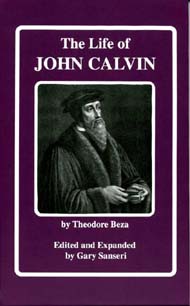
The Life of John Calvin, Theodore Beza; translated by Henry Beveridge (1844); edited and expanded by Gary Sanseri
(this edition, Back Home Industries, 1996), hb., 149 pp.
In our working through the Reformation we have made our way to John Calvin. When I looked I saw we had three biographies of Calvin. Here I will comment on one I decided not to use for my boys (I hope to comment on the other two soon).
This biography was written by Calvin’s close friend and successor and is therefore and authoritative account. However, it is also not directly aimed at reading for younger children. The style and wording would be difficult at various points, and since Beza is writing to his contemporaries he assumes knowledge of various events and people. For these reasons it is not a top pick for reading to your children, but I read it for myself to provide some definitive background when reading one of the other books. For this purpose, this book is excellent!
Beza wrote his brief account to answer critics and to describe the ministry and character of Calvin. This edition includes a number of helps. The editor, first of all, provides numerous notes to explain less common words and to explain people or events. Some of the notes seemed unnecessary to me, but too many is probably better than not enough. Additionaly, for easier reading some spelling has been modernized, longer sentences have been broken up, and paragraph and chapter divisions have been added. The book is also augmented by fives appendices which address these topics:
“Calvin on Reforming the Church”– basically a summary of Calvin’s Reply to
Sadoleto and his On the Necessity of Reforming the Church with historical
background
“Calvin and His Wife”
A Letter from Calvin on dealing with Michael Servetus– This contributes to the discussion of Calvin’s support of the execution of this avowed heretic.
“Calvin on Religious Persecution and Religious Freedom”– excerpted from The Creeds of Christendom, by P. Schaff
“John Calvin on the Love of Money”
Notes in the text of Beza’s biography direct the reader to appendices where they are relevant in the flow of the story.
Although I have previously read other accounts of Calvin, I was especially struck in reading this book by the labor and diligence of the man. I would recommend this as a good resource for parents when preparing to read a more imaginative account of the life of Calvin.
New Site on Children’s Books
Steve Barancik at his website, “Best Children’s Books,” has created a new page devoted to blogs that focus on children’s literature. He lists a number of blogs with each blog providing a “3 Best” list. The Children’s Hour is featured on this page with a list of three best Bible story books for children.
Mr. Barancik has nice things to say about this blog. His site may be of interest to some of the readers here. His list includes blogs from a wide range of opinion including books on Zen for children. Clearly these blogs do not all share my perspective but I am glad to be able to recommend some good Bible story books in that setting.
Ordination Charge- Love the Church
Ordination Charge- Love the Church
Here is a slightly edited version of an ordination charge I recently gave. I try here to communicate that love for the church ought to be a key source from which our ministry arises. Loving the people is not in contrast to preaching, etc. Rather, it is the context from which it emerges.
—————————————————————–
1 Corinthians 13:1-3 “If I speak in the tongues of men and angels but have not love, I am a noisy gong or a clanging cymbal. And if I have prophetic powers and understand all mysteries and all knowledge, and if I have all faith so as to remove mountains, but have not love, I am nothing. If I give away all I have and if I deliver up my body to be burned, but have not love, I gain nothing.”
We need more men who love the church deeply, passionately, vehemently.
We need men who love the church universal, whose hearts race and the thought of joining in labor with those who have gone before, who feel the connection with brothers and sisters around the world. We need men who value the communion of the saints.
However, loving people in general can at times be an excuse for loving no one in particular. We need men who love the particular, local church they serve.
If you love your people:
-It will keep you from being just one more denominational politician disguised as a preacher.
-It will keep you from being a mere professional simply seeking advancement in a career, treating the people of God as stepping stones, building your own kingdom and calling it God’s.
-Love for your people will guard your heart from arrogance
-Love will drive you to study the text and preach well, not to impress but because you know your people need the word of God
-Love for your people will aid you in your own fight with sin, as you know your sin will affect them and as you know they need a righteous man to lead them.
-Love will keep you out of the ivory tower and compel you out into the lives of your people to know them, to know their lives, their joys, and their struggles. How else will you pray for them, preach to them and oversee their souls?
-Love will compel you to watch over their souls and not be content with simply filling a pulpit.
-Love will cause you to labor hard and to impart not only a message but your very life. (1 Thess 2)
-Love will cause you to speak the word boldly to them. Some speak boldly, it seems, because they like to hear their own voice and they are pleased by their own posturing. Let it not be so with you. Rather follow the maxim of Bernard of Clairvaux, “Boldly I speak, because faithfully I love.” Then your people may say of you as they did of Baxter, “We take all things well from one who always and wholly loves us.”
-Love will lead you to discipline.
-Love will keep you from being overbearing (1 Pet 5).
-Love will cause you to shepherd the flock “not under compulsion, but willingly…not for shameful gain, but eagerly” (1 Pet 5).
So it has always been with the choice servants of God:
Luther opposed all the assembled powers of his day because he would not bear to see his people deceived by the indulgence hawkers.
Huss and Tyndale went to the flames because love for their people drove them to give them the Word in their own language.
Love the church, particularly your specific congregation, because in doing so you imitate the Chief Shepherd who loved the Church and gave Himself up for her (Eph 5).
Imitate your Lord who said:
“I am the Good Shepherd. The Good Shepherd lays down his life for the sheep. He who is a hired hand and not a shepherd, who does not own the sheep, sees the wolf coming and leaves the sheep and flees, and the wolf snatches them and scatters them. He flees because he is a hired hand and cares nothing for the sheep.” (John 10:11-13, ESV)
Historic Roots of Systematic Pastoral Visitation
When describing the need for careful oversight of a congregation people often think of the example of Richard Baxter. Baxter is of course a good example, and I have fairly frequently referred to Baxter in posts on this blog. However, we must not think Baxter originated the idea of regular, systematic visitation of one’s congregation.
Theodore Beza, in his Life of Calvin, describes some developments in the pastoral ministry in Geneva in 1550:
“It was determined that the ministers should at a certain season of the year, attended by an elder and a deacon, go round all the wards of the city, to instruct the people, and examine every individual briefly as to his faith. This they were to do, not only in sermons … but also in each house and family. It is scarcely credible how great benefit ensued” (trans. Henry Beveridge)
Pastoral Care Essential
I am increasingly concerned that guys who are earnest to reclaim the importance of biblical proclamation are losing sight of the importance of pastoral care. Increasingly I hear of guys who think their only role is to fill the pulpit and that they should not be bothered with other things. This is simply not the biblical model. How can we adequately oversee the souls of our people- in preparation for God holding us accountable (Heb 13:17)- if we are not involved in their lives on a regular basis? No doubt people are over-reacting to examples where pastors did much visiting but no real preaching. Let us not answer with the opposite extreme, however. Of course, if we do not provide biblical instruction we are not truly pastoring. But, you cannot adequately preach to people with whom you have no or little contact. The New Testament does not refer to our office as “preacher” but with three terms:
Elder- stressing spiritual maturity
Pastor- stressing the shepherding aspect
Overseer- again stressing the oversight and care of the congregation
Let us not think that “oversight” here would focus on “oversight” of the budget, building, etc. These did not exist then. The concern here is the oversight and shepherding of the people. Preaching is one aspect of that.
This “preaching removed from pastoring” does not emerge from the Reformation. I have previously posted on Martin Luther’s comments on the necessity of deep, practical love for one’s people. Let me then point to the example of the other key figure in the Reformation, John Calvin. Whether or not one agrees with Calvin, he is a key figure in the Reformation and a significant proponent of the centrality of expositional preaching. Some even view him as austere, removed and perhaps too academic. However, in the brief biography written by Theodore Beza, Calvin’s close personal friend and successor, mention is made of the time when the plague severely struck Geneva. Beza writes:
At that time the custom in Geneva was, to send those suffering by the plague to an hospital outside the city. The assistance of a steady and careful pastor was required. The greater part declined from fear of infection.
Beza notes then that three pastors including Calvin volunteered. One was chosen and he then refused to go in fear. Calvin greatly desired to serve in this way, but the other leadership intervened to keep him from going. In spite of the fact that Calvin was regarded as the leading theologian and the most published scholar in the region, he did not use that as a reason to absent himself from the daily care of his people. The pastor’s heart yearns to care for his people. The heart that seeks to avoid the people in order to do other things is the heart not of the pastor but of the hireling.
A Children’s Bio of Tyndale
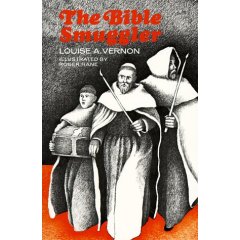
Bible Smuggler, Louise Vernon
(Herald Press, 1967), pb., 137 pp.
Wow! Having read and not been real impressed with four other Vernon Bio’s I was not expecting a whole lot from this one, but we had no other biographies of Tyndale. However, we were pleasantly surprised. This book worked well as a story. It was compelling, flowed well and communicated well the basic points of Tyndale’s life. After the first chapter I was already impressed and my boys were longing for more. In fact in this book practically each chapter ended at a cliffhanger- something which I don’t think the other books did.
In this story Collin Hartley, an English peasant boy, gets the opportunity to learn from William Tyndale preaches against the abuses of the Church. When Tyndale begins his work on translating the Bible into English and moves to the Continent Collin goes with him. The danger of the time and persecution of those who sought to read and translate the Bible is communicated well. With spies chasing Tyndale, Tyndale’s dogged determination, and the overcoming of various hurdles this was a compelling read! It is of a significantly different sort of the other Vernon volumes we have read.
It still would be nice to have a brief note on what was historical. There wasn’t much to question here, but the one thing was significant. Mrs. Vernon has Tyndale meeting Luther and spending time with him. I have not read elsewhere of this happening. It could be true but things of this significance should be clear. Still, we would highly recommend this book.