In order to provide a an easier way to get oriented to this site, my friend Brian Denker has added a category on the right hand side of the page entitled “Pivotal Posts.” At the moment the one item listed there is an article I wrote previously explaining briefly some of my basic thoughts on Bible material for children and some of the books my family had found most helpful at the time of the first writing (a few years ago now). If you want to get a quick orientation that might be a good place to look.
This blog post originally pointed to this article.
Most of All, Jesus Loves You
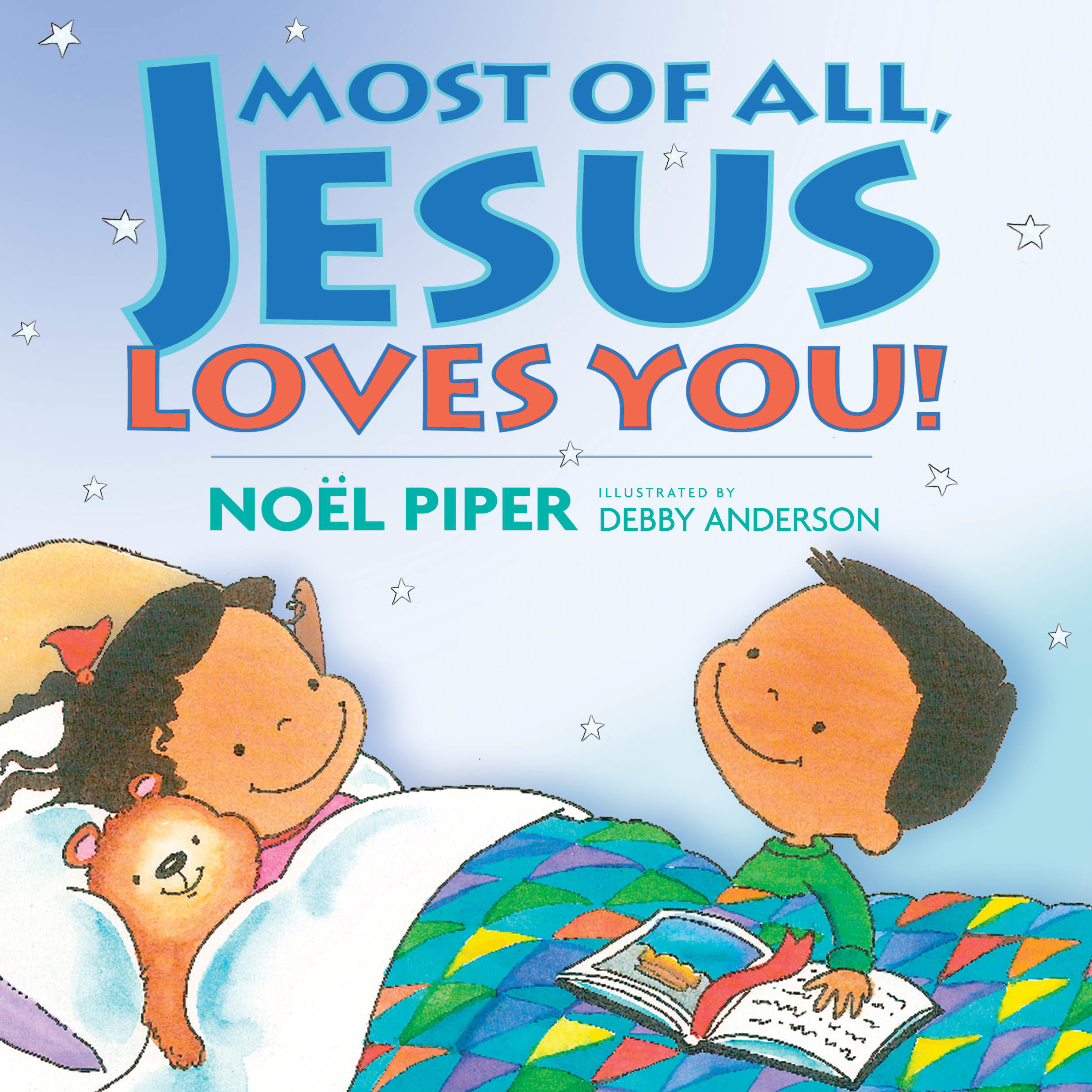 Most of All, Jesus Loves You
Illustrated by Debby Anderson (Crossway Books, 2004), hb., 24pp.
This little book is written as a parent speaking directly to his/her child. It lists various people who love the child ending with “Most of all, Jesus loves you.” That is the extent of the text. I, honestly, was a bit surprised at the brevity of it. While it has the nice illustrations of Debby Anderson as in I Love My Bible, it lacks the same sort of depth. Now, I use “depth” advisedly knowing we are considering reading to young children. Still I have become accustomed to books with a bit more substance even for young children (some have been discussed here).
For what it is this is a fine book. One just should realize what it is and what it is not. It is essentially a brief “goodnight” for your children. The back cover suggests the book is for children ages 3 to 7. I think it will be most useful to children three and younger. The sweetest thing about it is the dedication which suggests this is a distillation of what Mrs. Piper regularly said each night to one of her daughters. The book does represent something good to say to our children. I just don’t think I would purchase a book for this.
Chalmers plea for passionate ministry
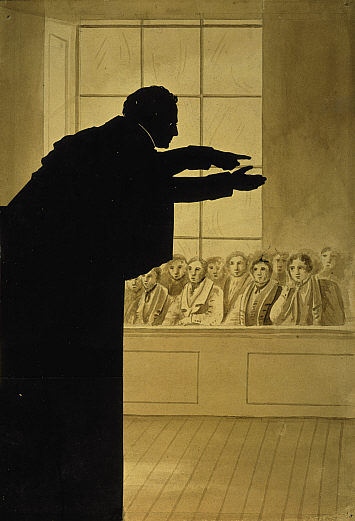
As we head into the weekend, here is a quote from Thomas Chalmers from my own “Defining Quotes” file. This statement comes from Dr. Chalmers’ sermon on the day of the funeral of Princess Charlotte of Wales:
“Is there no room for men of zeal and of strength, who might go forth among these wanderers, and compel them to come in; for men of holy fervour, who might set the terrors of hell and the free offer of salvation before them; for men of affection, who might visit the sick, the dying, and the afflicted; for men who fastened their most intense aim on the great object of preparing sinners for eternity …”
-quoted by Thomas Bridgman in The Nature and Necessity of a Revival of Vital Godliness: A Sermon (Montrose: Smith & Hill, 1820), p. 14, footnote.
The Boy’s Guide to the Historical Adventures of G. A. Henty
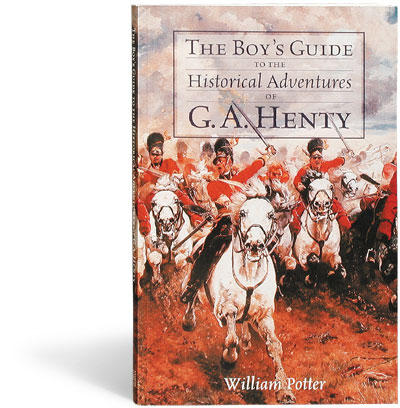
The Boy’s Guide to the Historical Adventures of G. A. Henty
By William Porter (Vision Forum, 2000), pb., 122 pp.
Since I just commented on one of Mr. Henty’s famous novels I thought it might be useful to mention this volume. The book is divided into two parts. The first part is entitled, “Why Boys Should Read the Magnificent Adventures of G. A. Henty,” and contains and introduction to the man and his work. Some might object to the exclusive focus on boys here, but there is no reason to do so. It is valuable to have books that address each gender specifically. Henty’s primary audience was boys as he sought to encourage and teach the values of courage, nobility and heroism- ideas which are not so highly prized to day but are all the more sorely missed. Furthermore, Henty pursues this task from a Christian worldview which is readily apparent in his books. The book contains this excerpt from an interview with Mr. Henty:
To be a true hero you must be a true Christian. To sum up, then, heroism is largely based upon two qualities- truthfulness and unselfishness, a readiness to put one’s own pleasure aside for that of others, to be courteous to all, kind to those younger than yourself, helpful to your parents, even if that helpfulness demands some slight sacrifice of your own pleasure. You must remember that these two qualities are true signs of Christian heroism. If one is to be a true Christian, one must be a Christian hero. True heroism is inseparable from true Christianity, and as a step towards the former I would urge most strongly and urgently the practice of the latter.
It is because this vision so much mirrors my own that I have collected Henty books for my boys. One other quote from the book (this time from Porter) will also help to make the point:
Perhaps the best reason boys should read G. A. Henty has already been alluded to: the Christian character of Henty’s boy-heroes made them men of Honor, fortitude, and perseverance. They took their place as leaders in the army, in civil government, in their professions, in trade, and in their families. They became manly men, unwavering in principle, eager to defend their families and prepared to die for family, nation, comrades, or in a just cause. Many of the real historical characters that anchor the stories, though flawed as all men are, still set examples that did not disappoint the boys of the story. From Richard the Lionhearted to William Wallace, from King Alfred to Gustavus Adolphus, from “Chinese” Gordon to the Duke of Wellington, we see examples of men devoted to duty, unafraid of death, makers of history. Are these not traits we want our boys to admire and embrace?
The second, and longer, part lists 72 of Henty’s historical adventures chronologically and grouped according to historical eras. They span from 1250 B.C. to 1900 A.D. A page is given to each story describing the basic gist of the story. This provides a great tool for using these books in teaching your own children history. Whatever period you are studying, this volume can show you which Henty books are set in that period. Porter claims to have listed all of Henty’s historical novels written specifically for boys. I think I have found some not listed here, but I may be mistaken. At any rate, this book is a very useful tool both for arranging these novels historically and for providing an introduction to this man’s life.
The Importance of Church Membership
Let me follow up the last quote from Ryken’s The Communion of Saints
“The same might be said of regular attenders who never join the church. They lack an unbreakable commitment to the church and its ministry. Nonmembers, however active they may be in the life of the church, are outside the covenant relationship with the body of Christ that God requires. They reserve the right to pick and choose their doctrine, lifestyle, and ministry. In effect they become their own elders denying the authority of the church to carry out its mandate of gathering and perfecting the saints. To put this in theological terms, they separate union with Christ, the head of the church, from union with his body. As a result, they confuse themselves and others – outside as well as inside the church – about what it means to be a Christian. This is a costly mistake to make because membership has its privileges. Martyn Lloyd-Jones went so far as to describe church membership as ‘the biggest honour which can come a man’s way in this world.’ There is no union with Christ apart from the communion of the saints. Nor can the saints have true communion without belonging to one another by belonging to Christ in his church. The communion of the saints is for members only.” (p. 55)
The Necessity of the Church
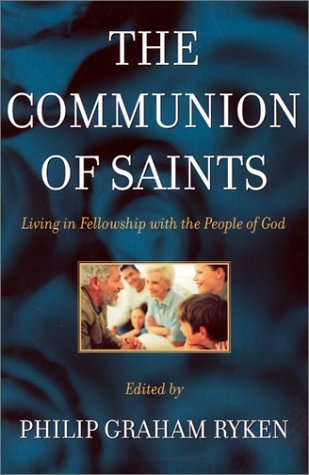
As a part of a Wednesday night class at my church, I am reading The Communion of Saints: Living in Fellowship with the People of God
“We are not ‘united in love,’ as Luther put it, simply because once we are saved it then makes sense to engage in communal duties. The Christian church is not merely a convenient way for individuals to practice their social piety. Rather, we are united in love because we are united to Christ by the Holy Spirit through faith. The Puritan Richard Sibbes (1577-1635) put it like this: ‘As we are knit to Christ by faith, so we must be knit to the communion of saints by love.’ There is no other kind of new life but common life, because fellowship with Christ in his graces, sufferings, death, resurrection, and glory is communal. We enjoy his graces by sharing our gifts. We participate in his sufferings by carrying one another’s burdens.” (p. 60)
The Dragon and the Raven, by G. A. Henty

The Dragon and the Raven
(London: Blackie & Son, 1885; reprint, Preston/Speed Publications, 1995)
Hb., 238 pp.
This is the first Henty novel I have read to my boys. If you are not familiar with Mr. Henty and his novels I would recommend you check out these sites for more information (about Henty 1, about Henty 2, reviews of his books). This sort of information is what prompted me about 7 years ago to begin collecting Henty novels for my boys to read one day. Henty’s books have a great reputation for historical accuracy and for upholding the values of courage, nobility, perseverance, and the like.
This specific book is set in the days of King Alfred of England in the late 800’s. In this time England was regularly invaded by Danish hosts. Alfred is the one who finally defeated the Danes and brought peace to England. In this story Henty creates for us a young Earl named Edmund who fights under Alfred and meets many adventures, in the typical Henty fashion. In the story Edmund is the one who introduces to England advances in warfare particularly naval warfare. In a way he seems to be a precursor to the famed British domination of the seas. Edmund fights the Danes, around England, ends up at the siege of Paris helping to defeat the Danes there and eventually finds adventures in the Mediterranean.
Henty’s concern for teaching history is evident in his preface where he writes:
“Living in the present days of peace and tranquility it is difficult to picture the life of our ancestors in the days of King Alfred, when the whole country was for years overrun by hordes of pagan barbarians, who slaughtered, plundered, and destroyed at will. . . From this terrible state of subjection and suffering the Saxons were rescued by the prudence, the patience, the valour and wisdom of King Alfred. In all subsequent ages England has produced no single man who united in himself so many great qualities as did this first of great Englishmen. He was learned, wise, brave, prudent, and pious; devoted to his people, clement to his conquered enemies. He was as great in peace as in war; and yet few English boys know more than a faint outline of the events of Alfred’s reign – events which have exercised an influence upon the whole future of the English people.”
In another regular Henty feature, the faith of Edmund, though not always at the forefront, does play an important part. The difference between the pagan Danes and the Christian Saxons is significant. It is seen even in how and why they fight. In an important scene, Edmund, the main character, answers a question from Freda a Danish maid.
“How is it that you, whose religion is as you say a peaceful one, can yet have performed so many deeds of valour and bloodshed?”
“I am fighting for my home, my country, and my religion,” Edmund said. “Christianity does not forbid men to defend themselves; for did it do so, a band of pagans might ravage all the Christian countries in the world. I fight not because I love it. I hate bloodshed, and would rather die than plunder and slay peaceful and unoffending people. You have been in England and have seen the misery which war has caused there. Such misery assuredly I would inflict on none. I fight only to defend myself and my country men and women. Did your people leave our land I would gladly never draw sword again” (p.116)
This makes this a valuable lesson for young boys in understanding how fighting fits in a Christian worldview.
Overall, this book started very slowly. Eventually it got going with battles and adventures. In the end my boys were enjoying it, but they admitted early on it was less enjoyable. Even as the action increased, I did think it was not as good a story overall as the first Henty novel I read myself, The Reign of Terror. The language from over a hundred years ago is different in various ways so I found myself regularly editing and paraphrasing. With an audience slightly older this would become less important. I would recommend this book, but know that your crowd will need to have mastered the ability to endure with a book for a while- a very useful ability to acquire!
Monday Reflections
Barry Maxwell has written a great post on pastoral ministry, especially from the perspective of analyzing on Monday what you just did on Sunday. He entitled it “Another Monday Reflection” and it is essentially a meditation on Rom 15:15-16.
While you are at it check out his honest Monday lament, “Another Manic Monday.” (Once you take this link you will have to scroll down to find this entry). It is a good example of being honest about the weightiness of the task. This sort of honest wrestling leads to the confidence in God discussed in “Another Monday Reflection”.
Thanks for sharing both your doubts (of self) and discoveries (of God), Barry.
Baxter quote for the weekend
Favorite Norse Myths
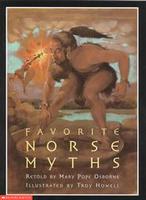
Favorite Norse Myths
Illustrated by Troy Howell, pb. 87 pp.
We really enjoyed this book! I read all of it and so far have only read some of it to my boys. It is a good source when studying the Viking era (as we have been). Some Christian parents are uncertain about discussing mythology (Greek, Norse or otherwise) with their children. I have discussed this earlier in a post, but I will say again that I do think it is important to ground your children well in the biblical story before dealing with the myths. It was fun to read the Norse creation story to my boys and hear them critique it! It was really funny in points as well. My boys found it ridiculous to think of things happening so much by chance and to hear of the pettiness of these gods.
I found it intriguing to note a number of similarities to the biblical story. I know some feel challenged by such similarities. However, if we all come from Adam and Eve, and then Noah, it is not surprising at all to find remnants of the truth in the stories of various people.
Lastly, the illustrations are really well done. There are reproductions of Viking art illustrating the stories, and there full and double page paintings. Both are really nice.