Article on Bible Material for Children

Here is a link to another piece I have written on bible material for children. I have posted this on my pastoral ministry blog previously, but it has been edited a bit (e.g., prices now in US dollars) and its subject is suited to this blog. This edition was recently printed in the Dec 21 edition of the Baptist and Reflector, the TN Baptist state paper. For convenience I have listed below the books recommended in this article.

The Learn About God series (Christian Focus)
God’s Little Guidebooks, by Hazel Scrimshire (Christian Focus)
Bible Time & Bible Wise, by Carine Mackenzie (Christian Focus)
Hear Me Read series, by Mary Manz Simon (Concordia Publishing House)
Big Truths for Little Kids, by Susan and Richie Hunt (Crossway Publishers)
My First Study Bible, by Paul Loth (Thomas Nelson)

Raising a Modern-day Knight

Here is another book I reviewed a few years ago.

Raising a Modern-day Knight: A Father’s Role in Guiding His Son to Authentic Manhood
Robert Lewis (Tyndale House, 1997; now from Focus on the Family)

This is a super book in pointing out the importance of a vision of authentic manhood and of a father passing this down to his son(s). Lewis rightly challenges the fathers to first be men of honor and then to pass on to their sons by example and instruction this vision of manhood. He lays out a vision for authentic manhood, a code of conduct and a transcendent cause. He posits in clear and concise terms a vision for manhood in four principles:
A real man:
– Rejects passivity
– Accepts responsibility
– Leads courageously
– Expects the greater reward
I think this sums up well a vision that we men need. I especially see in the first 3 issues which I am so often tempted to shirk.

He then outlines in three statements a summary code of conduct, which in effect fills out the responsibility mentioned in principle two:
– A will to obey (God’s)
– A work to do (vocation)
– A woman to love
This is in essence nothing new, but I found it very encouraging to sum up my responsibilities concisely like this. It gave an extra sense of dignity to my vocation and to loving my wife.

Then Lewis argues that we need a transcendent clause to make this all worthwhile. He lists 3 necessary characteristics of a transcendent cause:
A transcendent cause must be:
– Truly heroic- “a noble endeavor calling forth bravery and sacrifice”
– Timeless- containing significance beyond the moment
– Supremely meaningful
In contrast Lewis suggests we often fail our sons at these three points in the following ways (87):
– “We invest our sons with marketplace competence, but not moral conviction.”
– “We help our sons to become socially successful, but not spiritually significant.”
– “We give our sons good things, but not the best things.”
As Lewis notes, the only truly worthwhile cause is following Jesus Christ. To faithfully follow Jesus will call for bravery and sacrifice and will have eternal significance and meaning.

This book grows out of the author’s desire to think through and pass these things on to his own sons and it shows. He and some fellow fathers used the metaphor of knighthood and its ideals as a model and it worked well giving tones of nobility and honor, characteristics sadly missing in our day. He also argues strongly for marking the son’s maturing with ceremonies which celebrate his maturing and reinforce the biblical view of manhood. He includes examples of what he and other fathers have done for such ceremonies. He clearly says these are only examples which others can adapt to their own situations. The examples will be great help to me one day as I hope to do something similar and they were very moving to read.

Probably the main fault with the book in my mind is that his use of Scripture is not always careful. It is always reverent, but the issue at hand sometimes overrides the primary meaning of the passage. This is not uncommon, and the major points still stand. The book does not say all there is to say about manhood, but it does sum up some key points very well. Folks like me who are forever worrying with the details and theory are well served by the likes of Lewis who can state succinctly a plan of action. We perfectionist detail guys may wonder if all details are included or about tweaks here or there, but I for one am glad for an action plan.

I recommend the book heartily to every father of sons. May we by God’s grace raise sons of dignity, courage, nobility, and honor who will fear God and keep His commands.

Some Children’s Books from Christain Focus

A few years ago I reviewed briefly some (then) recent publications for children from Christian Focus Publications, one of our favorite publishers of Bible material for children. Here is a link to that review.
The books mentioned here are:

For children about ages 7 and up:
Carine Mackenzie, The Bible Explorer: God’s Truth from Genesis to Revelation
Irene Howat, Ten Boys Who Changed the World, Ten Girls Who Changed the World, Ten Boys Who Made a Difference, and Ten Girls Who Made a Difference

For younger children:
Penny Reeve, God Made Something Strong
Catherine Mackenzie (daughter of Carine), My God is So Big

The Church, Once More

I have been planning a follow up to my previous post on the importance of the church, and a recent column from Christianity Today has pushed me to go ahead and post at least part of it. According to the CT article, George Barna’s latest book argues that there is a great spiritual revolution going on and most of the people see no need for the local church. According to Barna, this is no problem.
Here is a quote from the article which cites Barna:

Unlike the Great Awakenings, which brought people into the church, this new movement “entails drawing people away from reliance upon a local church into a deeper connection with and reliance upon God.”

Who needs a church when you have God? Especially when the church can be so common, day-to-day, and unexciting. To quote the article again:

Barna illustrates with two fictional characters who “eliminated church life from their busy schedules.” Why? They did not find a ministry “that was sufficiently stimulating” and “their church, although better than average, still seems flat.”

The article also interacts a bit with Barna’s argument that the New Testament does not call for active involvement in a local church.

I confess that this has me a bit wired up. I can’t believe he has finally said it so baldly, but this is the spirit of the age. This properly pictures for us what many out there are thinking. I am proud of CT for critiquing it. Barna has been allowed to be a guru for years all the while showing that he has little theological or biblical basis. In fact this approach to church which he reports and encourages is simply the logical end of the consumerism he has been promoting for some time.

But, my main point is to say this simply underscores the need for clear teaching in order to properly shepherd the people entrusted to our care. This neglect of the local church is not good for us, and in spite of some common misconceptions it is not the heritage of Protestantism through the Reformation. When Protestants today are so negligent and apathetic towards the church they are in fact abandoning their heritage. The Reformers were strong in their ecclesiology. In fact Calvin wrote, “If we do not prefer the church to all other objects of our interests we are unworthy of being counted among her members” (Institutes, 4.1.1). You can pursue this further with a really good book from Soli Deo Gloria entitled, Onward Christian Soldiers: Protestants Affirm the Church. It is a collection of addresses on the church by people like John MacArthur, Do Whitney and R. C. Sproul.

Since my first post on this topic began with a story about my children I’ll close this one with another story. I came in recently to find my third son, Jonathan, playing with a tape measure. As I walked up to him, I saw him pull out the tape measure a certain length, look at it studiously, and then he said matter-of-factly, “Yep, it’s 32 degrees outside.” Things like this Barna book are much like my son here. Measuring with the wrong instrument, and therefore coming up with really flawed results. At least my son will eventually learn better and his error concerns trivial things rather than controverting Scripture to the detriment of the Bride of Christ.

Catechism and Stories


Susan and Richie Hunt, Big Truths for Little Kids.
Good News Publishing, 1999, hb., 160 pages. $12.50. ISBN 1581341067

This book quickly became a favorite of ours after my wife purchased it 5 or so years ago. It can be used with kids as young as three and then continues to be of much interest to my nine year old. It pairs a modern day story with a children’s catechism. I have previously written a review of this book which you can find here. The link will take you to a page with two reviews. This book is in the second review.

This would be a great book for every home, and makes a great gift.

Pilgrim’s Progress for Children

Often times renditions of classic books for children are disappointing. However, we have found two renditions of Pilgrim’s Progress which we have really enjoyed.

The first one came across and used is The Evergreen Wood, by Alan and Linda Parry. In this book the Parry’s retell the story with all animal characters. For example, Christian becomes Christopher Mouse. He is fleeing the Dark Wood and journeying to the Evergreen Wood. The transformation is nicely done. The sense of adventure and the gospel lessons come through clearly. My children at ages four and five loved this book! We read it repeatedly and I was glad to be able to set before them the basic story and message of this book at an early age.


The second book, which we introduced a little later, is Dangerous Journey. This book tells the story with out so much adaptation, but with really nice illustration (interestingly, the illustrations are by Alan Parry). This one is still quite readable but contains more text and information than The Evergreen Wood. We used this one with our boys at about ages six and seven. This was too has become a regular favorite.
I commend both of these to you.

New Blog on Children’s Books

I have started a new blog called The Children’s Hour dedicated to reviews and recommendations for children’s books. Parents are often asking about good books to read to their children (and it is a good thing for pastors particularly to be ready to give guidance here), so I decided to post the reactions of myself and my boys to the books we read together. I have put up a few posts so far and will continuing posts from books we have read in the past as well as post books as we read them. I hope it will be a useful resource.

The Story of Rolf and the Viking Bow, Allen French


The Story of Rolf and the Viking Bow(originally published early 1900’s; Bethlehem Books, 1993), 244 pages.

This was a great story! It did seem to start slowly, and the language is different (they talk in Elizabethan English and various Icelandic or Norse terms). However, there is a glossary to help in getting started, and the story is well worth the work. There is grand adventure, battles, intrigue and an underlying theme, as typical in the old tales, of honor, nobility, courage and faithfulness. The closing even drew together points from the story to make a strong point concerning endurance without complaint and the value of humility and being willing to ask forgiveness. French, according to the introduction, was steeped in the ancient sagas and lore, and this shows in the style and quality of his writing. This was another story that made it difficult on the next book we turned to.

The story follows the life of Rolf a young boy in Iceland around 1010 AD, about a generation after Christianity was introduced to the island. In addition to the positive qualities just mentioned, the story is helpful in becoming familiar with this era in history in Northern Europe which has significant connections to the development on British and therefore American history.

This is one of the really good ones. My 9, 8 and 6 year old boys loved it. It is probably too complicated for children younger than 6.

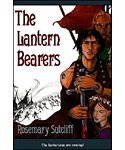
The Lantern Bearers, Rosemary Sutcliffe


The Lantern Bearers, Rosemary Sutcliffe
(Oxford University Press, 1959; Sunburst, 1994), 280 pages.

We have read several Rosemary Sutcliffe books by now, and though this is the first one I am posting about it is not the first we read.

This story concerns a young Briton, Aquila, who is a Roman soldier but stays behind when Rome withdraws from Britain. The story then focuses on the invasion of the Saxons, from Aquila’s enslavement by Jutes to his regained freedom, and fighting alongside the remnants of Roman leadership and British tribes against the invading Saxon tribes.

Sutcliffe, as seems typical from what I have read of her so far, is very reliable with her historical data, making this a good way to learn this era of history. Then, battles were central enough to this story line that my boys enjoyed this one. However, it was really written for an audience significantly older, so a number of the issues and concerns were really lost to them. My boys ranked this as one of the books they most enjoyed in our 2005 reading, but they do not realize how much adapting I did in reading it to them- (adapting and interpreting on the fly is an important ability for reading to your children, in my opinion).

So, this is a good book, but probably more suited for children about 12 years old or older. Of course if you can adapt a bit and clarify my seven and nine year old really enjoyed it.

Children’s Bio of Saint Patrick


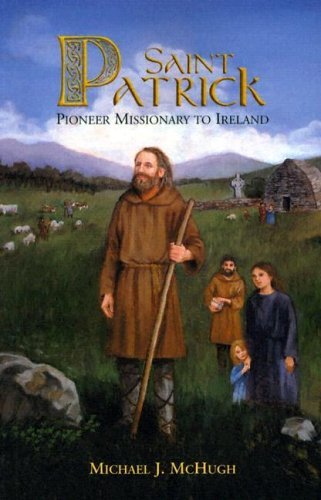
Saint Patrick, Michael J. McHugh
(Christian Liberty Press, 1999), 150 pages.

Stories about key historical Christian leaders are always attractive to me but we have learned from experience that a good idea for a book does not insure the good writing of the story. This book, however, is really well done. The story is told well, including good action. My boys really enjoyed it. The author also does a good job at various places in the story of presenting the gospel- not in a cheesy or truncated manner as so common in many kids stories. The gospel arises naturally as Patrick considers his soul during his enslavement in Ireland eventually resulting in his conversion (which is related well), and then in his missionary preaching later on. Each time the gospel call is repent and believe.

Now, this book is not Narnia level writing. It does seem a little heavy handed at times, but I do warmly recommend it. It presents courage, perseverance, the importance of obedience to parents, sharing of the gospel, gospel removing fear of death and enabling boldness. The author clearly seeks to distance Patrick and the British church from Rome, which is fine with me, but I do not know how historically accurate that is.

(Note: I cannot find this book listed on the publisher’s website currently. I have contacted them and will update this post when I hear something. Sadly, this book like several others we have enjoyed is not available through Amazon. Amazon does have an Audio version)
UPDATE: The link above will now take you to an Amazon page where the book can be purchased.