Community

As many of us seek a restoration of sound biblical teaching, seeking depth and awe in place of shallowness and entertainment, I don’t think I hear enough on the importance of real community in the church. I will trumpet right along anyone else the absolute essential of having sound, rigorous biblical exposition. Without it, all else is lost. However, we must also have a community of faith gathered around the Word in which we encourage, rebuke, help, strengthen, watch over and pray for one another. If we speak with the tongues of men and angels – and if we understand all mysteries and all knowledge but have not love we are nothing- love that is not merely nice respectability but deep affection forged through sacrificing for one another, hurting with and rejoicing with one another. There are as many cultural forces fighting against the establishment of this sort of fellowship as there are against sound teaching.

The value of this community came to mind again today when I was home for lunch. Somehow in our lunch table conversation (with my wife and four boys) something was mentioned about sisters. My three year old, Benjamin, said “My sister [is] named Anna Beth.” Anna Beth is a young girl in our church, one of his friends, but as my wife pointed out to him, not technically his sister. My wife, who is pregnant, went on to say, “This baby might be a sister for you and we could name her - and she mentioned an option. Benjamin responded, “I want to name our baby Michael Tankersley!” Michael is the son of one of my fellow elders and is one of Benjamin’s close friends. I guess he thought, “Let’s just have another Michael here!”

It was all funny and quite cute. On my way back to the office, though, it hit me. While he knows the distinction between our immediate family and his church family, the distinction is not sharp. Those at church are to him family. They are in his mind, brothers and sisters. This made my heart well up in a huge, “Yes!” He is from his early days learning to see the community of faith not as something “out there” but as part of our intimate circle. One of my prayers for my boys is that close-knit church community be a basic assumption from their earliest days.

As we labor in the ministry let us labor for the community of the saints, that the watching world might know by our real and active love for one another that we are indeed followers of Christ.

Titus and Church Health

I think the little letter to Titus is in many ways a discourse on church health. People today often overlook this letter, but Luther said of it, “This is a short epistle, but a model of Christian doctrine, in which is comprehended in a masterful way all that is necessary for a Christian to know and to live.” Here is a link to an article I wrote seeking to expound the overall message of this letter. I argue that the structure of the letter shows that the letter details four necessary elements of church health: Proper Leadership, Proper Response to Error (moral and doctrinal), Proper Living, and Proper Understanding of the Gospel. A pdf version of the article can be found here.
I have often used this (in oral presentation) with churches in interim periods or other times of self-evaluation.

Reading and Listening

In this blog I am simply assuming the value and importance of reading aloud to your children. One of my goals in reading to my boys (in addition to the main goal of learning) is to develop a love for hearing good reading. So, books on tape or audio dramatizations fit our goals well. My boys love to listen to audio stories while we travel. These are great ways to encourage the art of listening and a love for being read to. Even if we had the chance, we would not take a video option in our automobile because we have already established an enjoyment of listening. One of our favorites is Adventures in Odysey, produced by Focus on the Family. These are nicely done stories, with good adventure and good morals. One could quibble with places, but by and large it is great stuff.
I posted earlier about one of our other favorites, the Chronicles of Narnia .

We have also enjoyed finding books on tape available at Cracker Barrel restaurants. You can purchase the tapes and then return them for a refund of most of your money. The result is that you can essentially rent the tapes for a very reasonable cost. If you return the tapes in a week you pay $3.49. When traveling this past summer we made much use of these and really enjoyed listening to books from the Magic Tree House series, the Boxcar Children series and the Hardy Boys.

Hand that Rocks the Cradle: Good Books to Read Aloud to Children


Hand that Rocks the Cradle: Good Books to Read Aloud to Children
By Nathaniel Bluedorn

We began building a library for our boys well before they could read. As we began one of the best resources we had was this little booklet, in which Bluedorn has listed books his parents read to him and his siblings as they were homeschooled. He lists over 400 books, grouped according to three reading levels (easy, difficult, advanced), and most books have a brief annotation. It is a great resource as you go along looking for books. I kept this booklet with me in Scotland so I would know what to look for when I had a chance to step into the used bookshops. The booklet is published by the Bluedorn’s family business Trivium Pursuit.

The Christmas Troll


The Christmas Troll
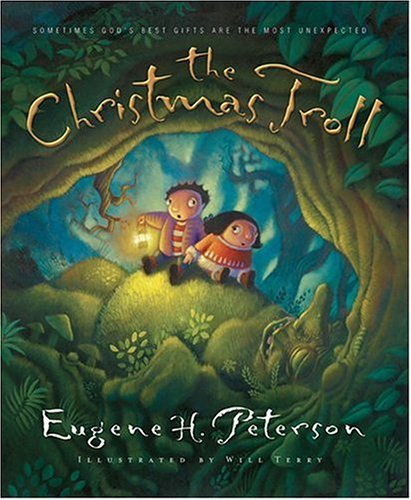
By Eugene Peterson (NavPress, 2004)

I bought this book a year ago because I think Peterson is a good writer and story teller. However, this book was a disappointment to me. It is nicely illustrated and the story is fine, there just was not much to it. The point of the book can be summarized in one of Peterson’s lines form the book, “Gifts are for giving and receiving, not for grabbing and getting.” That’s a fine lesson but the book simply was not as substantive as others we have read.

The Gold Thread

The Gold Thread: A Story for the Young, by Norman Macleod, D.D.
(London: Burnet & Isbiter, nd), 68 pp.

I found this old book in a little bookshop in Scotland, and it has become a favorite in our family. This is a beautiful allegory of the Christian life in a manner that reminded me of C. S. Lewis though I believe this would have been written prior to Lewis.

The story is all about Eric, son of good King Magnus. He has gotten lost in the wood because he strayed from the Gold Thread which would safely guide him through the wood back to his Father. Eric endures difficulties being lost in the wood, finds his way back to the thread, and must face various temptations and threats which would pull him away from the thread. I am not entirely sure what Macleod’s intention was, but I took the Gold Thread as a symbol for Scripture, that which is to guide is along our way on the journey to our Father’s kingdom. The temptations to leave the thread, even slightly, that Eric faces portray in a very compelling way the temptations which we face do divert from Scripture. At places it seems impossible to go on with the thread, that it will lead into a wall or over a cliff or into the clutches of a lion, but each time when he follows on in faith the thread does lead him safely along. These parts of the story provide a great picture of faith, trusting and obeying God’s Word even when we do not understand- an important lesson powerful communicated.

My boys enjoyed this story beginning around the age of five. It is clearly written and full of adventure. I recommend it heartily, as it is one of our families all time favorites. Used copies can sometimes be found, and more recently a reprint edition of this wonderful little book has been made available.

Son of Charlemagne


Son of Charlemagne, Barbara Willard
(Doubleday, 1959; Bethlehem Books, 1998), 183 pp.

This is essentially an overview of the career of Charles the Great, King of the Franks, written from the perspective of his son and heir, Carl. According to information in this new edition, the book was originally written for a series which aimed to present significant times and events from a Christian perspective for children- a great aim.

We were not real impressed with this book, however. While it had its places with excitement, it often moved slowly. This may be due in some part to the fact that we read the excellent story of Rolf and the Viking Bow just before this one! Nonetheless, this story was a lesser one for several reasons. First, it was very difficult to follow the flow of time in the story. From one chapter to the next several years may have passed with no statement of that fact. Thus, it was often confusing wondering what the ages of the characters were and whether young Carl was an older boy, a teenager or what. This had a serious disorienting effect on the reading. Secondly, for us, it was to pro-Catholic. Of course, this was the religion of the time, but the lack of explanation or clarification introduced barriers for us. I do not want to present the pope as the Vicar of Christ or Sovereign Pontiff; but this was strongly affirmed in the book. Of course Catholic readers would appreciate this, but for Protestant readers, reading to their young children and shaping their views, this is a significant issue.

So, this is a decent book, it does give some historical background, but I would not go out of my way to get it.

NOTE: Interestingly my opinion is significantly different from the three reviews posted at Amazon. This highlights one of my reasons for doing this blog. We routinely have had books recommended that we thought were below average. So, at least here’s another angle.

John Piper’s Letter

I am sure you are well aware by now of John Piper’s cancer. It has been good to see so many expressing concern and praying. I want to point out here his letter to his church which announced the cancer. You may have already read it. When I read it last week I was especially struck with his discussion of how and why this was good for him and for the church. He writes:

This news has, of course, been good for me. The most dangerous thing in the world is the sin of self-reliance and the stupor of worldliness. The news of cancer has a wonderfully blasting effect on both. I thank God for that. The times with Christ in these days have been unusually sweet.

When I first read the letter, I was lost at first for the referent to “this news.” I wondered if it was referring to the immediately preceding paragraph about recovery time, etc. Then as I read on I understood he meant that the news of having cancer was good for him! To say that in such sincerity is a powerful example of grace at work and maturity lived out. This letter is a good example of pastoral leadership in the midst of difficulty and suffering. Here is a model for us to learn from.

The Picture Bible


The Picture Bible
By Iva Hoth. Chariot Victor Publishing. 800 pages

We bought this one because I remembered enjoying it so much as a kid. I had encountered it as a series of smaller volumes in our church library, and loved them. It took us a long time to find it and then we discovered this hardback all-in-one edition (and this one is in color!). Bible stories are faithfully told in a comic strip format. I know the words “comic strip” used in conjunction with the Bible does not bode well, but this one is well done.

While we were trying to find The Picture Bible we bought a copy of The Lion Graphic Bible. The animation is more update in the Lion book, but the stories are not as faithfully or tastefully done. I would recommend passing on the Lion Graphic Bible, but the Picture Bible is a good addition and a fun way for younger readers to read the basic story line of the Bible.

HOW TO BE A GREAT THEOLOGIAN

I picked up this excerpt from Martin Luther some years back and have used it often. I came back to it today, and then thought it could be of use to pass it on here. There is much helpful wisdom here.

1. Prayer. For this reason you should despair of your wisdom and reason; for with these you will acquire nothing, but by your arrogance cast yourself and others into the pit of hell as did Lucifer. Kneel down in your chamber and ask God in true humility and seriousness to grant you true wisdom.

2. Meditation. In the second place, you should meditate, and not only in your heart, but also outwardly, the oral Word and the expressed words that are written in the Book, which you must always consider and reconsider, and read and read over with diligent attention and reflection to see what the Holy Spirit means thereby. And take care that you do not become weary of it, thinking that you have read it sufficiently if you have read, heard, or said it once or twice and understand it perfectly. For in this way no great theologian is made, but they (who do not study) are like immature fruit, which falls down before it is half ripe. For this reason you see in this Psalm 119 that David is always boasting that he would speak, meditate, declare, sing, hear, read, day and night forever nothing else than the Word of God alone and the commandments of God. For God does not purpose to give you His Spirit without the external Word. Be guided by that. For He did not command in vain to write, preach, read, hear, sing, and declare His external Word.

3. Temptation. In the third place, there is tentatio, that is, trial. That is the true touchstone which teaches you not only to know and understand, but also to experience how true, sincere, sweet, lovely, powerful, comforting the Word of God is, so that it is the wisdom above all wisdom. Thus you see how David in the Psalm just mentioned complains about all manner of enemies, wicked princes and tyrants, false prophets and factions, which he must endure because he always meditates, that is, deals with God’s Word in every possible way, as stated. For as soon as the Word of God bears fruit through you, the devil will trouble you, make you a real teacher, and teach you through tribulation to seek and to love the Word of God. For I myself – if I am permitted to voice my humble opinion – must thank my papists very much for so buffeting, distressing, and terrifying me by the devil’s fury that they made me a fairly good theologian, which otherwise I should never have become.

4. Humility. Then (namely, if you follow the rule of David exhibited in Psalm 119) you will find how shallow and unworthy will appear to you the writings of the Fathers, and you will condemn not only the books of the opponents, but also be ever less pleased with your own writing and preaching. If you have arrived at this stage, you may surely hope that you have just begun to be a real theologian, one who is able to teach not only the young and unlearned, but also the advanced and well-instructed Christians. For Christ’s Church includes all manner of Christians – young, old, weak, sick, healthy, strong, aggressive, indolent, simple, wise, etc. But if you consider yourself learned and imagine that you have attained the goal and feel proud of your booklets, teaching and writing, as though you had done marvelously and preached wondrously, and if you are much pleased because people praise you before others and you must be praised or otherwise you are disappointed and feel like giving up – if you are minded like that, my friend, just grab yourself by the ears, and if you grab rightly, you will find a fine pair of big, long, rough, donkey ears. Then go to a little more expense and adorn yourself with golden bells, so that wherever you go people can hear you, admiringly point at you with their fingers and say, “Lo and behold, there is that wonderful man who can write such excellent books and preach so remarkably!” Then certainly you will be blessed, yes more than blessed, in the kingdom of heaven; indeed, in that kingdom in which the fire of hell has been prepared for the devil and his angels! . . In this Book, God’s glory alone is set forth, and it says: Deus superbis resistit, humilibus autem dat gratium. Cui est gloria in secula seculerum [God resists the proud, but gives grace to the humble. To Whom be glory forever and ever]. Amen.