“It Is Glory Enough”

I read this poem tonight and was taken with its spirit. I don’t know authorial intent, but it strikes me as a compelling portrait of life lived without regard for the shifting winds of public opinion, standing for God’s truth regardless of the cost.

“It Is Glory Enough”

IT is glory enough to have shouted the name
Of the living God in the teeth of an army of foes;
To have thrown all prudence and forethought away
And for once to have followed the call of the soul
Out into the danger of darkness, of ruin and death.
To have counselled with right, not success, for once,
Is glory enough for one day.

It is glory enough for one day
To have marched out alone before the seats of the scornful,
Their fingers all pointing your way;
To have felt and wholly forgotten the branding-iron of their eyes;
To have stood up proud and reliant on only your soul
And go calmly on with your duty —
It is glory enough.

It is glory enough to have taken the perilous risk;
Instead of investing in stocks and paid-up insurance for one,
To have fitted a cruiser for right to adventure a sea full of shoals;
To sail without chart and with only the stars for a guide;
To have dared to lose with all the chances for losing
Is glory enough.

It is glory enough for one day
To have dreamed the bright dream of the reign of right;
To have fastened your faith like a flag to that immaterial staff
And have marched away, forgetting your base of supplies.
And while the worldly wise see nothing but shame and ignoble retreat,
And though far ahead the heart may faint and the flesh prove weak —
To have dreamed that bold dream is glory enough,
Is glory enough for one day.

–          William Herbert Carruth

“Reliant on only your soul” may be taken as a sort of self-reliance which minimizes God, but it could be taken in terms of standing alone, without the support of others (like, e.g., Daniel, his three friends or Martin Luther). Count me in for fitting a “cruiser for right,” considering what is right and not just what will succeed, and standing for the name of God regardless of the contempt of the worldly wise. That will certainly be glory enough.

Pastors, Physicians of Souls

There is a striking analogy between the office of a pastor and that of a physician They both have respect to the welfare of men and while the one seeks to heal the diseases of the body the other aims at restoring to health the disordered souls of men. It belongs to each not only to cure but to prevent diseases and to soothe and comfort such patients as it may be found impossible to cure As the physician cannot safely follow his profession without an accurate knowledge of the human frame so the pastor ought to be well acquainted with the constitution of the mind and with all its faculties susceptibilities and passions And as the body and mind are intimately but mysteriously united, it appertains to both these professions to be acquainted with the effects of this union in their reciprocal influence on the constituent parts of our nature; therefore the knowledge of physiology is important to both. I have often been struck with admiration at the ardour and self-denial manifested by the students of medicine in acquiring the requisite knowledge of the anatomy of the human body and in making themselves acquainted with the pathology of the most loathsome diseases. They learn to enter cheerfully into the wards of hospitals almshouses and asylums for the insane that they may become acquainted with the symptoms of all classes of disease to which the human frame is liable, and they spare no pains in making experiments and ascertaining the efficacy of particular remedies and modes of treatment. And I have desired to witness something of the same diligence and self-denial in candidates for the holy ministry that they might become better qualified to deal with the moral diseases of those souls which are committed to their care. Every pastor should study to become a skilful casuist for if he is a faithful shepherd he will meet with a great number and variety of cases of conscience which will call for both his tenderest compassion and spiritual skill in the treatment.

–          Archibald Alexander, found in Princeton and the Work of Christian Ministry, 191-92

Rootedness & Trust in Times of Trouble

Several weeks ago now, John Crowder, pastor of First Baptist Church in West, TX, where the fertilizer plant exploded, wrote a moving and very useful column about ministry in the aftermath. He mentions a number of lessons he drew from the event, and several are useful for pastoral ministry. Here, in his words,  is one that stuck out to me:

Another lesson I’ve learned is that it helps for a pastor to be somewhere for a while. It helps build the trust of your community. Then when disaster strikes, you’ve got that trust, and the community knows it can depend on you. If you’re always moving to work your way up to a big church, you lose that opportunity to minister to folks. You haven’t been there long enough to build trust. I’ve been here for 18 years. At times I’ve thought, I wonder why I have to stay in this little church, this little town. I wish I could move on to bigger and better things. But now I know that God was having me build a long tenure so I’d be ready for this. (emphasis original)

Thanks to Mike Garrett for pointing this article and this paragraph out to me.

Once to Every Man and Nation

My poem of the week this week is James Russell Lowell’s “Once to Every Man and Nation.” This version, which appears in some hymnals, is edited from Lowell’s original, and I have left out some verses which are problematic.

These three verses powerfully communicate the need to stand for truth whether or not you will be successful. They communicate in verse a principle I state often with my kids and in classes- better to die nobly than to survive ignobly.

Once to every man and nation, comes the moment to decide,
In the strife of truth with falsehood, for the good or evil side;
Some great cause, some great decision, offering each the bloom or blight,
And the choice goes by forever, ’twixt that darkness and that light.

Then to side with truth is noble, when we share her wretched crust,
Ere her cause bring fame and profit, and ’tis prosperous to be just;
Then it is the brave man chooses while the coward stands aside,
Till the multitude make virtue of the faith they had denied.

Though the cause of evil prosper, yet the truth alone is strong;
Though her portion be the scaffold, and upon the throne be wrong;
Yet that scaffold sways the future, and behind the dim unknown,
Standeth God within the shadow, keeping watch above His own.


– James Russell Lowell


Audio from “Read, Pray, Sing”

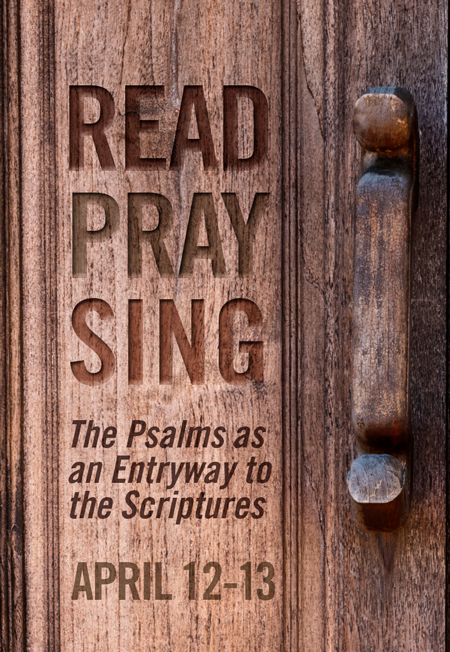
ReadPraySing_header-400We had a blessed time at our conference, “Read, Pray, Sing: The Psalms as an Entryway to the Scriptures.” One of my favorite comments was from a man who said he and his wife had been attending conferences for 35 years, and this one was “the most reviving to our souls of any we have attended.”

I am excited to post that the audio is now available from our sessions. All the plenary sessions and most of the breakout sessions are available (we had technical difficulties with the recording of a few sessions). By common assent, one of the most powerful parts of the event was the Psalmfest, where we had the opportunity to put into practice what we talked about, singing the Psalms corporately. I am glad that we have audio of that portion as well.

Here is what is available in audio:

Ray Van Neste- Theme Interpretation, “Read, Pray, Sing: The Psalms as an Entryway to the Scriptures”

Chris Mathews, leading, Psalmfest

Plenary Sessions:

Heath Thomas, “God, Israel, and the Nations: Praising God and His Salvation in Psalm 117”

Andy Davis, “The Sufferings of Christ and the Subsequent Glories in the Psalms”

Breakout sessions:

Heath Thomas, The Magnificent 7: Seven Ways of Reading (or Misreading) Scripture 

Andy Davis, The Bible Comes to Life: How Scripture Memory Transforms One’s Life

Harry Lee Poe, “C.S. Lewis on the Psalms

Paul Jackson, Don’t Miss the Forest for the Trees

Kevin Chen, God as a Poet: The Poetry of the Psalms

Be Strong!

My poem of the week this week is another on the theme of perseverance. I am finishing out the school year with my boys memorizing these as an aid to stir them on to difficult tasks- and to stir me on as well!

Be Strong!

Be strong!
We are not here to play, to dream, to drift;
We have hard work to do, and loads to lift;
Shun not the struggle―face it; ‘tis God’s gift.

Be strong!
Say not, “The days are evil. Who’s to blame?”
And fold the hands and acquiesce―oh shame!
Stand up, speak out, and bravely, in God’s name.

Be strong!
It matters not how deep intrenched the wrong,
How hard the battle goes, the day how long;
Faint not―fight on! To-morrow comes the song.

–          Maltbie Davenport Babcock

Humility and Manhood

My boys & I recently read George MacDonald’s Phantastes. C. S. Lewis famously said this book baptized his imagination. I can’t say our experience was so lofty. It is a challenging book to follow, though there are beautiful and wise comments along the way. The last portion of the book is quite good as the young man who is the main character accomplishes his quest for maturity and finds true manhood not in his conquests or his prideful pursuits but in humility, service and work.

The quote below captures the point of the conclusion of the book and is worth contemplation.

Then first I knew the delight of being lowly; of saying to myself, “I am what I am, nothing more.” “… I learned that it is better, a thousand-fold, for a proud man to fall and be humbled, than to hold up his head in his pride and fancied innocence. I learned that he that will be a hero, will barely be a man; that he that will be nothing but a doer of his work, is sure of his manhood. In nothing was my ideal lowered, or dimmed, or grown less precious; I only saw it too plainly, to set myself for a moment beside it. Indeed, my ideal soon became my life; whereas, formerly, my life had consisted in a vain attempt to behold, if not my ideal in myself, at least myself in my ideal.

“Determination”, by Edgar Guest

My poem of the week this week is another selection from Edgar Guest. My boys are to recite it this morning.

“Determination”

I’ll see it through, whate’er the danger be.
One death is all that God assigns to me.
I’ll stand erect against the odds and shout:
“I may be whipped, but will not turn about!”

I will not play the coward! Fail I may,
But at the post of duty I will stay.
Nor dread of loss, nor fear of being hurt,
Nor softening pride shall tempt me to desert.

I’ll play the man! What if the way seems long?
I will not whimper that all care is wrong.
Blunder I may, but none shall ever cry
I died a failure, since I would not try.

-from Life’s Highway, by Edgar A. Guest (Chicago: The Reilly and Lee Co., 1933), 28

Here is a link to several of Guest’s works at Amazon

“Give me the heart of a Man!”

My poem of the week this week is one my oldest son found a few months ago when I gave them a few books of poetry and required them to find one they would read and explain for all of us the following day. After reading it aloud for us he suggested it would be a useful one to have memorized. So today is the day for each of them to recite it from memory.

I want my boys to learn dogged determination and perseverance and this poem captures that well.

Battle Cry 

More than half beaten, but fearless,
Facing the storm and the night;
Breathless and reeling but tearless,
Here in the lull of the fight,
I who bow not but before thee,
God of the fighting Clan,
Lifting my fists, I implore Thee,
Give me the heart of a Man!

What though I live with the winners
Or perish with those who fall?
Only the cowards are sinners,
Fighting the fight is all.
Strong is my foe–he advances!
Snapt is my blade, O Lord!
See the proud banners and lances!
Oh, spare me this stub of a sword!

Give me no pity, nor spare me;
Calm not the wrath of my Foe.
See where he beckons to dare me!
Bleeding, half beaten–I go.
Not for the glory of winning,
Not for the fear of the night;
Shunning the battle is sinning–
Oh, spare me the heart to fight!

Red is the mist about me;
Deep is the wound in my side;
“Coward” thou criest to flout me?
O terrible Foe, thou hast lied!
Here with my battle before me,
God of the fighting Clan,
Grant that the woman who bore me
Suffered to suckle a Man!

by John Gneisenau Neihardt

The Hobbit & The Psalms

My boys and I really enjoyed the recent Hobbit movie. We expected to enjoy it with adventure, fun characters, nobility, courage, perseverance, loyalty- what’s not to like? But I found myself captivated by a certain scene in a way I did not expect. And later I discovered it captivated my boys as well. I am referring to the scene with the song of the dwarves.

I was taken with the robust singing of male voices and the sense that this was a song of a people, one that had been passed down and which told their story, where they had been and where they were going. In singing this song the dwarves reminded themselves of their identity and embraced it anew. They also steeled themselves for their difficult task as the song called them to their duty. The song placed their lives in continuity with the past, calling them to play their part in the history of their people. The song reminded them of a kingdom lost and their duty to reclaim it. I was mesmerized. We bought the soundtrack, and as I listened to it I found myself thinking, “I wish my family had a song like this.”

Then it hit me- We do have songs like this. Not the Van Nestes, not even TN nor the US (though we have national songs as well), but the church. The church has songs which have been passed down through the generations which tell of our past, victories & defeats, which remind us of our identity & remind us of our task and where we are going. These songs are the Psalms. The Psalms retell the history of our people, the people of God, and remind us of the kingdom that was lost due to a dragon’s destruction. They remind us of our role in obedience to the true King who has come and will return to destroy the dragon and re-establish his kingdom. In singing these songs we steel ourselves for the difficult road ahead, and we reaffirm our identity as God’s people as we take up the songs of our forefathers. With these songs we also internalize these truths and shape our characters so that we might be faithful and honor our King.

Let us sing!