365 Bible Stories for Young Hearts


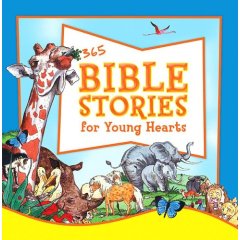
365 Bible Stories for Young Hearts
(Crossway Books, 2006), hb., 440 pp.

This is a nicely illustrated story Bible designed to cover the Bible in one year. Breaking it up into 365 stories is a helpful device for families. My wife has been using this book for our 4 year old when she has Bile reading time with the older boys. Our 4 year old can follow along to some extent.

The illustrations are nicely done. Many of them also appear in the ESV Children’s Bible. Alan Parry is one of our favorite illustrators.

As with most story Bible’s most attention is given to the narrative portions of the Bible. It is just more difficult to handle the letters in a story Bible. Still 4 stories are given to Paul’s letters, one to Hebrews and one to Revelation.

This is a good story Bile for use with younger children and the set up can be helpful for families in establishing a regular Bible time with younger children.

Brooks Robinson Bio

Third Base Is My Home, Brooks Robinson, as told to Jack Tobin
(Word Books, 1974), hb, 202 pp.

This is an out of print book I stumbled upon and read over one weekend. I did not read it to my boys. I read it myself, but thought along the way that this will be a good book to give them to read on their own. It is probably best suited for a boy around 10 years old.

I was really taken off guard by the “niceness” of the book. I did not expect anything bad, but the tenor of the book certainly took me back to a different day in professional athletics. Robinson was presented to me as a model by my dad when I came up playing third base. His defensive skill was held in high esteem and he was known baseball’s “Mr. Nice Guy.” So I was thrilled to find this book so interesting and so wholesome.

It reads like a fireside chat with Robinson, I assume as a result that it arises from Robinson recounting his story to Tobin. Robinson often pauses to encourage young players in mechanics as well as life lessons. There are many points of encouragement for hard work, discipline, perseverance, humility and the value of family. I have already recounted a story from the book to my boys to encourage them to more diligence in their school work.

Robinson also discusses his Christian faith in the book, which was an aspect I did not know about. This is good, though he also discusses his decision to become a Catholic in order to join his wife in her church. On the one hand this is a bit disappointing since significant theological issues are shrugged off. On the other hand, one ought not expect to get theology in a sport bio.

In reading this book I did find myself longing for a different day in professional sports. I am glad though to have a nice book I can give to my son who is particularly interested in baseball. Now some would not favor this book because it is not high literature. However, my wife and I see the value of a wide range of literature. My son’s reading of this book will not endanger his appreciation of The Chronicles of Narnia, for example. We do not mind giving them good reading as well as excellent reading.

Adventure in Roman Britain

The Eagle of the Ninth, Rosemary Sutcliffe
(Oxford University Press, 1954; reprint Sunburst edition, 1993), pb., 291 pp.

Along the way I want to go back and post about books we have read in the past but did not comment on (typically because we read them before the blog began). This is one such book. In the fall of 2005 we were studying the era of the Roman Empire and we read this book.

The story concerns a Roman Centurion who has grown up hearing about his father’s Legion and how they disappeared in the mist of what is now Scotland. They had marched out to deal with an uprising and were never heard from again. This was almost considered impossible given the size and might of a legion, so the question remained as to what had happened to this legion. What had happened? Had they been entirely decimated? Had some deserted?

The son eventually embarks on the very dangerous mission to seek to discover what had happened and to recover the lost “eagle” of the Legion. The recovery of the Eagle could rehabilitate the status of the lost legion as well as deprive the enemy of a powerful symbol of their capability to overcome Roman might.

As might be expected this is a tale full of adventure, suspense and action. However, it was a bit slow at several points and often not as readily understandable for my boys (ages 9, 7 and 5 at the time). I did a fair bit of editing on the fly and explaining. It does give a good bit of information on Roman life and customs along the way. This book is probably best suited to a slightly older audience. If you can edit as you go and your kids are willing to stick with a book, it can be quite an enjoyable read. My boys, unaware of the editing job, thought it was great.

Stewart on Preaching the Good News


I have come across another old book of sermons by James S. Stewart, the prominent Scottish preacher of the mid-20th century. I have previously posted quotes from his book on missions (first post; second post; third post).

This book, The Strong Name, was published in 1941 so I imagine the sermons were originally preached in the early days of WW II. This seems to be the point in the opening of his sermon “The Romance of Orthodoxy.” Preaching from 2 Kings 7:9 he rebukes the idea which was apparently (and understandably) current then that “these are bad days and not time for the announcing of good news.” Stewart rebukes such an idea for the church by pointing to the Gospel. No matter our situation we have been loved and redeemed by God! Stewart closes the sermon with the following words which are a good exhortation to us in any day. Perhaps it is especially good as we approach Sunday and many of us will be preaching. Proclaim the Gospel, brothers!

If the Church were witnessing with all her might, and in all her members, to the things which she most surely believes and by which she lives, how incalculable might be her achievement in this perplexed, distracted generation! If we, the children of Zion whose captivity God has ended, had our mouths filled with singing for the gladness of that great deliverance, what threatening shadows might be scattered, what dark and dreary places flooded with the blessed light of hope! If every professing Christian were a veritable ambassador of Christ, how the royal banners of His Kingdom would go from strength to strength, conquering and to conquer! This is a day of good tidings. One thing is needful. The world cries for it. Honour claims it. Christ commands it. Send the good tidings on!

Amen!

Children’s Bio of Blaise Pascal


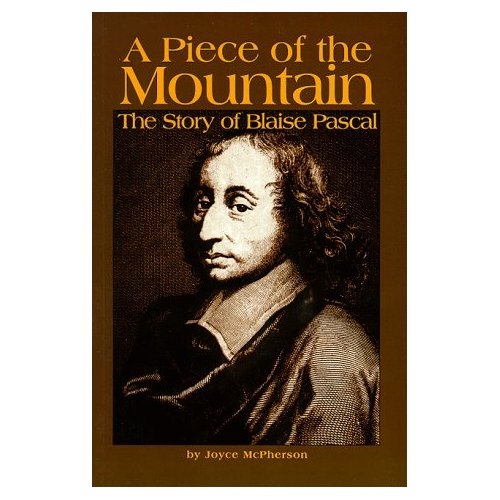
A Piece of the Mountain: The Story of Blaise Pascal
By Joyce McPherson (GreenLeaf Press, 1995), pb., 124 pp.

Blaise Pascal is another key figure in history that we would all want to introduce to our children. He was one of the most important scientists and mathematicians of the 17th century and after his conversion became ardent proponent of the faith. The author of this book has also written a biography of Calvin which has been reviewed previously.

As important as Pascal is, this book was not very compelling to my boys- ages 10, 8, and 6. Mrs. McPherson begins with his childhood and seeks to describe his youth as well as adulthood. The inclusion of children often helps with making a book interesting, but this one never really grabbed them. Describing for a young audience Pascal’s work with math and science is no doubt difficult. My boys would much rather hear about a battle or mystery. Some of the science work could, it seems, have been described in a way that would be more accessible to children though. Concepts- theological as well as scientific- were introduced with little explanation or clarification. For example Pascal’s involvement with the Jansenists figures significantly in the latter part of the book, but there is little explanation of what this movement was about.

Pascal is an important enough figure that the book is worth reading if you can help your children to stick with it. Pascal provides a good example of one who worked hard at his school work for example. This application is not made in the book, but you can make it. Also, the end of the book is the best part. After doing secret writing on behalf of the Jansenists (some intrigue which peaked interest), Pascal and his friends must face the wrath of Rome. Pascal’s stand is worthwhile reading for one’s children. Still, your children may pick up (as at least one of mine did) that Pascal is still with Rome even after the Reformers have broken away. Children need explanation as to why one we are reading of as a hero continues with the group who so persecuted others we have held up as right. The book offers no such explanation.

Kierkegaard in KJ

I continue to benefit from reading Kairos Journal, the online resource for pastors. You must register, but it is free.

The following is from KJ. The first paragraph is an editorial introduction to the quote (second paragraph) from Kierkegaard. This is a much needed exhortations to pastors, lest we play at our task, willing to rebuke the sins of the world, but unwilling to address the sin in our own congregation, flying the banner of inerrancy while conveniently avoiding difficult texts concerning issues like church discipline or ministerial pride.

Kierkegaard has received well-deserved criticism from modern evangelical theologians. Nevertheless, the following passage taken from his Journal powerfully exposes the terrible problems that develop when the Church fails to understand the seriousness of her task in the world. To the Church of his day, Kierkegaard exhorted: your battle is spiritual, and war is grim business: get on with it. To the preacher, he underscored the need for risky sermons, which could cost him his comfort, his position, and even his life.

We all know what it is to play warfare in mock battle, that it means to imitate everything just as it is in war. The troops are drawn up, they march into the field, seriousness is evident in every eye, but also courage and enthusiasm, the orderlies rush back and forth intrepidly, the commander’s voice is heard, the signals, the battle cry, the volley of musketry, the thunder of cannon – everything exactly as in war, lacking only one thing . . . the danger.
So also it is with playing Christianity, that is, imitating Christian preaching in such a way that everything, absolutely everything is included in as deceptive a form as possible – only one thing is lacking . . . the danger.

Preaching this week

From Sunday until this Wed (9/17-20) I am preaching in a “series of meetings” at a church here in town. I have explained to the people that I will approach these services in a way perhaps not typical of Revival meetings. I have argued that if we truly want revival, we must start with the church being the church- the people of God must get right first. Therefore, I am preaching on the church. Sunday morning I preached on the identity of the church from 1 Tim 3:14-16. In the evening I took up Ephesians 4 :1-16 pointing out that Paul describes gospel living in terms tied up with living in community (contra our typically over individualistic views of holiness, Christian growth) and that Paul in this passage stresses the importance of each member, that no one can grow as they ought unless their church around them functions properly. Thus, your own growth will be hindered if your church is not being healthy. Also, your fellow members cannot flourish as they ought if you are not supplying to the body. This is a crucial point in light of the fact that in most churches about 50% of the people on the membership roll have not attended in years.

This evening then I preached from Heb 3:12-4:16 pointing out that the author presents three antidotes to apostasy, answers to how God supplies for His people to persevere. The first one, that receives most attention in this text, is the community itself. There is strong language here about watching over one another, exhorting one another daily which presumes significant interaction between church members between Sundays. The other two then are exposure to the Word of God and drawing near to our High Priest.

I think tomorrow I will then preach from 1 Cor 5 on church discipline. Historically the renewal of discipline has often sparked revival, so it would seem to be a very appropriate (though atypical) topic.

I am convinced that if we really want to be effective in evangelism we must get serious about the purity and integrity of the church. For too long we have ignored this and sought to just “get ’em in.” Surely we can see the lack of effectiveness of this approach. Scripture would call us to another way.

Lastly, this church is a great group of people with a real hunger for the Word. I am encouraged by them and their faithful pastor.

Enjoying Books

For sometime now I have been wanting to write something on instilling a love for reading in your children. This is not that piece, but perhaps is a precursor.
Today we made an outing, partially to be a nice event after our son’s accident (and full recovery). We went out to eat and then to a used bookstore in town that we all like. At lunch, as we discussed going to the bookstore, my 10 year old looked up and declared, like a man stating his preference of the finer pleasures of life, “I like the smell of books, Dad.” I smiled, and inwardly rejoiced! Yes! Love books, my son, and you will be nourished in so many ways in life.

Jehovah, Shepherd of My Soul

Randall Bush, my creative colleague who’s field is philosphy but is also a gifted musician and poet, has set out to compose a hymn dedicated to each of the faculty members of the School of Christian Studies here. This week he passed on this one for me. Taking the oversight theme, he begins with the 23rd Psalm and moves to the Good Shepherd passage. See what you think.

Jehovah, Shepherd of My Soul

Jehovah, Shepherd of My Soul,
Let Thy staff my steps direct.
May Thy crook of comfort my heart console
Through dark death’s vale protect
In pleasant pastures greened by grace
Make Thou my soul to lie
By peaceful waters wind my ways
Till I to Thy fold draw nigh.

Good Shepherd, Jesus, save Thy sheep,
Our wayward souls restore.
From robbers, thieves, and ravenous beasts
Secure Thy sheepfold’s door.
Away from sin’s entangling snares
Direct our straying feet,
Of strangers’ lures let us beware,
As we hear and follow Thee.

“If you love me,” sounds the Shepherd’s voice,
“Then feed my hung’ring sheep.”
To deny him can never be our choice
If our love for him runs deep
As Jesus did his life lay down
His sheep one flock to make,
May we His gift of love compound
In our service for his sake.

Great Shepherd guide us to Thy fold
When life’s great course concludes
Past starry heavens bring our souls,
To realms of highest good,
Till we find Mercy’s mystic source,
Shall drink from Goodness’ well,
And in Thy house forevermore
Secure with Thee shall dwell.

Added Note: Dr. Bush has also composed an original tune which I hope to get to hear soon. If I can find someone tech savy enough, maybe it can be posted too.

A Prayer for Youth, by John Newton

A Prayer for Youth
John Newton

Bestow, dear Lord, upon our youth,
The gift of saving grace;
And let the seed of sacred truth
Fall in a fruitful place.

Grace is a plant, where’er it grows,
Of pure and heavenly root;
But fairest in the youngest shows,
And yields the sweetest fruit.

Ye careless ones, oh hear betimes
The voice of sovereign love;
Your youth is stained with many crimes,
But mercy reigns above.

True, you are the young, but there’s a stone
Within the youngest breast,
Or half the crimes which you have done,
Would rob you of your rest.

For you the public prayer is made,
Oh, join the public prayer!;
For you the sacred tear is shed,
Oh, shed yourselves a tear!

We pray that you may early prove
The Spirit’s power to teach;
You cannot be too young to love
That Jesus whom we preach.

Newton, John. The Works of the Rev. John Newton. Edinburgh: Thomas Nelson, 1841, pp. 574-575.

Quoted in Worthy is the Lamb, Puritan Poetry in Honor of the Savior
Maureen Bradley; Edited by Don Kistler and Joel Rishel (page 309)