A Children’s Bio of Gutenberg


Ink on His Fingers , Louise A. Vernon
(Herald Press, 1972, 2004), pb., 127 pp.

This biography of Johann Gutenberg is written similarly to Mrs. Vernon’s biography of Wycliffe reviewed previously. A young boy, Hans Dunne, is pursuing his desire to make copies of the Bible. He thinks of making handwritten copies, but stumbles upon the efforts of various people to make copies with movable type. Eventually he ends up working as an apprentice for Johann Gutenberg.

The story itself works well. There is an air of mystery as well as a strong sense of working against opposition. These aspects made it a compelling read for my boys. Mrs. Vernon highlights the fact that other people were working on movable type and the opposition Gutenberg faces. In fact it seemed to me that one point of the book was to highlight Gutenberg’s perseverance and the fact that those who seek to serve God do encounter difficulty. Thus, the book gives the reader a good sense of the hard work it took to produce movable type (for the production of Bibles) and encourages perseverance.

I have two main criticisms or requests. First (and the least of the two), a small glossary would be very helpful. A number of books we have read in historical fiction have provided a glossary for words from the era and this has been helpful. A glossary would add to this book as well. The more authentic the book seeks to be the more helpful a glossary is. Secondly, I really appreciate a note from the author describing at least briefly what he/she has created for the story and what is based on fact. This is very helpful since the distinction is not obvious. I have no problem with the fiction aspect of the book, but children often want to know what part is historical. In this book it seemed especially hard to distinguish. Fair enough, we do not have many details about Gutenberg’s life. However, I at first assumed the key “bad guy” in the book Herr (Mr.) Fust was a fictional creation. After some searching of my own, though, I discovered that Fust was a historical person who did the basic things described in the book. Knowing this really added to the reading.

In summary, we enjoyed this book and would recommend it to others. It succeeds well in the basic goal of introducing children (and parents!) to Gutenberg and the labor to make printing a regular part of life.

Another Wycliffe Bio


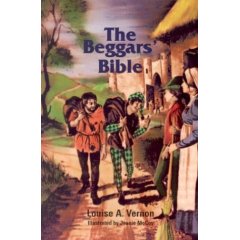
The Beggars Bible , Louise A. Vernon
(Herald Press, 1971), pb., 135 pp.

Following the Thomson biography of Wycliffe, we read this one by Louise Vernon, The Beggars’ Bible. Whereas the Thomson bio began as Wycliffe first went to Oxford, this book picks up well in to Wycliffe’s career.

This story centers around a young peasant boy, Arnold Hutton, who wants the chance to go to Oxford along with his noble born friend, Timothy. Arnold was given the opportunity to learn alongside his noble born friend due to the encouragement of Wycliffe and due to Wycliffe’s influence he eventually enters Oxford. This bio makes more of Wycliffe’s hot temper as an example of his humanness. There is also more mystery and intrigue as people plot against Wycliffe and Arnold and Timothy try to discover and foil the plots.

This book is overall more of a compelling story than the Thomson bio, though my boys enjoyed both. The mystery element in Vernon’s book probably was the big difference. However, Vernon’s (like too many children’s stories it seems) ends quite suddenly which was disappointing. I also thought the Thomson story provided more overall information about the life and times of Wycliffe. Thomson provides some clarity about what is fictional, but Vernon does not. Vernon though does provide a nice glossary of words form the era that are less common today.

Overall, the books complement each other well, and I would recommend using them both.

Beautiful Feet Books Catalog


We have recently come across another helpful catalog for children’s literature. The folks at Beautiful Feet Books, like a number of others, both publish books of their own and offer books sold by others. We appreciate having several catalogs like this because it gives us access to books discovered by various people rather than leaving us simply with what one group has found or liked.

The Beautiful Feet Catalog is put together as a resource for teaching children history through literature, which is exactly what we are trying to do. It is a good approach whether you homeschool or send your children to school. The little essay on this topic in the catalog is well worth a read. They make the point that literature was the typical way of learning history for years until someone got the bright idea of writing books stripped of story and containing merely the facts- enter the standard textbook and the association of boredom with history! My boys will currently say that history is one of their favorite things because they love stories, and truly history is simply the story of humanity through various eras and situations. Now, I intentionally started them years ago with stories of battles and adventures because I knew that would be more appealing, but there is nothing wrong with meeting them where they are!

Anyway, this can be a helpful resource. They list age appropriate books by historical era which is very useful. I obtained a copy of the catalog for free by requesting it from their website, http://www.bfbooks.com/.

United at Justification

Last Friday I was privileged to speak at a pre-conference pastors’ luncheon at St. Andrews Presbyterian Church in the Memphis area. St. Andrews will be holding a conference this summer on the topic of Justification with Dr. Tom Nettles as the speaker. Wayne Herring and Doug Barcroft, pastors at St. Andrews, have become burdened about the lack of understanding of the basic gospel in evangelical churches, and believe that Justification is the appropriate point for unity among Protestants. I have been encouraged just to meet these two fellow pastors. I think they are entirely right that evangelicals in America are in real danger of completely losing the objective gospel and that proper ecumenism among Protestants can be accomplished by rallying around the basic truths of the gospel like justification. This central gospel is our core message anyway, so unity here will be significant.

The meeting itself was very encouraging. About 50 pastors attended. I know we had various sorts of Presbyterians (PCA, PCUSA, ARP), an Assembly of God pastor and several Southern Baptist pastors. Other denominations may have been represented as well. Wayne and Doug were clear about the fact that we held denominational distinctives which were important to us and there was no need to minimize those. Our unity is in the core gospel. The spirit of the gathering was deeply encouraging. My task was to speak to this gathering on the importance of Justification. Many things could be addressed (and I am sure Dr. Nettles will cover them!), but I chose to simply speak to the basic issue. Here is a brief outline of my remarks:
>>>>>>>>>>>>>>>>
Bildad’s question in Job 25:4- “How then can man be right before God? How can he who is born of woman be pure?”

Justification- how can guilty sinners be restored to favor with a righteous God

This is no merely academic exercise. This concerns how people can be saved! Brothers, as those charged to watch over souls and to act as messengers of God, we dare not be flimsy or uncertain here. The eternal fate of our people depends on this!

From our definition several questions arise in our current context, several points at which key presuppositions of this classical definition are under attack or are overlooked.
1. We are guilty sinners- not merely errant children, we are guilty before God
2. We are out of favor with God, thus we are under the wrath of God
3. God as righteous must punish our sin- He cannot just overlook our sin

These are weighty issues, but for the brief time we have here I will take up one text which addresses each of these issues- Romans 3. We must be clear about the biblical witness of these issues or we will not properly grasp the gospel. Our debates on justification will be mere academic exercise with no real meaning.

Rom 3:9-20- The reality of sin, the totality of our depravity

Until we face the depth of the desperation of our condition we will lack power in our preaching, earnestness is our exhortation. We must feel the weight of our condemnation

Self-centered prosperity preaching cannot withstand the withering blast of this doctrine. All of a sudden we will not be able to bear a message that is all about us, because we are caught in sin. We need to hear of something or Someone outside of ourselves.

Jesus said he who is forgiven much loves much. Perhaps our self-centered,
apathetic condition in the church is due to a failure to consider how bad off we
are and thus a failure to realize just how much we have been forgiven.

Rom 3:19-20; 1:18; 2:6- The reality of God’s wrath against sin

We need God to rescue us from God. If we soft pedal the wrath of God we will never feel the glorious beauty of the gospel. This is what really brings home the glory of our rescue.

Understanding this issue is what will awaken true worship. If we understand this we will not need more gimmicks and hype to “get the people going” for worship. Worship, because it is an expression of love, arises in response to truth.

Rom 3:21-26- An alien righteousness from outside of us, provided to us.

We need to understand that the problem with the gospel is not, “How could God condemn anyone?”, but rather, “How can a holy God forgive any sinful person?” This is particularly true in light of passages like these:
Exodus 23:7- “I will not acquit the guilty”
Proverbs 17:15- “He who justifies the wicked…[is] an abomination to the LORD.”
Justification explains how this happens.

Practical results of this doctrine:
1. No room for boasting (3:27-31)- Glory in this doctrine which destroys your pride! Gloat not in your understanding of this doctrine. The doctrine itself undercuts our pride.

2.Peace with God (5:1)- God is now for us! We are freed from the burden of perfectionism (language from Bruce Demarest, The Cross and Salvation).

3. Celebration (5:2)- The gospel is the source of true worship.

4. No condemnation! (8:1)- Oh, how I need this truth- and how often.
“My Sin, O the bliss of this glorious thought-
My sin not in part but the whole
Is nailed to the cross and I bear it no more
Praise the Lord Praise the Lord O my soul”

>>>>>>>>>>>>>>>>>>>>>>>>>>>>
A more complete exposition of this text can be heard here.

Pastoral Lessons from Oprah Winfrey?

I am a bit late in posting this but a couple of weeks ago USA Today ran a story entitled, “The Divine Miss Winfrey”. This is not really surprising but it was a revealing look at typical views of spirituality in our culture. What first caught my attention though were the letters to the editor a day or two later. The letters were printed under the title, What preachers can learn , and since I do not know how long the link will work I have pasted in the full text of the last letter:

Though I do not think Oprah Winfrey is the “spiritual leader for the new millennium,” I am sure she is making, and will make, a significant contribution to the spiritual lives of many people who do not find what they should be getting from their churches.
Further, I anticipate a backlash from this article from preachers who are not cutting it. But instead of denouncing the premise that Oprah has a spiritual contribution to make, they should be embracing an opportunity to study what Oprah is doing that is making such a significant impact on the lives of so many people.
Perhaps Ms. Winfrey would be kind enough to offer seminars throughout the country for preachers who want to regain contact with the people they feel called to serve. If she would, I would like the opportunity to be the first to sign up.
The Rev. Brian A. Mahoney, Rockville, Md.

This is another example of the decline in the concept of what a pastor is and how the office is being shaped by the culture rather than by Scripture. “Making an impact” is a slippery category for measuring success. It tends to mean “drawing a crowd” and “getting positive reviews.” This though is not our goal. May we be deaf to the siren calls of culture and devote ourselves to the biblical tasks for us, as Eugene Peterson powerfully put it, word and sacrament.

Wayland Reprint in the Works

In case you did not see it in the comment section of the last post, Solid Ground Christian Books is in the process of reprinting Letters on the Ministry of the Gospel and they are including in the same volume J. W. Alexander’s Letters to Young Ministers (if you follow the link to this book you will have to scroll down a bit to the book). Solid Ground does a great service to the church with the various books they reprint and this is no exception. The links will give further details about the books and authors. I spoke with Mike Gaydosh at SGCB and he said he hopes to have this book ready soon. You can pre-order a copy (as I have done), and pre-orders help to move the production along.

In case you are not yet persuaded that this book is worthwhile, here is yet another quote from Wayland. Keep in mind all the quotes I have mentioned have come from only one letter in the book! This quote beautifully captures a point I have tried to make that our people should be able to learn to read their bibles from the way they see us handle the text. No wonder than that so many today handle the Scriptures so poorly.

“But all this benefit is lost when a text is taken merely as a matter of form, simply as a motto, with which the ensuing discourse has no connection; or when some isolated phrase is taken as a text, and a large part of a discourse is employed in showing that an inference may be drawn from it which every one sees to be entirely alien from the obvious scope of the passage. Is it any wonder that men come to consider the Bible unlike any other book, a book of riddles, in which every sentence may be made to mean whatever the preacher pleases, and which no one but the preacher is able to explain? Is it any wonder that Christians lose all confidence in their power to explain for themselves a book which is susceptible of so great a variety of almost opposite interpretations?
And here it may not be inappropriate to ask, Why is it that expository preaching has so entirely died out among us? When ministers had comparatively little theological education, such preaching was very common. It was entirely destitute of theological learning, but it was simple and devout, and in most cases threw some light upon the subject, and, at any rate, generally induced the hearers to examine it for themselves. Now, when eight or ten years are spent in the study of language, and in preparation for the ministry, we very rarely hear anything of the kind. Can it be that after all this study men are unwilling to trust themselves to explain and enforce a paragraph of the word of God?”

Children’s Bio of John Wycliffe

Morning Star of the Reformation , Andy Thomson
(Bob Jones University Press, 1988) pb., 134pp.

This is a kid’s biography of John Wycliffe. The author has created a fictional account of Wycliffe’s life from the time he first came to Oxford as a student. I was a bit frustrated with this book at first because the editor’s note at the beginning did not clarify what intended to be factual and what was created by the author. However, along the way I discovered the “Author’s Note” at the end- yes, I should have checked more carefully when we began! 🙂 The “Author’s Note” made clear that the young friends of Wycliffe were fictional but that all the key events were factual.

While I was still uncertain about the book, my boys were already talking about how much they liked it. It is not at the level of Allen French or C. S. Lewis, but it was a good read. I always wonder in books like this how much the main character is molded into our own expectations, but this book does provide a good introduction to the problems of the medieval church in England and the efforts of Wycliffe to address these. The book really “got good” towards the latter half as you see Wycliffe encountering pressures and persecutions. His steadfastness was a powerful example for us, and lead to good conversation, especially as we talked about the continuing need for reformation in our day and the costs that will come our way. At this point knowing that some of Wycliffe’s associates in the book (as pointed out in the Author’s Note) eventually recanted under pressure, made it even more poignant.

One should know that a children’s bio of this size will not be the place for a definitive treatment. However, the aim of this book is to present an accurate portrayal of life in the time, the issues and pressures of the day and the basic work of the person. In these goals this book succeeded very well. We would warmly recommend this book.

Wayland on Preaching the Text

As is no doubt becoming apparent, I am quite taken with Francis Wayland’s letter, “In What Sense is the Ministry of the Gospel a Profession.” In fact I am thinking of ways to have it or the whole book reprinted. Here is another excerpt- good advice needed today on preaching in plain language, textual preaching, and preaching the intent of the passage. There is here a good rebuke of all those sermons which seem not to really need the text that was read before them!

“[In Scripture the minister] finds the ideas of God in the language of men. These he presents to the consciences of men. He must do it with plainness, simplicity, and with unshrinking fidelity, knowing not the persons of men, but speaking solemnly in the fear of God. To suppose that he can add to the impressiveness of the word of God, by strengthening it with the reasonings of men, seems to me to be arrant folly. No reason can every be so strong for any belief as the simple fact that God has said it.
All this, at least, is acknowledged by our universal practice. When we preach we always take, ostensibly as the basis of our discourse, some passage of the word of God. This is called a text; and without it, our communication may be an oration, a speech, a lecture, or an essay, but it is never called a sermon. But why take a text? Simply because we profess in preaching to unfold some idea of inspiration, and, on the authority of God, enforce it on our hearers. If this be not our intention we need no text at all; or we may as well take one from Bacon’s Essays or any other work, as from the Scriptures. This being so, it is not enough that we take for our text the words; we must take the ideas of the sacred Scriptures. It is not that some idea analogous to that in the text may be found in the Bible; we must endeavor to ascertain the precise idea communicated by the Spirit of God in the particular passage. It is not enough that what we utter may be true; we must, by manifestation of the truth revealed to us by God, commend ourselves to every man’s conscience.” (p. 63-64)

More from Wayland

Here is another quote from Frnacis Wayland in his book Letters on the Ministry of the Gospel. This quote comes from a letter entitled, “Is the Ministry a Profession?” As some of thecomments on the last post ntoed this is like a prequel to Piper’s Brothers We Are Not Professionals. May we heed this biblical exhortation!

“The minister is an agent [of] Almighty God. He is appointed of God to perform a special service, and to God he is responsible. He may preach so as to please his congregation; they may pay him punctually and liberally; they may applaud his efforts, and be proud of his talents, while both he and they, in this very thing, are odious in the sight of God; and he, especially, who has undertaken the cure of their souls, may be fixing upon himself the doom of the unprofitable servant. God has sent him to deliver his message to this people; has he delivered it? He may have all the while been delivering something else, or he may have delivered something like it, but so modified to please his hearers, or gain for himself a reputation, that God never acknowledges it as his communication to sinful men. The command of the Master is, that he preach the preaching which the Spirit gives him, whether men will hear, or whether they will forbear; and if he do not obey the command, however much men may applaud, he can expect nothing but the frown of an offended God.” (p. 40-41)

Wayland on real ministry

Here is a very interesting quote from Francis Wayland’s Letters on the Ministry of the Gospel (out of print to my knowledge). Wayland ministered 1800’s, but his words are very pertinent today, especially the points on avoiding offense and making unconverted people comfortable by the absence of searching preaching. The point on cultural acceptability and financial stability trumping higher issues is one for us to hear as well.

“…an important change has come over the character and labors of those who appear before men as the messengers of reconciliation. . . . We have in the pulpit far more correct rhetoric than formerly; our ministers are better dressed, and much more familiar with the usages of society. . . . The terms of science and allusions to recent discovery are frequently used, either to enforce or explain the truths of the gospel. The worship of God by singing, accompanied by costly instruments, is frequently performed by salaried professional artists. Everything is in the highest degree decorous and proper. You may attend upon one of our churches for months without any danger of being offended by a single instance of false grammar. But little moral emotion is however aroused, nor does it seem to be much expected. On special occasions, on leaving the house of God you may hear the sermon applauded in terms such as these: ‘What a noble effort!’ ‘That was a beautifully written discourse.’ ‘What a brilliant train of thought!’ ‘That sermon ought to be published; it would give reputation to our society.’ The sermon, however, excites no particular discussion. It gives rise to small self-introspection. No man asks himself, What have I done, or What shall I do to be saved? It is a very rare occurrence for any hearer to be convicted by a sermon, or to be led by it to the cross of Christ. Such a result, as the
immediate effect of preaching, seems neither to be labored for, nor anticipated. Of those who attend the worship of God, I fear that the better part go because it has been their custom from youth. Some go for the respectability of the thing, others for the purpose of setting a good example, and all go expecting to hear a discourse on some serious subject to which a text from the Bible has been prefixed. This discourse is accurately written, and pleasantly delivered; tinged, it may be, with a reference to passing events, and sometimes with an allusion to authors that happen to be in vogue. If all this is successfully performed; if a fair proportion of the audience is wealthy and occupy a prominent position in society; if they pay their pew-tax freely and contribute respectably to the ordinary associations for benevolence; if they take good care of their minister, and provide liberally for his various seasons of recreation, the church is deemed to be in a flourishing condition. All this goes on year after year, and men seem hardly to suspect that these services were intended by Almighty God to be the means of rescuing them from hell and preparing them for heaven. The most that is accomplished is the pleasant occupation of the hour. Those who profess to be the disciples of Christ, and those who make no such profession, are equally at easy under the guidance of one who has assumed the care of their souls; while all are rapidly drawing near to the judgment-bar, and the great majority under the condemnation of the second death.” (p. 13-15)

Thanks to Brian Denker for the quote.