A Prayer for Power on the Means of Grace, Newton

As we approach the Lord’s Day once more, here is another great poem from John Newton. He reminds us of our utter dependence upon God to bless our efforts that they might be effective. This is a useful prayer we can appropriate.

A Prayer for Power on the Means of Grace
John Newton

O Thou, at whose almighty Word
The glorious light from darkness sprung,
Thy quickening influence afford,
And clothe with power the preacher’s tongue.

Though ’tis Thy truth he hopes to speak,
He cannot give the hearing ear;
‘Tis Thine the stubborn heart to break,
And make the careless sinner fear.

As when of old the water flowed
Forth from the rock at Thy command,
Moses in vain had waved his rod,
Without Thy wonder-working hand.

As when the walls of Jericho,
Down to the earth at once were cast,
It was Thy power that brought them low,
And not the trumpet’s feeble blast.

Thus we would in the means be found,
And thus on Thee alone depend,
To make the gospel’s joyful sound
Effectual to the promised end.

Now, while we hear Thy Word of grace,
Let self and pride before it fall;
And rocky hearts dissolve apace,
In streams of sorrow at Thy call.

On all our youth assembled here,
The unction of Thy Spirit pour;
Nor let them lose another year,
Lest Thou shouldst strive and call no more.

Newton, John. The Works of the Rev. John Newton. Edinburgh: Thomas Nelson, 1841, p. 577.

Quoted in Worthy is the Lamb: Puritan Poetry in Honor of the Savior; Edited by Don Kistler and Joel Rishel (page 220)

The Magna Charta, James Daugherty

The Magna Charta, James Daugherty
(1956; 1984, Beautiful Feet Books), pb. 181 pp.

This is another book we bought because we found it in the Veritas Press Catalogue. The backcover blurb notes that the author is a Newberry Award winner. However, this was not a compelling book. The book starts like a textbook relating data rather than telling a story. It told us information that we had already learned (almost without realizing it) while reading good stories. However, this format was much less enjoyable to read.

Eventually the book settles into more of a story format as it relates the story of King Richard and the eventual rise to power of his brother King John. The story gets better here, but does not rise to the level of other good books we have read. The importance of the topic is clear, but such an important story deserves to be told better.

Lastly, the book continues to trace what the author thinks is the continuation of the trajectory of the Magna Charta. One’s own understanding of politics and principles will be key here in what you make of the book. Daugherty sensibly connects the Mayflower Compact and the Declaration of Independence to the Magna Charta. However the connections to transnational agreements (some not even affirmed by governments) is less than compelling.

In the end, I would say you could safely give this book a pass.

Men of Iron, by Howard Pyle

Men of Iron, by Howard Pyle
(originally published 1891)

I have looked forward for some time to reading this book to my boys because I have heard high praise from various quarters. However, this was disappointing. The book starts slowly, and it took some perseverance to go on. Eventually though the book did pick up, and there were some great scenes. However, it did require a fair bit of work throughout to make it intelligible to my boys. That may be one issue- perhaps the book would be better for a slightly older audience (my boys who were listening are 9, 8 and 6).

The main figure in the story is Myles Falworth, and the setting is early 15th century England. Myles’ father Lord Falworth has fallen out of favor with the king, eventually being branded a traitor. Myles therefore grows up away from the finer things of life but eventually is taken in as a squire in the household of Lord Mackworth, a friend of his father’s. The main thrust of the story which gradually unfolds is the attempt by Myles to restore his father’s honor.

Early on in the story I was a bit concerned about the portrayal of the main character. Typically in these books the main character is presented as a role model for the young readers (or listeners). However, Myles is rebellious and strong-willed. It is primarily directed at authority which he does not respect, but it is not a positive picture. At first I was not sure what to do with this, not knowing what exactly the author was going to do with this- e.g., Is the author going to portray this as positive? Is this perspective going to be corrected eventually or will this persist throughout the book? My 9 year old son would ask frequently in this portion of the book, “Was it ok for him to do that, Daddy?” This did present some opportunities for discussion, but I did not want to read a book to my boys that presented as heroic a boy who consistently challenged authority. It would have been helpful for me on the front end to know that the author would eventually come around to show that this behavior was not right. Eventually you learn that Pyle is presenting Myles as a strong-willed young man with many admirable traits but who also needs to learn to submit appropriately to the yoke of proper authority. If you know that going into the story it can be very helpful. Eventually, when this was made clear and we discussed it, my 9 year old said, unprompted, “Oh, this story shows that the main character does not always do what is right. In the other stories they usually do, but we can’t always do right can we, Daddy?” He was not excusing sin, but grasping that this provided an honest assessment of the struggle with self discipline.

In the story there are a number of moving portraits of honor and courage, of loyalty, of a son’s love for and devotion and loyalty to his father, etc. There are parts that read well and are exciting. The biggest negative in the end for us was that it was not as compelling a read as many other books we have read (see for example the previous post and links there to other books by Allen French).

Lastly, the edition we have is an abridged edition. I do not typically favor abridged editions, but this just happened to be the copy I found in a bookstore in Scotland. So it was what we have. Perhaps some things would be improved in reading the full edition.

“We Are Ambassadors for Christ”. John Newton

While up with the baby late at night, I have found I can read a little poetry. Reading in Worthy is the Lamb: Puritan Poetry in Honor of the SaviorI came across some more really good poems. I have previously posted Prayer for Ministers’ by John Newton. Here is another great one from Newton directed to pastors once more. Don’t miss that the second verse is referring to the pastor. I hope this encourages and challenges you as it has me.

“We Are Ambassadors for Christ”
John Newton

Thy message by the preacher seal,
And let Thy power be known,
That every sinner here may feel
The word is not his own.

Among the foremost of the throng,
Who dare Thee to Thy face,
He in rebellion stood too long,
And fought against Thy grace.

But grace prevailed, he mercy found,
And now by Thee is sent,
To tell his fellow rebels round,
And call them to repent.

In Jesus, God is reconciled,
The worst may be forgiven;
Come and He’ll own you as a child,
And make you heirs of heaven.

Oh, may the Word of gospel truth
Your chief desires engage!
And Jesus be your Guide in youth,
Your joy in hoary age.

Perhaps the year that’s now begun
May prove to some their last;
The sands of life may soon be run,
The day of grace be past.

Think, if you slight this embassy,
And will not warning take
When Jesus in the clouds you see,
What answer will you make?

Newton, John. The Works of the Rev. John Newton. Edinburgh: Thomas Nelson, 1841, p. 580.

The Lost Baron


The Lost Baron, Allen French
(1940; Bethlehem Books 2001), 297 pp, pb

Wow! Another homerun from Allen French! After Rolf and the Viking Bow, The Red Keep and now the Lost Baron, French has become one of our favorite authors. French really knew how to tell a story. We tend to blow through these books because they are so much fun that we don’t want to put them down. All the while we cover what life was like in feudal Britain.

This story is set in Cornwall in the year 1200. The structure of the story bears the closer resemblance to The Red Keep. A young girl is left the heiress of a castle and its lands after the death or disappearance of her father, but another man holds power over the lands. Further in both stories the young woman is eventually helped by a local young man as he comes to age. These similarities in no way detract from either story in my opinion, or in the opinion of my boys.

In this story Martin is the young hero and he provides a great example of various qualities including bravery, honor, loyalty, humility and wisdom. French also clearly seeks to advocate a concern for the common people from those of the nobility. This story pulled in my 6 year old as well as my 9 and 8 year olds. Even my 3 year old repeated portions of the story to me along the way!

This is another great book and we give it our highest recommendation.

Reviews Coming

Mom and baby are doing well, though sleep and extra time, as usual, have been less. 🙂
I thought I would at least write briefly to note the books which are ready for reviewing just as soon as there is time to write!

We finished reading The Lost Baron just as the baby arrived, so I am itching to write on one more homerun by Allen French. He is becoming one of our favorite authors. Then tomorrow night we should finish Howard Pyle’s, Men of Iron. I have been trying for sometime to complete my review of Hymns for a Kid’s Heart, by Bobbie Wolgemuth and Joni Eareckson Tada. I have also been waiting for enough time to do justice to the wonderful Big Picture Story Bible, which you probably have noticed is already listed in the side column of “favorites” even though no review has been written yet. Then, there is the ESV Children’s Bible which my boys love and I am ready to review as well.

Hopefully some of these will appear soon.

Benjamin Keach on Preaching

Here is another quote sent to me from my brother, Scott. This comes from Tom Nettles’ book The Baptists. Keach (1640-1704) was a leading Baptist pastor even suffering fines and imprisonment for his beliefs. Nettles is commenting on what Keach said and would say today concerning preaching. The quote begins with Nettles words and then moves to a quote from Keach himself.

“He would likely comment on our preaching. As he did in his own day, he would criticize much as unworthy of the majesty of its purpose. ‘There is too little of it,’ he might say, ‘because you seem to have no confidence in its glory…. I am sure the devil has no greater delight than to know that preachers consort with his purpose of elevating the world above the Word. As long as anything appears more agreeable and palatable than the feast of grace set forth in Scripture, you forfeit the ordained means of grace and threaten to fill the church with mere professors and not true Christians.'” (189)

This is relevant to the previous post. That kind of advertising is not usually linked with this sort of preaching. If we present the Bible simply as a self help manual we have missed it. Does the Bible speak to the issue of our families? Certainly! But not simply in dosing out some tips on living. The Bible speaks to families in an inherently theological, Christological way and we mishandle the Bible if we fail to connect with this theological basis- and the Bible’s directives on family and life in general will not make sense without the overall theological framework.

Bad Advertising


Yesterday afternoon I received in the mail this glossy card from a local church advertising their upcoming services. It was professionally done and very slick- but very sad.

The picture above shows the front cover of the card with its obvious allusion to the “Desperate Housewives” show. The reverse side advertised the church’s upcoming sermon series entitled “Desperate Households,” which will run the next four weeks. The first sermon is titled, “Wife Swap”! Of course the sermon will not encourage the practice of wife-swapping. The point is to use this language for its shock value. The sermon on Mothers’ Day is entitled, “Desperate Housewives”

This is really sad. I can see an unbelieving detractor of the church saying, “What a pitiful lot Christians are since their message is so weak that they must pimp and prostitute it so in order to gain a hearing.”

The draw for the church is not slick advertising and shameless accommodation to culture, but the power of the preached word and the credibility of the lives of her members.

Brothers We Are Not Professionals

In my Pastoral Ministry class we just discussed John Piper’s, Brothers, We Are Not Professionals: A Plea to Pastors for Radical Ministry . This is a very useful book, and I recommend it highly. I previously wrote a brief review for The Southern Baptist Journal of Theology which can be viewed here. In this post though, I want to point out specifically the essay, “Brothers, Bitzer Was a Banker.” By special permission of the publisher, you can find this essay in its entirety on the website of Union University’s Ryan Center for Biblical Studies. Here is the link to the essay.

This is one of the best statements I have read on the value of biblical languages for the pastorate. In more recent years we have relegated the biblical languages to something useful only for professors. Such was not always the opinion. Note these quotes from the essay, often Piper quoting great leaders of the past.

“Yet what is more important and more deeply practical for the pastoral office than advancing in Greek and Hebrew exegesis by which we mine God’s treasures?” (85)

“And why do seminaries not offer incentives and degrees to help pastors maintain the most important pastoral skill – exegesis of the original meaning of Scripture?” (85)

“I know studies much, about 12 hours a day, chiefly Hebrew . . . [and] committed portions of the Hebrew Old Testament to memory; and this I did with prayer, often falling on my knees. . . . I looked up to the Lord even whilst turning over the leaves of my Hebrew dictionary.” (86 – quoting George Mueller)

“Though weak, I often spent two hours in my evening retirements and prayer over my Greek Testament, and Bishop Hall’s most excellent Contemplations, every hour that my health would permit.” (86 – quoting George Whitfield)

“Luther said, ‘If the languages had not made me positive as to the true meaning of the word, I might have still remained a chained monk, engaged in quietly preaching Romish errors in the obscurity of a cloister; the pope, the sophists, and their anti-Christian empire would have remained unshaken.'” (86)

“The original Scriptures well deserve your pains, and will richly repay them.” (87 – quoting John Newton)

“You must not think that I have attained, or ever aimed at, a critical skill in any of these: . . . In the Hebrew, I can read the Historical Books and Psalms with tolerable ease; but, in the Prophetical and difficult parts, I am frequently obliged to have recourse to lexicons, etc. However, I know so much as to be able, with such helps as are at hand, to judge for myself the meaning of any passage I have occasion to consult.” (88 – quoting John Newton)

Read, be challenged, and labor to be found faithful.

Review of Feed My Sheep


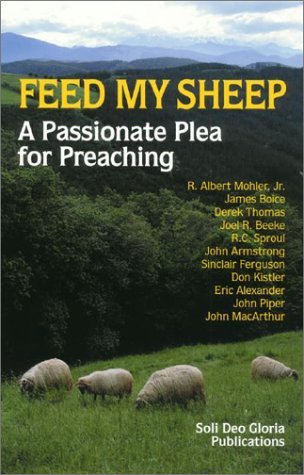
Since I am still not in full mode, I thought I’d link to a review I wrote a year ago of Feed My Sheep: A Passionate Plea for Preaching , edited by Don Kistler. I found this to be a helpful, challenging, encouraging and convicting book.

The essays in the book are as follows:

Albert Mohler, The Primacy of Preaching
James Boice, The Foolishness of Preaching
Derek Thomas, Expository Preaching
Joel Beeke, Experiential Preaching
R. C. Sproul, The Teaching Preacher
John Armstrong, Preaching to the Mind
Sinclair Ferguson, Preaching to the Heart
Don Kistler, Preaching with Authority
Eric Alexander, Evangelistic Preaching
John Piper, Preaching to Suffering People
John MacArthur, A Reminder to Shepherds

The review primarily provides exemplary quotes from key themes addressed in the essays.