McCheyne on Sermon Preparation

As we prepare for Sunday, here are a few more quotes on the subject of preparing well for preaching. These come from The Memoir and Remains of Robert Murray McCheyne, by Andrew Bonar.

“anxious to give them on the Sabbath what had cost him somewhat, he never, without an urgent reason, went before them without much previous meditation and
prayer.”

“in truth, he never preached without careful attention bestowed on his subject . . . He spoke from the pulpit as one earnestly occupied with the souls before him. He made them feel sympathy with what he spoke, for his own eye and heart were on them.”

“And in the same spirit he carefully avoided the too common mode of accommodating texts,- fastening a doctrine on the words, not drawing it from the obvious connection of the passage. He endeavoured at all times to preach the mind of the Spirit in a passage; for he feared that to do otherwise would be to grieve the Spirit who had written it. Interpretation was thus a solemn matter to him”

“His manner was first to ascertain the primary sense and application, and so proceed to handle it for present use.”

“His exhortations flowed from his doctrine, and thus had both variety and power. He was systematic in this; for he observed: ‘Appeals to the careless, etc., come with power on the back of some massy truth’ (He suggests this was Paul’s method as well citing Acts 13:40 and Heb 2:1).

May his tribe increase!

Story Telling, by Edgar Guest

Since I am not able to write up a review just now, I’ll post a poem from a poet I really like, Edgar Guest. I have been reading Guest for a few years but just today came across this poem. I like what he expresses here.

Story Telling
Edgar Guest

Most every night when they’re in bed,
And both their little prayers have said,
They shout for me to come upstairs
And tell them tales of gypsies bold,
And eagles with the claws that hold
A baby’s weight, and fairy sprites
That roam the woods on starry nights.

And I must illustrate these tales,
Must imitate the northern gales
That toss the Indian’s canoe,
And show the way he paddles, too.
If in the story comes a bear,
I have to pause and sniff the air
And show the way he climbs the trees
To steal the honey from the bees.

And then I buzz like angry bees
And sting him on his nose and knees
And howl in pain, till mother cries:
“That pair will never shut their eyes,
While all that noise up there you make;
You’re simply keeping them awake.”
And then they whisper: “Just one more,”
And once again I’m forced to roar.

New stories every night they ask.
And that is not an easy task;
I have to be so many things,
The frog that croaks, the lark that sings,
The cunning fox, the frightened hen;
But just last night they stumped me, when
They wanted me to twist and squirm
And imitate an angle worm.

At last they tumble off to sleep,
And softly from their room I creep
And brush and comb the shock of hair
I tossed about to be a bear.
Then mother says: “Well, I should say
You’re just as much a child as they.”
But you can bet I’ll not resign
That story telling job of mine.

From the book “Rhymes Of Childhood” ©1924
http://sofinesjoyfulmoments.com/quotes/storytel.htm

Packer on the Necessity of Christian Fellowship


Here is a good quote from J. I. Packer on the absolute necessity of real fellowship among believers. This is supposed to be central to the church- not something we have to go find apart from our local church.

“We should not . . . think of fellowship with other Christians as a spiritual luxury, an option addition to the exercises of private devotion. We should recognize rather that such fellowship is a spiritual necessity; for God has made us in such a way that our fellowship with himself is fed by our fellowship with fellow-Christians, and requires to be so fed constantly for its own deepening and enrichment.”

-J.I. Packer, God’s Words: Studies of Key Bible Themes (Downers Grove, Ill: InterVarsity Press, 1981), 193. Cited in Ryken, Philip Graham, The Communion of Saints (Phillipsburg, NJ: P&R Publishing, 2001), 124.

Francis Wayland on Sermon Preparation


Here is a quote from a key Baptist preacher form the past, Francis Wayland. It speaks directly to the previous discussions on doing your own work in sermon preparation. Thanks to my brother, Scott, for passing on the quote.

“A strong temptation frequently assails a man, when preparing a sermon, to look around for helps. He can easily find a book of skeletons made to his hand, and it seems to him very convenient to make use of it. Let me urge every brother, as he values his self-respect, his honesty, his ministerial usefulness, as he values his own soul and the souls of others, to resist this temptation at the outset. If he have any of these crutches, let him commit them at once to the flames, or he will never learn to walk. The habit is absolutely fatal.”

Francis Wayland, Notes on the Principles and Practices of Baptist Churches, as cited in Bush and Nettles, Baptists and the Bible.

Baby Before Blogging :)

Blogging will be suspended a few days due to the arrival of our fifth child- but first girl!- this morning at 8:54. Abigail Calene was 8 pounds 11 ounces and was 20.5 inches long. Mom and baby are doing well, and big brothers are very proud. Coming as she did on Easter Sunday – as mom had long predicted- she is our little reminder of new life.

Baby Before Blogging :)

Blogging will be suspended a few days due to the arrival of our fifth child- but first girl!- this morning at 8:54. Abigail Calene was 8 pounds 11 ounces and was 20.5 inches long. Mom and baby are doing well, and big brothers are very proud. Coming as she did on Easter Sunday – as mom had long predicted- she is our little reminder of new life.

John Angell James on a Learned Ministry


Here is one more post from James’ An Earnest Ministry. One other strength of the book is his treatment of the place of learning in the pastorate. After reading just a few pages one can tell that James himself was a learned man, just with the words he uses and the way he uses them. It is not uppity but powerful.

James has no place for anti-intellectualism. He repeatedly holds up the value of learning.

“God forbid we should ever be afflicted by so great an evil as an unlearned one[ministry]” (27).

“All other things being equal, he is likely to be the most useful preacher, who is the most learned one.” (50)

“A minister . . . can never have too much knowledge.” (50)

Then, one of my favorite quotes is one that James borrows from a Dr. Wiseman:
If God hath no need of our learning, he can have still less of your ignorance.” (51)

Well put! However, if James has no place for anti-intellectualism, neither does he have any place for mere intellectualism- the idea that learning is an end in itself.

“Learning as an ultimate object and for its own sake, is infinitely below the ambition of a holy and devoted servant of Christ; but learning employed to invigorate the intellect, to enrich the imagination, to cultivate the taste, to give power to thought, and variety to illustration; to add to the skill and energy with which we wield the weapons of our warfare, is in some cases indispensable, and in all invaluable.” (55)

Learning is a tool which we should make use of as much as possible in order to be all the more useful in the proclamation of the gospel. Next, I give here a long quote, knowing that many will not choose to read it. However, I include it because it states so well the danger of the errors on both side (anti-intellectualism & mere intellectualism) and calls for the right path.

“We trust that among the rising ministry no one will allow himself to be tempted to the task for the mere reputation of learning. The real value of learning, in the estimate of a faithful servant of Christ, lies solely in the use that can be made of it. He who employs time and toil in rendering himself a learned man, which employed otherwise, would more effectually render him a useful man, is unfaithful to his Master. There are few things more important than the right appreciation of learning. There are some who spend their whole lives in acquiring it, in amassing hoard upon hoard; as it were the object of life to try how much may be got in a given time; not how much good may be done with it, or to what uses it may be turned as it is acquired. It is get, get, get; all getting and no giving. This is of a piece with the mania by which some are possessed in the mercantile world, the mania of money-making: with whom life’s problem is, how they may die rich, how much they can be worth in the world, before the moment comes when they must leave it. There is one material difference between the two cases; and, strange to say it is in favour of the rich rather than of the learned man. The rich man leaves his amassed treasures behind him; so that, although to himself they have been of little use while he lived, and now are of none, thy are not lost; others may use them, and use them well. But he, who has been acquiring learning all his days without expending it in its appropriate uses, leaves nothing behind him. He carries all with him. There is no bank for deposits of learning, as there is for lodging silver and gold. So far as his fellow-men are concerned, therefore, the money-hoarding miser does most good. And should it be thought an advantage on the side of the miser in learning, that he carries his mental stores away with him, as being treasures that belong to the immortal mind, there are two serious deductions to be made from this advantage: the first that the large proportion of what he had acquired, is of a nature to be of little use to him, in all likelihood, in the world to which he is going; and the second, that in common with the man of wealth, he carries with him to that world, the guild, (unthought of by him here, it may be, but noted in his account with his Divine Master,) of not having laid out his acquisitions for the good he might have accomplished by them, where and when alone they could be available. Let it not be forgotten that mere learning is not wisdom; that wisdom is learning or knowledge in union with the disposition and ability to make a right use of it. Neither let it be forgotten that there is an opposite extreme to that which has just been described. If there are some who are ever getting and never giving, there are some too who would fain be ever giving while they are never getting. They are fond of preaching, but not of reading and study. Such young ministers may be well-meaning; but they are under the influence of a miserable mistake. Itinerants they may be, and useful ones: but efficient pastors they can never be. They may preach the simple elements of the gospel, from place to place; but for the constant regular instruction of the same flock they are utterly unfit. He must be an extraordinary man who has resources in himself for such a work, that render him independent of reading and study. Barrenness, tameness, sameness, triteness, irksome and unprofitable repetition, must be the almost invariable result of such presumption. There are some too, who, by way of honouring the Bible, make it their rule to study nothing else, not even such human helps as may fit them for understanding and illustrating its contents. This also, though a better extreme than his, who neglecting the Bible itself, studies only human opinions about it, yet is still an extreme, and an extreme which, while it professes to put honour upon the Bible, indicates no small measure of self-sufficiency. We put most honour upon the Bible, when we manifest our impression of the value of a full and clear comprehension of its contents, in the diligent application of all accessible means for the attainment of it.” (52-54 – quoting Hagenbach)

John Angell James, Passion for Souls

Yesterday I mentioned John Angell James book, An Earnest Ministry. One of the striking and beneficial things about the book is the deep, compelling passion for the salvation of souls. Here are some quotes to that end.

Here the author begins referring to himself in third person:

“And now that his shadow lengthens on the plain, and his eye is fixed on the declining sun, he feels, in the review of life, that the thought of having done any thing to save souls from death gives him far more delight than he could have derived from having made the largest acquirements in learning and science, or from having gained a reputation for genius and taste. There is a time coming to every man when the knowledge of having been the instrument of plucking a single brand from the eternal burning, will yield him more real satisfaction than the certainty of having accomplished the loftiest objects of literary ambition.” (xvii)

On the importance of making clear the human condition in sin:

“We have, as our first business, to fasten a charge of guilt upon men naturally disposed to think well of themselves: to produce a sense of utter worthlessness and depravity in those who . . . admit only some few imperfections and infirmities . . . and to substitute for a general and unhumbled dependence upon Divine mercy, such a conviction of exposure to the curse of God’s violated law, as makes it difficult for the trembling penitent to see how his pardon can be harmonised with the claims of justice” (188-189)

Then he is so good on how we present the claims of the gospel. We could do well to ponder this quote at length.

“It is as if he had said, ‘wherever we go, we find men in unprovoked hostility, inveterate enmity, and mad rebellion, against God’s holy nature, law, and government: we carry with us, as his ambassadors, the proclamation of mercy through the mediation of our Lord Jesus Christ: we tell them that we are appointed by God whom they have offended, and who could overwhelm them with the terrors of his justice, to call upon them to lay down their arms and accept the offer of eternal pardon and peace: but we find them every where so bent upon their sins, and the enjoyment of their worldly occupations and possessions, that we are compelled to use the language of the most vehement entreaty, and to beseech and implore them in God’s name, and in Christ’s stead, to come into a state of reconciliation.
“This is the most wonderful scene that the universe will ever witness; a beseeching God, an imploring Saviour, standing at the door of the sinner’s heart with eternal salvation in his hand…. The insulted Omnipotent Creator of the universe, beseeching a worm, whom an exercise of his will could sink in a moment to perdition, and his justice be glorified in the act, to accept his pardoning mercy, and waiting year after year, in all long-suffering, for the sinner’s reconsideration of his obstinate refusals.” (23)

Wow! He captures well the reality that God is under no compulsion to save anyone (He could condemn all and his justice be glorified), and yet this God due only to His own sovereign mercy and grace holds out salvation to all who will repent and believe. This is cause for wonder, awe, worship celebration and proclamation.

Living Exegetically

My students in NT Survey turned in responses today from listening to my sermon on Romans 3. This typically turns up some good discussion, but one student statement I thought was particularly worth citing here. The student was responding to my statement that you should not be surprised to find your thinking to be in error if you do not intentionally seek to shape your thinking by Scripture. He then wrote:

“Sometimes my life is like a sermon that takes a verse and runs with it- may my life be lived more exegetically”

I don’t know if the phrase ‘living exegetically’ is original with him or borrowed, but I thought it was well put. May we provide models for living for our people by preaching exegetically that they might live exegetically. May our preaching and our living rightly represent the truth of God’s word (1 Tim 4:16).

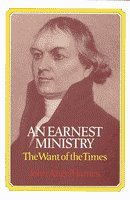
An Earnest Ministry: The Want of the Times

Today in my pastoral ministry class we discussed An Earnest Ministry: The Want of the Times, by John Angell James. This book, originally written in 1847, is a real gem. I have 16 pages (single-spaced) of quotes drawn from the book! James gives a clarion call for a return to earnest, i.e. passionate, devoted, ministry. He says the way this is to be accomplished is for pastors to return to the basic purpose of their calling- the salvation of souls. As such this is a very passionate book on evangelism from an heir of the Puritans. Some are confused, however, when he also says in the book that the purpose of pastoral ministry is the oversight of souls (Heb 13:17). In the way we typically use the words these would seem contradictory- one is evangelism, the other is caring for those already converted. However, for James (and indeed the Bible) these are not contradictory but synonymous. He pauses at one point to clarify exactly what he means by “salvation of souls.” He writes:

“The salvation of souls’ as the great object of the ministerial office, is a generic phrase, including as its species, the awakening of the unconcerned; the guidance of the inquiring; the instruction of the uninformed; and the sanctification, comfort, and progress of those who through grace have believed; in short the whole work of grace in the soul.” (36)

Thus, James has a biblical view of salvation which involves not only conversion but also sanctification. So the compelling goal of pastoral ministry according to James is the overall work of laboring to see people come to faith in Christ and then to see them persevere in that faith. Truly, this is the biblical witness and we do need an increase in earnestness to this end.