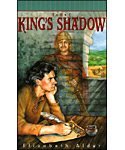
The King’s Shadow


The King’s Shadow, Elizabeth Alder
(Bantam Double Day Dell, 1995), pb., 259

My wife reads to our boys in the afternoon as the key part of our history studies, and then I read to them in the evening before bed. Sometimes I end up jealous 🙂 over books that I miss out on, and this was one of those! My boys really liked it and so did my wife. She often would fill me in later in the evening.

The story centers around a young Welsh serf, Evyn, whose life is suddenly overturned with the killing of his father and the cutting out of his tongue. The story follows Evyn’s life as he eventually becomes a servant to Earl Harold of Wessex, eventually King Harold. The story leads right up to the Battle of Hastings where William the Conqueror defeated Harold. The adventures along the way are well told, and the worldview which emerges clearly from the story is so good. The clear point in the story is persevering through trials and finding one’s purpose in life. The book is full of sturdy, hearty sense. The best way to illustrate this without giving away the whole story is to include here a brief excerpt. This part of the story occurs as Evyn interacts with a young monk friend, Lewys. Mrs. Alder wonderfully presents an encounter where one friend refuses to allow another friend to sulk in self-pity but instead does the difficult, and risky, work of confronting that friend with the truth he needs to truly persevere.

That night in the whitewashed cell he shared with Lewys, Evyn sat with his wax tablet on his knees, writing furiously while Lewys looked over his shoulder in amusement and a little irritation. Lewys read the first line aloud: “I will not go back.” He walked over to look Evyn in the face, and as he did so his huge shadow followed him around the candlelit room.
“Evyn, our lives are not our own. After all that you have endured” -Lewys’s green eyes narrowed with intensity – “you of everyone here must know that.” He paused, pressing his lips together in exasperation. “I am a monk. I answer to the abbot. By God’s will he is my lord here in this life. But you were meant to live in the world. And, as God has made Harold Earl of all these lands, so he, Harold, is your lord. To serve God, you must serve Harold.”
Evyn sneered and bent over his tablet again, his knife racing swiftly across the surface, forming letters. When he finished, he held the tablet up for Lewys to see.
“‘As water boy?’ Lewys read. ‘Ah, I see, the Devil’s favorite sin – pride. You still fancy yourself a free man and a storiawr, do you? Are you too important to draw water? Does that not bring life and health to people?”
Evyn scribbled again.
“So, they are not your people, you say. Tell me, Evyn, where are your people?” Lewys raised his voice sharply. He would be cruel, if need be, to make Evyn understand. “Your people are in a Carmarthen graveyard. That was your old life. You are no longer Evyn of Carmarthen. You are no longer free. You are a silent shadow now. Why God has allowed this I do not know. But I do know that now it is your duty to serve Harold, and if Harold’s Lady needs a water boy, then that is your vocation, and you should fulfill it with holy pride, which comes of serving God.”
Lewys paced the room again, running his fingers through the fringe of his hair, while Evyn sat sullenly hunched over his wax tablet.
“Do you know,” Lewys said suddenly on a different tack, “that you have yet to make one sign of gratitude for all you have received from Harold’s Lady? It was in her power to make you a galley slave or a mole burrowing in one of the mines. Instead, she gave you food and clothing, and kind words, too, I will wager.” (p. 72-73)

This is a truly biblical worldview- whether intended by the author or not I do not know. We have here the need for trusting God even when we don’t understand, simply serving God wherever we find ourselves, not thinking ourselves above menial serivce, the fact that we serve God only as we submit to proper authority, the need for gratitude no matter how hard life has been, and simply the picture of true friendship in being willing to speak the hard but necessary truth.

This was a good book for our boys in various ways (beyond the basic goal of learning history!) confronting whining, teaching gratitude, self-sacrifice and perseverance. The account of his tongue being cut out could be a bit much for a younger audience. My boys were 9, 8 and 6 at the time of the reading, and it was fine for them. We would commend this book heartily.

Ephesians 4 and Church Health

I have been thinking a bit lately about the fourth chapter of Ephesians and what it tells us about church health- stimulated significantly by conversation with my fellow pastor, Lee Tankersley (oh, the joy of not being isolated in ministry!). There is much here so I may devote a few posts to various aspects. Here I want to take up particularly the language of verse 16 and its emphasis on each member. Having described God’s gifts to the church, the saints working in ministry and the pursuit of maturity, Paul concludes this section (4:1-16) by describing the body functioning properly. In this setting he refers to the body being “joined and held together by every joint with which it is equipped.” Of course taking the body metaphor strictly, not each member is a “joint.” But I think here the point is that the church coheres through the work of each member. This is supported by the immediately following words, “when each part is working properly.” This results in the body growing. There is a strong emphasis here on the necessity of the help of each member if the church is to be healthy. If any member of your local church is disconnected, failing to invest in the others and not receiving from others, your church cannot be healthy as it should- no matter what you do with marketing and programs. How seriously do we take this truth?

Writing in 1864, in his commentary on the Heidelberg Catechism, George Bethune spoke to this issue. He wrote:

“It is the order of grace that Christians are instrumentally dependent upon each other; as we grow they grow; and as they grow we grow. Whatever we do for their benefit is for our own; whatever they do for our benefit is for their own. Thus it is not only our duty, but our best interest, to impart freely of all God’s gifts to us for the benefit of our fellow Christians. There must be a communion [sharing] of prayers and acts and gifts, as there is a communion of grace. If we refuse this closeness of union to our fellow-Christians, we shall suffer doubly; for the Holy Spirit will not use us as the channels of his grace to them, nor can the effectual working through them reach us. Nothing but weakness and death can result from such selfish isolation.” (quoted in The Communion of Saints, 98).

How healthy are our churches then? How should this shape our pastoral priorities? Doesn’t this challenge much of the typical practice we see around us? It certainly would require us to work hard at building a real community in the church and teaching that each member is vital to the church. We can’t afford to just write people off saying (as I have heard leaders say) it would be easier to let them go than pursue them. Can we achieve this in a setting where people do not know each other? This will require the intentional investing in each others lives. Perhaps if we scale back the programming people would be able to do more of this.

The Pastoral Heart of Robert Murray McCheyne

While studying in Scotland, I was privileged to find a free copy of Memoir and Remains of Robert Murray McCheyne, by A. A. Bonar, a hard bound copy from 1891! I had heard much about this as a spiritual classic and finally I read it. It was a deep blessing to me and I heartily commend it to you.

Here is a quote from the closing of a sermon he preached to his people in Dundee. The heart for his people is clear and exemplary.

“Dearly beloved and longed for, I now begin another year of my ministry among you: and I am resolved, if God give me health and strength, that I will not let a man, woman, or child among you alone, until you have at least heard the testimony of God concerning his Son, either to your condemnation or salvation. And I will pray, as I have done before, that if the Lord will indeed give us a great outpouring of his Spirit, He will do it in such a way that it will be evident to the weakest child among you that, it is the Lord’s work, and not man’s. I think I may say to you, as Rutherford said to his people, ‘Your heaven would be two heavens to me.’ And if the Lord be pleased to give me a crown from among you, I do here promise in his sight, that I will cast it at his feet, saying, ‘Worthy is the Lamb that was slain! Blessing, and honour, and glory, and power, be unto Him that sitteth upon the throne, and to the Lamb for ever and ever'” (123).

If All the Swords in England: A Story of Thomas Becket

If All the Swords in England: A Story of Thomas Becket , Barbara Willard
(1961; repr. Bethlehem Books, 2000), pb. 181 pp.

The story of Thomas Becket’s brave stand against the King is a moving and powerful story. It is full of lessons and examples about ultimate allegiance to God alone and the willingness to follow God even to the point of death. However, this retelling of the story does not succeed very well in communicating this powerful account. Mrs. Willard seems to assume her audience knows the story already, and therefore jumps about in the story often without clear clues to her readers. This is similar to my complaint with her other book, Son of Charlemagne.

Honestly, this is one we endured our way through. I had to work hard to salvage the key points of the story. The account follows pretty carefully historical accounts as far as I can tell, but it simply is not communicated well. Tell your children about Thomas Becket, but look for other resources to help you in doing so.

Spurgeon on Weekly Communion


I am currently writing an article in which, among other things I am arguing for the weekly celebration of communion. In the process I was pointed to this quote from Spurgeon. I like it especially because it expresses so well what I have experienced at our church where we do have communion weekly. The biblical arguments are readily available and the benefits can be enumerated at length. More on those later. But here is Spurgeon’s quote:

“So with the Lord’s Supper. My witness is, and I think I speak the mind of many of God’s people now present, that coming as some of us do, weekly, to the Lord’s table, we do not find the breaking of bread to have lost its significance – it is always fresh to us. I have often remarked on Lord’s-day evening, whatever the subject may have been, whether Sinai has thundered over our heads, or the plaintive notes of Calvary have pierced our hearts, it always seems equally appropriate to come to the breaking of bread. Shame on the Christian church that she should put it off to once a month, and mar the first day of the week by depriving it of its glory in the meeting together for fellowship and breaking of bread, and showing forth of the death of Christ till he come. They who once know the sweetness of each Lord’s-day celebrating his Supper, will not be content, I am sure, to put it off to less frequent seasons. Beloved, when the Holy Ghost is with us, ordinances are wells to the Christian, wells of rich comfort and of near communion.”
“Songs of Deliverance,” Sermon no. 763, July 28, 1867, preaching from Judges 5:11. http://www.spurgeon.org/sermons/0763.htm.

Amen!

Dever on pragmatism and numbers orientation

You have probably already seen this elsewhere, but Mark Dever’s “The Apparent Piety of Numerical Goals” is an important piece well worth reading. I am convinced that pragmatism is one of the greatest threats to our evangelical churches in the West. Dever argues this well pointing to the problems of our number oriented goal setting. This points to some of the significant mindset shifting that we need in our churches and amongst pastors.

The Hobbit, J. R. R. Tolkien


The Hobbit, J. R. R. Tolkien

This was a fun book to finally read with my boys (which was also my first reading of the book as well). This book, like most it seems, did start a bit slowly, but my boys really loved it once it got going. It helped that there was some built in anticipation because we have talked about this book and the Lord of the Rings for a little while. A good friend gave us a very nice deluxe edition of the Lord of the Rings Trilogy about a year ago so that has added to the anticipation.

The story speaks to various important themes including courage/nobility, pluck, teamwork, simplicity, and the danger of greed. Tolkien, of course, is not writing an allegory (in contrast to Lewis’ Narnia) so we are not to look for direct connections to the gospel. However, he has created a meaningful world, so there are connections to biblical truths about living. As has been said, all the truly great stories are great because they resemble at some level the story- the drama of redemption.

In The Hobbit each character has his flaws, so we see real “people” dealing with the issues of life, encountering fears and temptations. This opens up numerous possibilities for conversations with your children. As the characters travel through the Mirkwood the challenge is to remain on the path in obedience to their directions, acting in faith in spite of their feelings and resisting distractions ( The earnest command to stay on the path is reminiscent of Pilgrim’s Progress) This was very relevant for some issues with our boys. The dragon of course is the picture of evil. The reading is all the more meaningful if you are aware of the traditional associations of the dragon- evil, greedy, and wily. There is a strong message about greed as the dragon is the greedy one and then when the treasure is captured greed affects those who have obtained it. In fact, the dwarf leader, Thorin, eventually says to Bilbo, “If more of us valued food and cheer and song above hoarded gold, it would be a merrier world.” (272-73).

Then as the story closes there is almost a surprise at the end as Gandalf mildly chides Bilbo for seeming not to be surprised at the fulfillment of the prophecies.

“Of course!” said Gandalf. “And why should not they prove true? Surely you don’t disbelieve the prophecies, because you had a hand in bringing them about yourself? You don’t suppose, do you, that all your adventures and escapes were managed by mere luck, just for your sole benefit? You are a very fine person, Mr. Baggins, and I am very fond of you; but you are only quite a little fellow in a wide world after all!” (290)

So, the story closes by affirming that something more is at work here than simply one creature having an incredible journey- the old prophecies are coming true. Exactly what Tolkien was up to here, I am not sure. But from a Christian standpoint, this opened up conversation about how God works history to His ends, how he still uses us in the process, and how our lives are about more than just us. We are playing our part in the bigger drama of God’s working in history.

Lastly, the edition we used (the one pictured above) has some really nice illustrations which my boys enjoyed checking out between readings.

Added note: At the time of this reading my boys are 9, 8, 6 (also a three year old but he was not much into it!). They all enjoyed it and followed well. I think the 6 year old might not have followed as well if it were not for older brothers. Perhaps that will help in your thinking about when this book might be good for your children.

Truett on Preaching

As we enter the weekend and no doubt many of you will be preaching, here is a word from George Truett. George W. Truett was one of the highly esteemed preachers in the SBC and beyond. He served as pastor of FBC Dallas from 1897 to his death in 1944. Brian Denker recently found this quote from Truett in a convention sermon. It is a fun quote as well as one which highlights the importance of true preaching.

“Verily Paul ‘magnified the ministry.’ The most important work in all the world is the work of the pulpit. There can no substitute for the spoken word from a living pulpit. It pleased God by the ‘foolishness of preaching to save them that believe.’ Whatever the progress and triumphs of the schools of civilization, with all its multiform organizations, can never be any displacement of the work of the prophets of God. The halcyon days of Christianity have always been the days of the right kind of preaching. All the decadent days of Christianity have been the days of the wrong kind of preaching. The Christian pulpit cannot be what it ought to be, and what God designs, if it be without the right kind of preaching. The Christian pulpit cannot be what it ought to be, and what God designs, if it be without the right kind of men in the pulpit. The pulpit is not the place for men of anemic spirit; they had better stay out of it. It is not the place for prigs and fops and dandies and for men seeking selfish ends. The most robust and virile and masculine and heroic business that earth ever saw is the right kind of preaching.”

Convention Sermon: “What We Preach”
Text: 2 Corinthians 4:5
Source: Truett, George W. Sermons from Paul. Vol. 2, Truett Memorial Series, ed. by Powhatan W. James. (Nashville: Broadman Press, 1947), 13-31

Doing Poetry and Dealing with Pride

One of the fun parts of blogging is encountering other people. Recently Derek Brown visited this site and I followed the link back to his blog. There I found a poem he has written entitled, “Unless the Heart is Broken.” If you have read this blog much, you know that I encourage the use of poetry in various ways. I really enjoyed Derek’s poem as it dealt with the struggle of pride and our need for humility.Here are the opening lines:

Unless the heart is broken
True love to Christ cannot flow
Only a heart that is broken
Can the beauty of Christ know

Check it out.

Plagiarism again, response to Sheep’s Crib

J. A. Gillmartin has posted his response to my arguments on pastoral plagiarism (post 1, post 2) at his blog The Sheep’s Crib. I think my argument can be best made by encouraging you to read his post and compare it with what has been said here, not only in my posts but in the wealth of good comments and the items I linked from Justin Taylor.

I do not think Gillmartin’s post adds significantly to the discussion, so I will not give a detailed response. Here are just two points.

1. He argues that stewardship would suggest we use all available good resources. I wholeheartedly agree. He claims I disallow the use of bound, printed sermons. I never said that. In fact I would encourage the use of such, at least from good expositors. I said clearly that we ought to learn from others, but then preach our own sermons.

2. He accuses my argument of being “neo-pharisaic” (his term). He is concerned about adding non-biblical requirements to believers, here particularly pastors. But, is the requirement of laboring in the Word an unbiblical, human addition? I agree that adding unbiblical requirements is damaging and dangerous (legalism). I also believe that negating biblical commands, telling people they need not do what the Bible says, is also damaging (antinomianism). In 1 Tim 5:17 the elders who rule well are defined as those who labor (the word here suggests toil) in preaching and teaching (see the commentaries for supporting argument that ruling well is defined as laboring in this way). Timothy is exhorted to “devote” himself to teaching (1 Tim 4:13) and he is to watch closely his teaching (4:16). Indeed his carefulness concerning his own life and his teaching will lead to the salvation of others (4:16). Search the Scriptures. The requirement for pastors to be men steeped in the Word as a result of real labor to understand them is a thoroughly biblical one. Leaning too much on the work of others, skipping the hard work ourselves, avoids this biblical mandate and will stunt the growth of pastors and the churches they lead. To encourage men to avoid this mandate is serious error.