Within the Palace Gates

Within the Palace Gates, by Anna Siviter

This book is a retelling of the story of Nehemiah, and is a good example of historical, biblical fiction. The story is well done with much attention to detail, culture, religion etc. and plenty of action. The story begins with Nehe (Nehemiah) enjoying his position in Persia. The account of Nehemiah’s brother coming with news of Jerusalem is really well done- the human touch, the reasonable filling in of details, the attention to historical setting- all is well done. The author never explained why Nehemiah went by Nehe in Persia in her account, but it is certainly reasonable that the portion which referred to Yahweh (‘iah’) would be dropped by the Persian court. This would be similar to the changing of the names of Daniel and his three friends.

We read this book a year ago, and I just recently did a study of Nehemiah. It was interesting to note how careful and faithful the author was in various points of this book. The story intentionally holds up obedience and reverence to God. It was a fun way to learn more about the Nehemiah story and to be edified. My 6 & 8 year old boys loved it.

It appears that Amazon is limited in its stock on this book. You can find it however at Veritas Press.

Greek Readings

Regular readers may notice the addition of a new feature in the left column- a daily passage from the Greek New Testament. I found this on some other sites (which ones I now cannot remember) and decided to add it here as an encouragement to pastors to labor in the original languages.

If you are unsure of the value of knowing and using Greek and Hebrew, or if you could use some more encouragement in the task I highly recommend a little piece written by Scott Hafemann for the Southern Baptist Journal of Theology back in 1999. The piece is written in response to the question:

“Is it genuinely important to use the biblical languages in preaching, especially since there are many excellent commentaries and pastors will never attain the expertise of scholars?”

Hafemann’s response is excellent! The rest of the article also contains responses to similar questions about the value of church history, etc. by people like Timothy George and Don Carson.

The Red Keep


The Red Keep: A Story of Burgundy in 1165,
by Allen French (1939; reprint, Bethlehem Books, 1997), 370 pp.

My boys (ages 9, 8 and 6) and I came to this book with much anticipation having greatly enjoyed French’s Rolf and the Viking Bow (see previous post; my 3 year old wasn’t much interested!). This book though is a bit longer than Rolf, and it did start a bit slowly. It was good to see that they had learned the discipline of persevering with a book long enough to allow it to come into full bloom. The reputation of the previous book helped.

Once we got a few chapters in, however, we were all rapt in attention- reading much further into the night than I intended at times! The story takes place, as the subtitle states in 12th century France. Thus, a good sense of basic medieval life is given (French and his wife apparently spent six weeks in this area in preparation for writing). The place of nobles, the role of holding a castle and governing a fief, the journey of a young man from page to squire to knight and various other aspects of life in that time are well portrayed- and a glossary is included to explain unfamiliar words. The story concerns a young man, Conan, as he matures into knighthood, a young heiress to a fief and castle, Anne, who has been displaced by the evil plotting of two castle-holding brothers, the Sauval, and the clash between good and evil which ensues. The story, rich in adventure and intrigue is told with relish. My boys were captured by the battles, the secret passage way and the struggle to see truth prevail.

Along the way medieval spirituality is evident. There is no modern effort to ignore or suppress the religious element. This comes especially into view in the closing chapters and opened discussion for us of the reality of the gospel and the need for salvation. Of course it is cast in the light of Medieval Catholicism verging on mysticism at points. I edited some things and paused to explain others. I took the opportunity to explain that people at this time (and some today) thought they were to pray to Mary, etc. In this latter section one of the main bad guys says in his thoughts “damn them” (p. 359). It is said in the context of death and hell so I do not think it is meant to be profane. Rather the character is, I think, in actuality hoping for the condemnation of the others. Still, I chose to edit this part, and it is likely something other parents will want to be aware of.

Lastly, this book is more graphic in the description of the violence than was Rolf. This is not necessarily a bad thing, but something one might want to bear in mind in light of the audience. Though we have read many accounts of battles, I did edit portions.

We found this book to be a fun read, one we eagerly looked forward to each day and a good way to learn about the era. I hope you may enjoy it as we did.


Video Church

There is a good bit of talk going on around the blogosphere and elsewhere about the validity (or lack thereof) of video churches- i.e., churches where the preaching comes via satellite or video. The arguments for this can easily be found. I am simply going to register my complete dissatisfaction with the idea.

Some of the discussion arises from churches growing quite large and therefore seeking to plant another church. So far so good. However, some have said that starting a church with another, different pastor did not work, so they started the new church and allowed them to have the same “preacher” by piping in the sermon via satellite link. In some cases these new churches are in outlying areas of the city where the “preacher” ministers. In other cases, the “satellite” church is in a different state (see Brett Maragni on this phenomenon). All of this begs some key questions about what pastoral ministry is, what corporate worship is, etc. If the oversight of souls (Heb 13:17) is at the heart of pastoral ministry (as I argue), then how does this happen in a video venue? Even if there are other elders “on site”, what is the impact of the detachment of the preaching? This seems to me to show that our view of preaching is too performance oriented. We want a certain amount of glamour rather than simply faithful exposition from a local shepherd. The fact is that while eloquence is nice, it is not required (1 Tim 3; Titus 1). Faithful, orthodox proclamation is- and certainly Titus 1:9 envisions preaching aimed directly at the local situation.

True preaching should arise from within the community as the pastor from within the community speaks from the Word of God to the people among whom he lives, works, shops, hurts and celebrates. Preaching and pastoral care cannot rightly be separated (in spite of the fact that they often are in larger church situations where the “main” pastor preaches and others do pastoral care).

The talk seems to suggest that people are gathering more around certain personalities rather than around the word of God and within the worshipping people of God. It also suggests that we place too much value on the gathering of crowds. Certainly we want more people to come to faith. The question is, “What is the right way to accomplish this?” The place of community and oversight has simply been lost in so much of the thinking about the church in our day.

Wisdom from Pascal

Here is a quote from Blaise Pascal which I have on my filing cabinet. I keep it there because I think it captures well the combinations of aspiration and humility. In our work as pastors we must aspire and long for advance in the kingdom, and we must realize that such advancement comes in the fulfilling of “small” duties.

“Lord, help me do great things as though they were little, since I do them with your powers, and help me to do little things as though they were great, because I do them in Your name.”

– Blaise Pascal

Gabriel’s Magic Ornament


Gabriel’s Magic Ornament , by Randall Bush
(Pristine Publishers, 2002), 110 pages; $11.95

This magical little book, written by my colleague Dr. Randall Bush, has become a Christmas favorite in my family. Dr. Bush has crafted a tale reminiscent of C. S. Lewis’s Chronicles of Narnia in which the fantasy land is itself the Christmas tree and the characters are the ornaments, all steeped in biblical imagery. Along the way the message of salvation (the true meaning of Christmas) is exposed with a very striking image of human captivity to sin (laboring in the cane fields), the holiness of God (“He is good and kind….  You must take him seriously, though, for he is not to be trifled with.”), and a beautiful description of heaven. Bush makes a clever use of names and symbols and includes a glossary in the back in case you miss the historical and biblical allusions.

The book is also available on CD. We have read the book and listened to it on CD, and my boys regularly ask to hear it again. I think my youngest was four years old when we first read it and he seemed to understand well and enjoy. I warmly commend it to all.

Bedtime With My Boys


“Bedtime With My Boys”
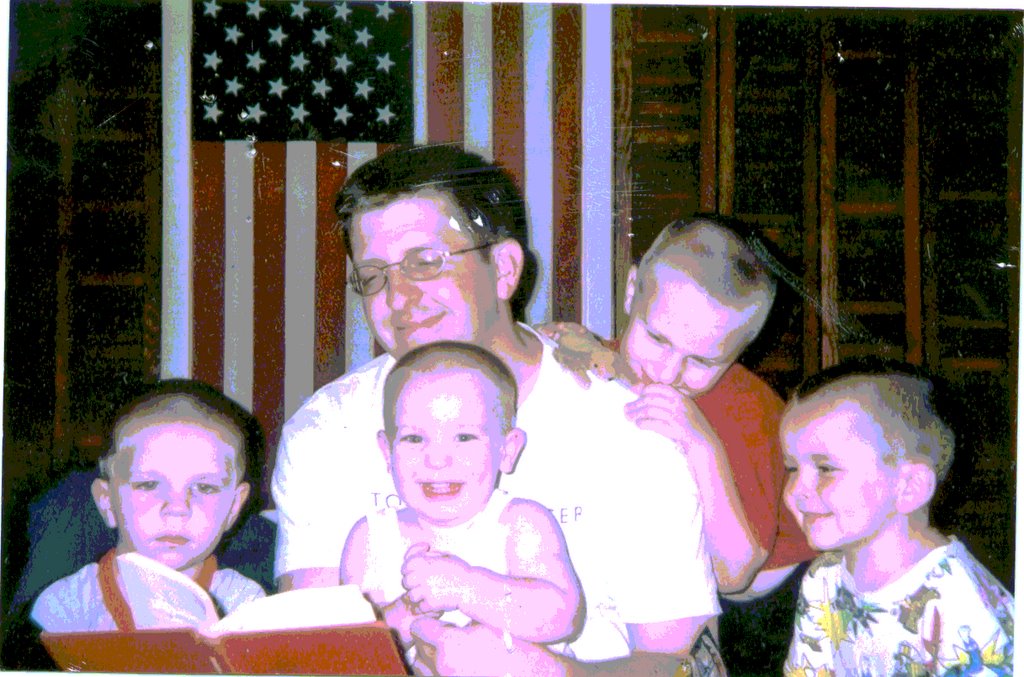
One of my favorite times is bedtime with my boys,
When we turn aside from the day’s busyness and noise.
We linger then together to read, talk and ponder
Over the Bible, stories, the day and wherever our minds might wander.
In this time more than any other of the day
Little hearts and minds open up, and I long to hear what they have to say
Of joys and fear, wonders and dreams
Of the way that life to each of them seems.
I see which of my lessons have sunk in well
And what views of life are beginning to gel.
Errors and almost truths oft expressed,
Can here be gently corrected and shaped to what’s best.
Truths and proper conclusions are stated as well,
Causing my soul to rejoice and my chest to swell.
Oh, what joy can be sweeter than from one’s offspring to hear,
Free, unprompted affirmation of truths you hold dear,
Assertions of warm-hearted orthodoxy
Aspirations of courage and nobility
Longing a good and godly man to be.

Yes, bedtime with my boys is a time I hold dear,
More and more precious with each passing year.
Lord, bless our discussions which go on each night
That well in the future they may grant my boys light
To walk in the path and keep to the straight way
And may they linger with their boys at bedtime someday.

“My son, keep my words, And treasure my commandments within you.” (Prov. 7:1)
“Listen, my son, and be wise, And direct your heart in the way” (Prov. 23:19)
“Be wise, my son, and make my heart glad” (Prov. 27:11)
“My son, if your heart is wise, My own heart also will be glad; And my inmost being will rejoice, When your lips speak what is right.” (Prov. 23:15-16)

– RVN, 5/15/03

Peterson and Priorities of the Pastorate

One of my favorite books on pastoral ministry is Eugene Peterson’s The Contemplative Pastor: Returning to the Art of Spiritual Direction. I differ from Peterson on a number of topics, but he is particularly good on discussing pastoral ministry. This quote is a gem. I encourage you to read it all carefully. He is describing the call of the people of God to their pastors. Let us hear, ponder and fulfill our ministry.

“We need help in keeping our beliefs sharp and accurate and intact. We don’t trust ourselves; our emotions seduce us into infidelities. We know we are launched on a difficult and dangerous act of faith, and there are strong influences intent on diluting or destroying it. We want you to give us help. Be our pastor, a minister of Word and sacrament in the middle of this world’s life. Minister with Word and sacrament in all the different parts and stages of our lives – in our work and play, with our children and our parents, at birth and death, in our celebrations and sorrows, on those days when morning breaks over us in a wash of sunshine, and those other days that are all drizzle. This isn’t the only task in the life of faith, but it is your task. We will find someone else to do the other important and essential tasks. This is yours: Word and
sacrament.
One more thing: We are going to ordain you to this ministry, and we want your vow that you will stick to it. This is not a temporary job assignment but a way of life that we need lived out in our community. We know you are launched on the same difficult belief venture in the same dangerous world as we re. We know your emotions are as fickle as ours, and your mind is as tricky as ours. That is why we are going to ordain you and why we are going to exact a vow from you. We know there will be days and months, maybe even years, when we won’t feel like believing anything and won’t want to hear it from you. And we know there will be days and weeks and maybe even years when you won’t feel like saying it. It doesn’t matter. Do it. You are ordained to this ministry, vowed to it.
There may be times when we come to you as a committee or delegation and demand that you tell us something else than what we are telling you now. Promise right now that you won’t give in to what we demand of you. You are not the minister of our changing desires, or our time-conditioned understanding of our needs, or our secularized hopes for something better. With these vows of ordination we are lashing you fast to the mast of Word and sacrament so you will be unable to respond to the siren voices.
There are many other things to be done in this wrecked world, and we are going to be doing at least some of them, but if we don’t know the foundational realities with which we are dealing – God, kingdom, gospel – we are going to end up living futile, fantasy lives. Your task is to keep telling the basic story, representing the presence of the Spirit, insisting on the priority of God, speaking the biblical words of command and promise and invitation.” (138-139)

African Adventures


African Adventures , Dick Anderson
(Christian Focus Publications, 2003), pb. 96 pp.
ISBN 1-85792-807-5

This is a book of missionary stories written for children. Rather than a collection of stories from different people, as I had assumed, it is a group of stories drawn (with some modification) from the experiences of one missionary doctor and his friends in Kenya (whether the author is that doctor or someone recording the doctor’s stories, I do not know). The book develops chronologically along the missionary’s time with the Turkana people, so the reader sees the growth from a lone missionary, to the building of a mission hospital, to the arrival of his family, further staff and the development of a church. Each chapter consists of a short story (4-6 pages) centering around an adventure including encounters with jackals, leopards, lions, snakes, bandits and diseases. Each story concludes with one person in the story drawing a spiritual truth from the incident.

My boys (ages 4 to 7) thoroughly enjoyed the book, as I read it to them. The adventure dimension of the stories was effective. I appreciated the opportunity to give them a picture of missionary work. It brought more clarity and reality to our praying for missionaries. The publisher has two other titles in this series, Rainforest Adventures and Amazon Adventures. For reading with young children or for slightly older children to read on their own, this book is a simple, fun portrait of missionary activity.

Tirzah


Tirzah, Lucille Travis
(Herald Press, 1991), 159 pp.

This is the story of a young Israelite girl, Tirzah, as she and her family follow Moses out of Egypt to Sinai and toward the Promised Land. We read this book about a year and a half ago and my boys (about 8 and 6 years old) enjoyed it. It was a bit slow for them in places, and I was a bit uncertain about some historical particulars, but overall it was a good book. It provides an “inside” look on what it might have been like to be a part of the Exodus. Mrs. Travis does a good job in showing the presence of those who led the complaining against Moses. It is helpful in understanding the story to be reminded that these people would have been neighbors and family members of the rest. The story represents well the stresses and strains on families as they seek to survive, to understand whom to believe and follow (Moses or others), and to be faithful to God. We can tend to simply assume that it would have been easy to have faith in this situation, but the story shows the struggle to believe.

The story ends a bit suddenly, just after the Israelites (at least the majority) refused to enter the Promised Land at Beersheba. The book closes with Tirzah’s parents, who had been for obeying the Lord, sitting around the fire with their children contemplating the judgment just handed down from God. After sitting quietly the father led them in prayer with tears. Then he takes his wife’s hand and says to his children, “My children, though we shall never see the good land Yahweh has promised, you will…. Your mother and I will prepare you for the day that will come when you shall enter the land. You will take our places, be our eyes, our ears. Your joy will be for us too…. We shall teach you all that we can, my dear ones, for as long as Yahweh wills…. When his wife begins to weep, he says, “Remember, my dear, we are forgiven. Yahweh’s love is great and his decree is just.” I had never considered a family sitting together contemplating the fact that the parents would die in the desert but the children would make it to the Promised Land. The picture of a faithful father leading his family through such a time with faith in the goodness of God was both convicting and encouraging. This powerful ending alone makes it a worthwhile read.