Schneider & Spirit-Empowered Boldness

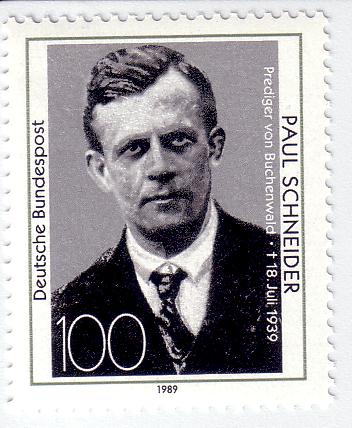
Connecting my last two posts, Paul Schneider is an example of Spirit-empowered boldness.  As he shepherded his people he found himself compelled to call evil by name as he saw it in the Nazi party which was solidifying its power in Germany and in the cowardice of some church leaders.

Notice the boldness and clarity of these quotes. May they challenge you as they do me.

[Schneider’s circular letter]

“Oh, the unholy party-spirit that sins against our entire people coming and going!  Where are those Christian consciences who judge righteously, who take the standards for their politics neither from National Socialism nor from socialism, but rather from the Gospel?  National Socialism draws nothing from that source; can this movement really unite both poles and lead our people into moral and religious renewal, when it needs renewal so badly itself?” 45

[Schneider to the Sate Police]

“In this I also cannot (as you unreasonably require of me in your communication) promise to refrain in the future from similar ‘expressions hostile to the state,’ if the duty of my office and my Christian confession demands it of me.  So that we can avoid such incidents – which certainly can damage the Party’s authority among our people who hold fast to the Bible and their creed – it is advisable that the Party and its organizations earnestly respect the regimens and authority of the church.” 60


[Schneider’s letter to Dornholzhausen]

“…know that the church of Christ returning to a relation of tension with the world is in truth returning to its normal condition.” 61

[Schneider to his congregation]

“Apparently with this Reichstag election it is not only mandatory that we give our votes to the Fuehrer and approve his foreign policy, but also that we approve the world-view and policy of National Socialism upon which the whole fate of the nation rests at its deepest point – a world-view and policy which ever more openly opposes biblical Christianity.  Germany’s fate however is not decided by the troops on the Rhine, but on the attitude of the German people to the Word of God.  Therefore the question of world-view is disproportionately more important than that other question. . . . An unchristian German community school system is supposed to be installed by force. . . . Therefore the Church of Jesus Christ cannot approve the path of the Third Reich in this most important of all questions, and cannot give her godly wish for blessing to the election of the new Party-Reichstag.  On the contrary, she has the duty to pronounce godly warning and the judgment of God to the Fuehrer and the regime if they do not desist from this policy of removing all Christianity and Christian confession from public life. . . . Bear witness to the Honor and Majesty of the living God, the Father of our Lord Jesus Christ, against the master-gods and false gods of this transitory world.” 69

[Schneider sermon]

“What is being put together in the ‘German Faith Movement’ is naked paganism with which there can be no agreement from the standpoint of the Christian faith…” 88

(quotes from Paul Schneider: The Witness Of Buchenwald)

Paul Schneider: The Witness of Buchenwald

Until recently I had never heard the name Paul Schneider.  Then, I was introduced to his powerful story by a compelling lecture by John Dwyer.  Following that lecture I bought and read an English translation of Rudolf Wentorf’s book, Paul Schneider: The Witness Of Buchenwald. This edition is not the greatest.  The translation is odd at a number of places. There are typos, places with words typed on top of others, etc.  It could really use some cleaning up.  However, in spite of all that, the story is so powerful that it is well worth reading.

Schneider was a pastor in Germany under the Nazis, who refused to capitulate to the party.  Because of his bold preaching he was arrested and eventually martyred.  He was the first Protestant pastor to be murdered by the Nazis, and is memorialized in the German Resistance Memorial Center.

The story of his bold witness is deeply moving.  In this post I want primarily to point out the example of his pastoral heart for his people.  He did not seek martyrdom but sought the glory of Christ and the good of his people.  Note these quotes from this biography:

“Who is the shepherd of souls?  Only he whose own soul has waded and suffered through the depths of human existence, always stirring in joy and despair.  He must be borne along by the experience that in the middle of his own powerlessness Christ is his help, Christ who is ever-present.” 36

“Therefore the church, as the community of those who believe in God, is answerable for every single member.  If one member of a body is sick, then the whole body is sick.  The direction an individual Christian takes with his life cannot be a matter of indifference to the church.” 41-42

“One question daily pressed on Pastor Schneider: How can I as a pastor, i.e., as a shepherd, save this congregation whose members have been entrusted to me from that spiritual death which inevitably leads to the loss of eternity?” 52

“His own temperament made him no warrior, but rather much more one ever ready to care for souls.” 59

“At all times he was one who cared for souls; his care for men, even for his opponents, never let go of him.” 61

Spirit-Empowered Boldness

This past Sunday I completed our class on “True Spirituality,” with a lesson arguing that one key work of the Spirit is empowering believers to speak the gospel boldly (and often to suffer as a result).  This can be seen in 2 Timothy 1 and as a theme in Acts where, I argue, speaking the word with boldness is the most common effect of being filled with the Holy Spirit.

Luther once made a similar point:

“But the comfort and courage of Christendom, created by the Holy Spirit, are steadfast, properly motivated, and pleasing to God and His angels.  Thus we read that the holy martyrs were defiantly courageous against tyrants, torments, and suffering.  When the young virgins Agnes and Agatha went to prison and to death, they went very confident and joyful.  They felt as they also said aloud, as if they were going to a wedding.  Truly my dear daughter, if to you going to prison and being beheaded is like going to a dance, you must in truth have a heart, mind and courage different from those of the world…. Such courage assuredly is the work of the Holy Spirit alone” (What Luther Says, p. 349, #1033, emphasis added)

Kierkegaard on a Church Visit

Brian Denker recently posted this quote from Kierkegaard and I thought it was a wonderful portrait of the church.  Here we have a pastor accomplishing his duties well, but even more a godly individual in the congregation making a powerful impact.

“The church itself attracted me greatly, the clergyman who I heard every Sunday was a right reverend personality, a unique figure, who knew how to bring out old and new from the experiences of an eventful life; he was perfectly in place in the pulpit. As a priest he satisfied completely my soul’s ideal demand, he satisfied it as a figure, satisfied it as an orator. I was glad every Sunday to think that I was to go to hear him.
But what increased my joy and made perfect for me the impression of divine worship in this church was another figure, an elderly woman, who likewise attended every Sunday. She used to come a little before the service began, and I likewise. Her personality was for me an image of the congregation, and thinking of her I forgot the disturbing impression of the parish clerk at the church door. She was a woman of a certain age, apparently about sixty years old, but was still beautiful, her features noble, her look full of a certain humble dignity, her countenance expressive of deep, pure, feminine character. She looked as if she had experienced much, not precisely stormy events, but as a mother who had borne life’s burdens and yet had preserved and attained the ability to rejoice over the world. So when I saw her coming far down the aisle, when the sexton had met her at the church door and now as a servant was deferentially escorting her to her seat, then I knew she would also pass the pew where I sat. So when she went by I always rose and bowed to her. For me there was so much implied in this bow, it was as though I would beg her to include me in her supplications. She entered her pew, giving a kindly greeting to the sexton, she remained an instant on her feet, she bowed her head, held a handkerchief an instant before her eyes as she prayed – it would take a pithy preacher to make so strong and salutary an impression as did the solemnity of that venerable woman.
It sometimes came into my mind that perhaps I, too, was included in her prayer, for to woman it belongs essentially to pray for others.”

Soren Kierkegaard, Either/Or, Vol. II, tr. Walter Lowrie, rev. Howard A. Johnson (Princeton: Princeton U, 1974), pp. 318-9.

The Danger of Leadership

Last Sunday Lee Tankersley preached a searching sermon on 2 Kings 14-17, “A Sobering Call to Turn from Sin.”Â  Walking through the text, the refrain of the continuing impact on the Northern Kingdom of the deeds of Jeroboam is unmistakable.  The picture is clear- the first king of this group set an example and trajectory which shaped the rest of their history until their destruction.  Jeroboam’s ways affected rulers who descended from him and those who did not.  Note the refrain:

Zechariah (son of Jeroboam)– And he did what was evil in the sight of the Lord, as his fathers had done. He did not depart from the sins of Jeroboam the son of Nebat, which he made Israel to sin. (2 Kings 15:9)

Menahem – And he did what was evil in the sight of the Lord. He did not depart all his days from all the sins of Jeroboam the son of Nebat, which he made Israel to sin. (2 Kings 15:18)

Pekahiah (son of Menahem) – And he did what was evil in the sight of the Lord. He did not turn away from the sins of Jeroboam the son of Nebat, which he made Israel to sin. (2 Kings 15:24)

Pekah – And he did what was evil in the sight of the Lord. He did not depart from the sins of Jeroboam the son of Nebat, which he made Israel to sin. (2 Kings 15:28)

Summary at the destruction of Israel- When he had torn Israel from the house of David, they made Jeroboam the son of Nebat king. And Jeroboam drove Israel from following the Lord and made them commit great sin. The people of Israel walked in all the sins that Jeroboam did. They did not depart from them, until the Lord removed Israel out of his sight, as he had spoken by all his servants the prophets. So Israel was exiled from their own land to Assyria until this day. (2 Kings 17:21-23)

Pastors, what we do today matters for eternity.  The example of the leadership echoes down through the generations for good or ill.  Our only hope is Christ!  Let us be examples of ready repentance and dependence on Christ.

Dobbins on Pastoral Care

Another Baptist voice from the past on the importance of oversight and pastoral care:

“The leader of a church must love his people.  He must watch over them with the tender solicitude of a shepherd.  He must exercise wise oversight of their lives, thinking ahead and planning ahead for their welfare, keeping them busily and happily at work, as a good overseer with a group of workmen under his direction.  He must add to his love the quality of vision and authority, so that his people will not only be protected from spiritual danger, but led to highest usefulness and effectiveness in Christian service.” 20

–  Gaines Dobbins, Baptist Churches in Action.  Nashville, TN: Sunday School Board of the Southern Baptist Convention, 1929.

Churchly Spirituality

I am finishing our class, “True Spirituality,” at church seeking to argue that biblical spirituality is earthy, everyday and communal, rooted in the gospel.  This quote from Donald Bloesch is very helpful:

“A spirituality that can ignite the church will furthermore be churchly.  It will seek not the elevation of believers to a higher spiritual plane but their empowering by the Holy Spirit in order to bear witness to the inbreaking of the kingdom of God in human history.  A churchly spiritually will celebrate the redemption of the people of God and not merely the beatitude of the individual soul.  It will not counsel flight from the world but hold out the hope of transforming the world into the kingdom of God.  This transformation will be effected not only by an elitist class of Neo-Brahmins who have discovered the secrets of self-mastery (as in the New Age guru Gerald Heard) but by the company of the faithful empowered and illuminated by the Spirit of God and acting in obedience to the living Christ.”

Donald Bloesch.  Spirituality Old & New: Recovering Authentic Spiritual Life, 14

Epitaph

Of Enoch:

“Now before he was taken he was commended as having pleased God.” (Heb 11:5)

This was also Paul’s ambition:

“Therefore we also have as our ambition, whether at home or absent, to be pleasing to Him.” (2 Cor 5:9)

A fitting goal for life. May it be said of us.

Death of Church

Walter Russell Mead has written a strong article on the decline of the mainline church.  Though he is speaking to the mainline, he makes perceptive points that apply to any church.  These are important points worth hearing.  Here are some excerpts:

At the deepest level, this involves the sustainability of the church itself….  Religion will not long prosper as a luxury good; it is not primarily a way that comfortable people who are basically happy with their lives can make their lives even richer and more rewarding. A sustainable religion must convince people that it is necessary to life, health and spiritual coherence. A church cannot be one club among many or one leisure activity among many; it must present itself as a bedrock necessity. Not all of its members will take the church at this estimate, but unless a critical mass of its members and leaders feel this way, a denomination (or a congregation) will be entirely dependent on outside cultural and economic forces for its health and even in the long run its survival. A successful church is not one whose pastors and other leaders think a life in church is one calling among many; a critical mass must deeply believe that it this vocation is so critical that they would do it, if need be, for nothing – that they would do it if actively persecuted and flogged from town to town.

The great question for modernist and mainline religion is the “so what” question. If members are not sinners being saved from the flames of Hell, if Christianity is not the one path of salvation offered by a merciful God to a perishing world, if a relationship with God is not the only means to surmount the challenges of each day much less to meet the great tests of life – why go to church? Why pledge? Why have the kids go to Sunday school rather than soccer practice?

If all religions are more or less true (and, presumably, therefore, all more or less false), why pay particular attention to any one of them?  If the churches develop their ethical standards (sex before marriage, divorce, homosexuality, racial justice, political ideas) from secular society and the general American consensus, why go to church for anything except weddings, funerals and Christmas carols?

What do you learn in church that you can learn nowhere else? What kind of relationships do you form in church that you can form nowhere else?

Why is church the daily bread you must have, not a lovely garnish on an already full plate?

A sustainable religion must have answers to these questions.

Otherwise it will slowly fade away.

The Value of Testimonies

At our church each person who wants to join the church shares their testimony with the church in our prayer meeting as part of the process. It is wonderful to hear about the work of God in another person’s life whether the account be long or simple. Yet, when I have commented on this here, many people have been nervous about the use of “testimonies.” Such “sharing” may have in certain places taken precedence over direct revelation, but that does not mean there is no place for believers to praise God by sharing how he has been at work in their lives. We have found this to be a very useful way for members to begin getting to know new members.
My friend and fellow pastor, Eric Smith, has written a useful explanation of the value of such testimonies and I commend it to you.