God Expects Joy in His Service

The Bible clearly speaks to the pain of this life and encourages us to be honest about it as well. This point is often lost on prosperity preachers and the “happy-clappy” approach to worship.

At times, though, I see the error in the opposite direction- the idea that those who are serious about their faith can be seen by their grave expression. Such people are never too carried away. When asked how they are doing they will immediately mention their struggle with sin, the reality of our fallen condition etc. and than say something like “What else can we expect in a fallen world.” While there is truth here, it is really the opposite extreme of the prosperity gospel.

God knows we suffer and told us to expect it. God does take sin seriously and does not want us to take it lightly. At the same time, the scriptures clearly teach us that because God has loved us and resolved our sin problem we should be joyful! I find that I too easily get caught up in the struggles and fail to ponder the reality of all that God has done for me, fail to revel in the assurances of the gospel. And revel I should and would if I think clearly about the amazing truth declared to me in the gospel!!

As Matthew Henry wrote:

“By holy joy we do really serve God; it is an honour to him to rejoice in him; and we ought to serve him with holy joy. Gospel-worshippers should be joyful worshippers” (on Psalm 100).

The Psalms have brought this all to my mind. The very Psalms which teach us to take our complaints to God also command us to approach God with joy.
Psalm 100:2- “Serve the Lord with gladness”
William Kethe’s famous versification of Psalm 100 rendered this “Him serve with mirth.” Later editors changed this to “Him serve with fear.” That is a proper rendering of Psalm 2 but not of Psalm 100!

Psalm 27:6 “I will offer in his tent sacrifices with shouts of joy.”
One versification renders this:
“Within his tent with glee
I’ll offer sacrifice.”
Such commands abound in the Psalter. God declares that we should approach him with joy because He has been so good to us. The command in Psalm 27 comes in the midst of the psalmist crying out to God because of enemies who are after him. This is no escapist imagination. Rather, it is the real assurance which births joy even in the midst of trouble. “If God be for me who can be against me!”

God Deserving of Universal Praise

“Make a joyful noise to the Lord, all the earth!” (Psalm 100:1)

“What the singers undertake has to do with the world, and should their horizon be at all foreshortened, the happening would immediately decay into something else. Against all practicality or human expectation of being heard, they summon mankind … nor do they measure their words against their only resources and possibilities. No, they look to him who is he focus of what they undertake and shout ‘all the earth’ because no lesser assembly can be contemplated where he is concerned. What they gather to do must always be set in the midst of the world, or it is surrender of truth ad future from the start.”
-James L. Mays, “Worship, World, and Power: An Interpretation of Psalm 100″, Interpretation 23.3 (July 1969): 320.

The Purpose of Preaching

One danger for preachers who understand the value of doctrine, is that we can lose touch with the practical focus of preaching. We do not want to be like many whose preaching is shallow and lacking in any biblical substance. This desire is correct, but it can then be easy to fall off the other side, turning preaching into mere lectures with our aim becoming simply the transfer of data. It is good- indeed vital- for our people to know doctrine, but not abstract doctrine for doctrine’s sake. We need to know truth so that we might live in such a way as to please God. We preach not simply to create skillful hearers of the word, or even experts in talking about the word, but to produce people who live according to the word because they deeply love God.

This truth came back to mind recently as I read Pilgrim’s Progress to my children one night. As Evangelist comes back to Christian and Faithful before they come to Vanity Fair, Bunyan notes what the two Pilgrim’s hope to hear from Evangelist, that is, why they want to hear a sermon:

“They hoped to hear from Evangelist things that would help them resist and overcome trials they were likely to encounter as they continued their journey.”*

Brothers, let us make sure that as we stand before the people of God we teach them from the mighty truths of Scripture how they can fight temptation and endure to the glory of God.

* Quote from the new edition edited by C. J. Lovik, p. 126

Holy Ground Book Tour

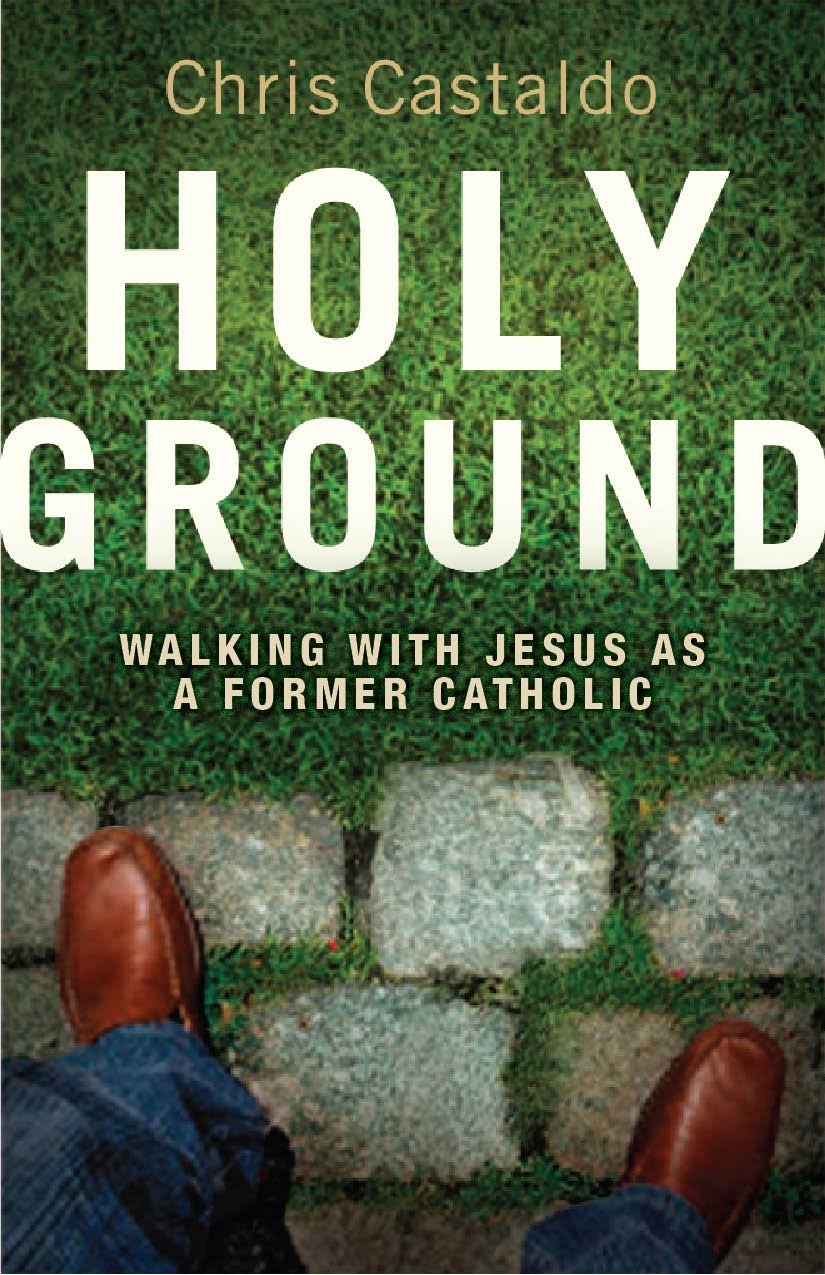
As I mentioned previously, I am participating in a blog tour for the book, Holy Ground: Walking with Jesus as a Former Catholic, written by Chris Castaldo, one of the pastors at College Church in Wheaton, IL.Chris is well prepared to write such a book since he grew up Catholic but is now an evangelical.(Some of the questions I asked Chris were similar to the questions of others so there is some overlap with some other stops on the blog tour).

Here are four questions with Chris’ answers:

1.) Why did you write Holy Ground?

My former pastor and colleague, Kent Hughes, deserves credit for planting the idea to write Holy Ground. During my second year of ministry at College Church, I counseled several couples – one member a Catholic and the other a Protestant – helping them see that, despite doctrinal differences, their marriages could remain intact. With these folks in mind I eventually offered a Wednesday night class on the topic entitled “Perspective on Catholicism,” intended to bring a more biblically informed balance. With John 1:14 as our model, the class sought to emphasize the need to follow after Jesus’ example of “grace and truth.” The material eventually became a manuscript and, thanks to Zondervan, Holy Ground was born.

2.) What are the distinct features of Holy Ground that separate it from other such books?

Among evangelical books that address Catholicism, Holy Ground has a couple of features that make it unique. First, many such books convey an unkind attitude. The doctrinal emphasis of these works is commendable, but the irritable tone rings hollow and fails to exhibit the loving character of Jesus. It’s the tone that my seminary professor warned against when he said, “Don’t preach and write as though you have just swallowed embalming fluid. As Christ imparts redemptive life, so should his followers.” This life is communicated in the content of God’s message and also in its manner of presentation. Therefore, I seek to express genuine courtesy toward Catholics, even in disagreement.

Second, most books on Roman Catholicism and Evangelicalism emphasize doctrinal tenets without exploring the practical dimensions of personal faith. Important as it is to understand doctrine, the reality is there’s often a vast difference between the content of catechisms and the beliefs of folks who fill our pews. Holy Ground is concerned with understanding the common ideas and experiences of real-life people.

3.) What do you miss most from the Roman Catholic tradition?

Great question! No one has asked me this yet. Of all the elements of which Catholic tradition consists, I’d say the one I miss most is the reverent ethos of the Mass. Even here at College Church where we work hard to emphasize transcendent realities, it’s rare that we focus on the cross with quite the same intensity that I remember from my boyhood parish. Granted, there are aspects of the Mass that are doctrinally and existentially troubling, seriously so; but the atmosphere of solemnity, organically woven into the overall worship service (and not simply tacked on to an otherwise regular sermon), unafraid of protracted moments of quietness, perhaps kneeling, concentrating on the crucified Savior with all our God-given senses, is something I’d like to see us more carefully incorporate into our services.

4.) What can a Roman Catholic learn from an evangelical?

I don’t mean to sound cheeky, but I think most of all we can help Catholics to understand the Gospel – the message of divine grace in Jesus’ death and resurrection accessed through faith apart from one’s meritorious behavior. This may sound terribly condescending and perhaps even anti-Catholic, but, to a large extent, it is the reality of the situation. Catholic philosopher Peter Kreeft describes the problem:

“There are still many who do not know the data, the gospel. Most of my Catholic students at Boston College have never heard it. They do not even know how to get to heaven. When I ask them what they would say to God if they died tonight and God asked them why he should take them into heaven, nine out of ten do not even mention Jesus Christ. Most of them say they have been good or kind or sincere or did their best. So I seriously doubt God will undo the Reformation until he sees to it that Luther’s reminder of Paul’s gospel has been heard throughout the church” (Peter Kreeft. “Ecumenical Jihad.” Reclaiming The Great Tradition. Ed. James S. Cutsinger. [Downers Grove: InterVarsity, 1997]. 27).

This is the concern of Holy Ground – that the grace of God in salvation remains central. When talking with Catholics, there are myriads of potential rabbit trails. We may enter into a conversation to talk about how Jesus provides life with meaning and suddenly find ourselves enmeshed in a debate about the apocrypha or Humanae Vitae. Sometimes it’s right to broach these subjects, but too often we do so at the expense of the gospel. This is tragic. What does it profit a person if he explicates a host of theological conundrums without focusing attention upon the death and resurrection of Jesus? In all of our discussion with Catholics we must consider, celebrate, and bear witness to the splendor and majesty of our Savior, the one who died, rose, and now lives.

The Church’s Esteem of the Psalter

I continue to enjoy greatly Rowland Prothero’s book, The Psalms In Human Life, where he the use of the psalms through the history of the church.

Here are a couple of quotes:

“From the treasure-house of the Psalter, whether in the ancient Latin version, or in vernacular prose, or in rough rhyme wedded to simple music, Roman Catholics and Protestants alike drew inspiration.The Psalms clave to the memories, and rooted themselves in the hearts of the people.” (p. 114)

Quoting Casaubon, a Huguenot scholar:

“This is the peculiarity of the Psalter, that everyone can use its words as if they were completely and individually his own.” (p. 142)

Praise Reorienting Life

“Make a joyful noise to the Lord, all the earth!
Serve the Lord with gladness!
Come into his presence with singing!” ( Psalm 100:1-2)

“This doxology needs to be understood not only as a literary assertion of trustful simplicity (which it is) but also as an action which reorients life. When the community praises, it submits and reorders life. It is not only a moment of worship, but also an embrace of a doxological life which is organized differently. So the summons is a summons to reorient life.”

– Walter Brueggemann, “Psalm 100″, Interpretation (Jan 1985): 65.

Hugging as Spiritual Warfare

Last week our denominational state paper ran an artilce of mine by this title. Here is the article:

I am a hugger and come from a line of established huggers. My dad was open with his affection to me and the rest of my family. He was practically an official “hugger” at our church, and I can remember him kidding about that often. I also remember well working with another man in the church on our “Fix-It Squad,” doing household chores for our widows and shut-ins. He was clearly a “man’s man” and was open with his affection and forthright on the value of hugging.

So, with that background it is no surprise that hugging my own children is so common to me that I almost do not notice it. I really never paused to reflect on why I hugged them. When I think of it I realize that primarily I hug them so often because I enjoy it so. I love my children and rejoice to demonstrate that. To give and receive these tangible expressions is for me a natural habit and a great joy.

Over the last year or so, however, I have reflected more on the value of this expression of affection to my children. This was prompted by pastoral work with people who are emotionally damaged. While talking with a dear brother who was struggling deeply with homosexuality, I was struck by his comment that he had never heard his father tell him that he loved him. Another man in the same situation related how he never remembered receiving affection from his father and had practically no positive memories of times with his father. People in other situations, wrestling with different problems, when baring their souls have often referred to the lack of affection in their families.

These negative experiences do not, of course, excuse sinful behavior. But these testimonies have reminded me of the value and importance of the hugs I give my children. One evening, in the midst of a time when I was walking with a church member through some dark days of struggle with homosexuality, I was holding my infant son, hugging him and preparing to lay him down to sleep. In that moment as I prayed for him, I realized afresh, that by hugging him I was investing in his soul. I was preparing him to face the onslaught of the enemy in days ahead. Spiritual warfare is often used to refer to glamorous or even odd things. But, in the truest since, I was at that moment waging war for my boy’s soul by investing in one more incident which is building up a general sense of belonging and strong, pure affection from his father. He will not remember that hug, but all these hugs will shape the general context of his early memories. I was, in however a small way, helping him to have a paradigm for a Father who loves him and also corrects him. In that moment I was making my corrective discipline more effective by reinforcing that it comes from a context of love.

This thought has encouraged and challenged me. It has sent me forth in greater diligence in loving my family. So, fathers, let us take up our “arms”, wrap them around our children and wage war for their souls by embracing them.

Walking With Jesus as a Former Catholic

I am participating in a blog tour by Chris Castaldo author of the new book, Holy Ground: Walking With Jesus as a Former Catholic. At Chris’ site you can see the participants and dates for the tour.

Two things drew me to this book right away. First, the fact that Chris serves on staff at College Church, Wheaton, spoke volumes. Second, I noticed that D. A. Carson had this to say about the book:

“This is the best book I have read that chronicles such pilgrimages. And it is full of godly commonsense.”

Significant praise from a significant source!

My official part of the tour is later this month but I wanted to go ahead and ask Chris how this book would be helpful particularly to pastors. Here is Chris’ answer:

Here it is in a nutshell: estimates say there are 14 million former Catholics in the United States who now identify as “evangelical” or “born again.” These are people who struggle to understand how their Catholic background still exerts influence upon them and who need to confront patterns of faith that are less than biblical, while simultaneously applying more of the gospel. At the same time, they wrestle with the challenge of effectively communicating the hope of Christ to Catholic family and friends. Most of us pastors have at least some of these folk in our churches. Holy Ground is written to help church leaders offer these individuals the contextualized form of discipleship they so desperately need.

The biggest surprise for me since Holy Ground‘s release has been the book’s appeal among evangelical Protestants with no Catholic background. They have Catholic neighbors, coworkers, and friends whom they want to understand and relate to more effectively. They have questions like: Are all Catholics the same? Where do the doctrinal lines of continuity and difference fall? How can I initiate gospel conversations? The depth of interest in these issues reveals a much broader audience than I anticipated.

Through an extended narrative describing my personal journey as a devout Catholic who worked with bishops and priests before eventually becoming an Evangelical pastor, Holy Ground tries to help readers to understand:

Priorities which drive Catholic faith and practice
Where lines of continuity and discontinuity fall between Catholicism and Evangelicalism
Delicate dynamics that make up our relationships
Principles for lovingly sharing the gospel of salvation by faith alone
Historical overview from the Reformation to the present

Because Holy Ground is a pastoral work, there are several aspects pertinent to church ministry, but let me mention one I constantly deal with in my role of equipping our people for evangelism.

When we communicate the gospel to Catholics we often make the mistake of thinking that our conversations should directly address doctrinal issues. This is not only incorrect, it is impossible. When speaking to a friend about faith, we don’t speak directly to his religious beliefs; we speak to a person who holds religious beliefs. This is a crucial, overlooked distinction. John Stackhouse in his book Humble Apologetics puts his finger on it:

To put it starkly, if “message without life” was sufficient, Christ didn’t need to perform signs, nor did he need to form personal relationships in which to teach the gospel to those who would believe him and spread the word. He could simply have hired scribes to write down his message and distribute it (John G. Stackhouse, Jr., Humble Apologetics: Defending the Faith Today. [Oxford: Oxford University Press, 2002], 134).

This is what sometimes frustrates me about books written to equip Evangelicals to discuss Jesus with Catholics. They seem to operate according to the assumption that if you can simply pile up enough proofs, Catholics will have no choice but to surrender under the weight of your argument. Sure, we must have reliable evidence and must know how to marshal it effectively; but, we can’t ignore the personal, cultural, historical, and religious dynamics which are also part of these conversations. Like, for example: What are the different types of Catholics in America today? How do Catholics generally view Protestants? What are the prevailing caricatures? What landmines do we routinely step on? What language is helpful and what terms undermine fruitful discussion? How can we navigate through controversies related to one’s ethnic background or the history of anti-Catholicism in America? Where is common ground and where must we necessarily draw lines of distinction? And the list goes on. Holy Ground addresses these and other such questions in order to help ourselves and the people we serve more effectively proclaim Christ’s glory among our Catholic friends and loved ones.

Paul and Pastoral Love

Yesterday Lee Tankersley preached a great message on Galatians 4:12-20 and how the gospel develops a deep love between members of the church. Before the sermon ever began, I was gripped simply by the reading of this text, and the heart for the Galatians which Paul exhibits. It is so important in this, perhaps the harshest of Paul’s letters, to see this pastoral love expressed.

There is a place for speaking the hard word. Rebuke is necessary and a true example of love. However, if you think rebuke and “calling out” are cool, you are missing the heart of God- and are currently in danger of harming the church. In fact this is a sign of immaturity. Mature leadership speaks the hard word, when necessary, from a heart broken for the people and yearning for their growth and obedience.

This text is worth meditating on often:

12 Brothers, I entreat you, become as I am, for I also have become as you are. You did me no wrong. 13 You know it was because of a bodily ailment that I preached the gospel to you at first, 14 and though my condition was a trial to you, you did not scorn or despise me, but received me as an angel of God, as Christ Jesus. 15 What then has become of the blessing you felt? For I testify to you that, if possible, you would have gouged out your eyes and given them to me. 16 Have I then become your enemy by telling you the truth? 17 They make much of you, but for no good purpose. They want to shut you out, that you may make much of them. 18 It is always good to be made much of for a good purpose, and not only when I am present with you, 19 my little children, for whom I am again in the anguish of childbirth until Christ is formed in you! 20 I wish I could be present with you now and change my tone, for I am perplexed about you.

Let us go and do likewise.

For God’s Sake Deal with Sin

Today in chapel at Union we had a great message from Jonathan Newman, a great friend whom I have been privileged to know since our student days here at Union.Jonathan planted and pastors Koinos Christian Fellowship in Troy, OH.

Jonathan challenged us with the necessity of dealing with conflict in the church lest we suggest by our actions to the watching world that God really does not matter.This is a wonderfully practical message tied to glorious truths.If we ignore the situations where we have offended others or where we have been offended we compromise the gospel and undercut its influence in and through us.I encourage you to listen in.