
Summer Reading, History

In a previous post I commended the Greek New Testament as part of one’s summer reading. Here I want to commend the reading of history. Reading history has so many benefits for people in general and for pastors in particular. It is useful to broaden our horizons and our awareness of the story of humanity. It is also helpful to understand what has gone on before us and around us as we seek to understand and interpret our own existence. In order to remain brief, I will illustrate from two books in my recent reading.

John S. D. Eisenhower’s General Ike: A Personal Reminiscence was a fun book to me. The author is the son of the famous general and U.S. President and provides some glimpses of his father’s life from a son’s perspective. Let me highlight just two illustrations which arose in my mind from this book. First, it was interesting to hear of how a young Ike was mentored by Gen. Fox Conner in Panama after WWI. These were uneventful years compared to what was to come. However, Ike himself would later say these were his formative years as an older officer took the time to invest in him, encourage him in reading the classics, and to deepen his mind. Today few of us know about Gen. Conner, but he shaped the key figure in the European theatre of WWII and an American President. Regardless of what you think of Eisenhower, Conner had a significant impact on history by investing in a younger man. Isn’t this the point of discipleship? I was encouraged to invest in the young men around men (not least my own sons).Second, it was fascinating to learn how devastated Ike was when the plans to invade Europe in 1942 were scuttled. We know D-Day eventually occurred in June 1944, but Ike and Gen. George Marshall worked hard on plans for an invasion in 1942 and lobbied strenuously for this plan. When it was scuttled, Ike wrote that this was the darkest day of his life. His son, looking back, noticed how this decision actually catapulted his father’s career. Ike would not have been the Allied (or even US) commander in the 1942 invasion. However, by the time 1944 rolled around President Roosevelt felt he could not spare Gen. Marshall in Washington so Ike was given the lead command. So, what he thought was his darkest day was actually a blessing, setting in motion opportunities he had not dreamed of. He had said at one point he would be stuck at desk jobs with no advancement.

Now again, whatever you think of Eisenhower, the illustration is clear. The book did not seek to make this point, but God has told us how life works- whether other people recognize it or not! Often times what we interpret as a setback God will use as a blessing.

Lastly, I have only begun reading Barry Strauss’ new book, The Spartacus War, but the opening is an example of brilliant writing. After reading the first page of the “Introduction” I sat the book down and said to myself, “That’s good writing!” Click here and you can read that first page. Reading good writing is not only enjoyable but it also helps teach you to communicate well. As preachers we need to read good writing to enhance our own ability to communicate this great truth as clearly and faithfully as possible.

These are just a couple of examples from my own experience of benefiting from reading history. I hope you will benefit as well.

Self-reliant, High-Pressure Evangelism Illustrated

If you have read Mark Dever’s good little book on evangelism, then you have seen an excerpt from C. S. Lovett’s Evangelism Made Easy used to illustrate the overly pragmatic approach to evangelism which relies on psychological pressure and aims simply at “decisions.” Now Tim Challies has more quotes along with the illustrations from Lovett’s book. You can’t spoof stuff like this! Check this out and be reminded why our thoughts of evangelism have been skewed so.

May this urge us on in proper evangelism, where we “renounce disgraceful and underhanded ways, … refuse to practice cunning or to tamper with God’s word, but by open statement of the truth we would commend ourselves to everyone’s conscience in the sight of God” (2 Cor 4:2-3).

BibleArc.com

As part of my class on Paul’s letters one of the daily assignments always is to trace the argument of a paragraph in Paul’s letters.Tom Schreiner has a helpful discussion of this in his little book Interpreting the Pauline Epistles, and some readers may have heard John Piper talk about “arcing.”

I have just recently learned about a new website devoted to helping people learn this method of “arcing,” which is essentially diagramming at a paragraph level.It is a graphic portrayal of the logical connections between the different assertions in a text.This is a very helpful tool in paying close attention to the text and seeking to understand the authors intended flow of thought.

This site, BibleArc.com, provides video tutorials on this method.If you have some familiarity with the approach I would recommend you go straight to the examples page where you can see someone walk through a text applying the method.Here you can also see how the software at the site works.I was really impressed.

This is a very helpful tool, which will take time but will render rich rewards.

Lastly, here is John Piper discussing why this approach is valuable:

Summer Reading, Greek

Greek students often ask what they can do over the summer to maintain the Greek they have learned and to really begin to use it. Pastors who have been out of school for a while often ask about tools to help revive their Greek skills. For both groups, and anyone interested in reading the Greek New Testament, I heartily recommend The UBS Greek New Testament: A Reader’s Edition.

This edition makes reading the Greek New Testament very accessible. I heartily commend it. It is a good way to make Greek a part of your summer reading.

Theology in Verse

My friend Justin Wainscott has started a blog called, Theology in Verse and I encourage you to check it out.He has posted on a number of topics, quite often posting poems and hymns several of them his own.He recently posted his hymn, Jesus Christ our Priestly Savior, which he wrote after hearing D. A. Carson, at the Ryan Center Conference, comment on the lack of good hymns about the priestly work of Christ.I also like his “How Slow and Dull of Heart We Are.”

Good stuff!

Missions with Children

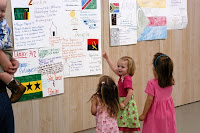
This past Sunday night the children at our church shared with the rest of the congregation what they have been learning on Sunday nights over the last year. On Sunday nights the adults have a prayer meeting. The children then also pray, work on scripture memory and are systematically working through the countries of the world, learning where they are, what life is like there (particularly access to the gospel) and how they can pray for each nation. Over this past year they covered Africa and learned all the countries of Africa using some catchy songs arranged by region. The children sang these songs and college students who worked with the children read of key prayer requests for each region. They also sang a portion of Psalm 119 which they had learned. We concluded by praying for some of those requests.

It was a moving evening hearing all they had learned and being reminded of the needs in other places. To me the most moving part was hearing the children sing, “How Sweet and Awful.” My wife, who organizes our children’s ministry, taught them this powerful hymn and it summarizes well the missions emphasis. One of the parents caught a portion of the singing on video (I could not figure out how to embed it here).

Here are the words of the hymn:
How sweet and awful is the place
With Christ within the doors,
While everlasting love displays
The choicest of her stores.

While all our hearts and all our songs
Join to admire the feast,
Each of us cry, with thankful tongues,
“Lord, why was I a guest?”
“Why was I made to hear Thy voice,
And enter while there’s room,
When thousands make a wretched choice,
And rather starve than come?”
‘Twas the same love that spread the feast
That sweetly drew us in;
Else we had still refused to taste,
And perished in our sin.
Pity the nations, O our God,
Constrain the earth to come;
Send Thy victorious Word abroad,
And bring the strangers home.
We long to see Thy churches full,
That all the chosen race
May, with one voice and heart and soul,
Sing Thy redeeming grace
– Isaac Watts
(Note: All these photos and the videos were taken by Sarah Ellsworth)

Humility & Hope in Psalm 49

As part of the Psalms Project We recently had the privilege of hosting Michael Morgan as he displayed a small portion of his incredible, personal collection of old and rare Bibles and psalters.

One of the rare psalters was:
William Tattersall’s collection, A Metrical Paraphrase of the Psalms, Originally Written by the Rev. James Merrick, Divided into Stanzas and Adapted to the Purposes of Public and Private Devotion (London: Thomas Paine, 1789).

Apparently this one never made it into common use and is recognized as not being very good for singing. I don’t know anything about that conclusion, but I was gripped by the rendering of Psalm 49, particularly these two verses:

10. Yet Man, with erring pride elate,
And high in pow’r, in honour great,
Shares with the Brute an equal doom,
And sleeps forgotten in the tomb.

15. My Soul, amidst your happy train,
The wish’d redemption shall obtain,
By God adopted, Death shall brave,
And mock the disappointed Grave.

I need to be reminded of my smallness and mortality so as to be delivered from pride and to be reminded of the hope of the gospel so as to be delivered from despair. This Psalm accomplishes these purposes well.

‘Twas the Night Before Summer

‘Twas the Night Before Summer
By Anne Margaret Lewis
Illustrated by Wendy Popko
(Mackinac Island Press)

My mother pointed this book out to me, sending me a web link where the full book could be viewed online. The story is not a deep or theological one, but is a fun tribute to summer and imagination. It is obviously framed in the line of “‘Twas the Night Before Christmas” and is a poem. It is nicely written and illustrated.

I think my main point in mentioning it here, though, is the web delivery system. By clicking on the page you can turn the page and keep reading. It is well done.

Grant’s Psalms Booklet

When James Grant spoke on introducing your church to Psalm singing last week he handed out a very helpful little booklet. He has now posted the booklet. In this post he links to the booklet and lists some other resources.

This booklet is great. It gives a basic overview of meter and lists some commonly known hymn tunes in some of the most common meters. With such a list in hand you can pick up a standard psalter and begin singing Psalms.

Second Coming of Christ Conference

I was privileged last week to speak along with my dean, Greg Thornbury, at the Second Coming of Christ Conference at FBC Goodletsville (TN), sponsored by Union University, the Tennessee Baptist Convention and several local Baptist Associations. The people in attendance were wonderful and we had a good time studying the scripture. The messages (with links to audio) were:
Session 1 – Greg Thornbury – 666, The Apostle John, Emperor Domitian & What ‘Left Behind’ Didn’t Teach You
Session 2 – Ray Van Neste – How the New Testament Applies the Truth of Christ’s Return
Session 3 – Ray Van Neste – Pastoring and Serving in Light of Christ’s Return (2 Cor 4-5)

Greg’s address focused on the historical setting of Revelation making the point that this book is not about abstract speculation but is the ultimate tract of political resistance. It is a clarion call to remain faithful to the one Lord, Christ, in the face of persecution by would-be gods.

In my first address I sought to survey key NT references to Christ’s return demonstrating the the NT does not encourage us to speculation. Rather, when the NT refers to Christ’s return it uses this doctrine to urge us to holiness and to the task of taking the gospel to the nations.

In my second address I examined 2 Cor 4-5 noting how the truths of Christ’s return and the resurrection empowered the Apostle Paul to endure in difficult, unpopular ministry. These are not idle, abstract ideas but bedrock truths to help us look beyond what is seen, to live in light of eternity, and to endure joyfully.