Introducing A Church to Psalm Singing

Last week James Grant, pastor of FBC Rossville, TN, spoke at Union as part of our Psalms Project. James’ title was “How I Introduced Psalm Singing to My Church…Without Getting Fired!”(link will take you to the audio). James knows more about Psalm singing than any other Baptist pastor I know and he did an excellent job. He has commented on this topic at his blog previously. He discussed how Psalm singing was a basic element of Christian worship from the beginning of the church until just about 150 years ago and then demonstrated how easy it is to begin singing metrical psalms to familiar hymn tunes.

Few of the people in attendance had sung psalms before but they easily caught on. We even sang Chad Davis’ version of Psalm 29 which no one had sung in a group before and went very well.

I encourage you to listen to James’ presentation and consider how your church might incorporate the songs which God gave us in His word.

Living in Light of Christ’s Return

Tomorrow I will be in Middle TN along with Greg Thornbury for a pastors conference focused on Christ’s return. Our focus will not be on millennial theories, date setting, etc. but on how the New Testament urges us to live in light of this truth.

It is being sponsored by area associations, the Tennessee Baptist Convention and Union University. It will be held at FBC Goodlettsville (615-447-0401 OR EMAIL: srussell@uu.edu). You can contact today to register or just come on for the sessions.

The schedule is as follows:
9:00am- Greg Thornbury, “666”
10:15am- Ray Van Neste, “How Does the New Testament Apply the Truth of Christ’s Return”
11:30am- Lunch (if pre-registered)
1:00pm- Ray Van Neste, “Pastoring and Serving in Light of Christ’s Return”

Hansen, The Art of Pastoring

Today while reading in Scott Hafemann’s excellent commentary on 2 Corinthians I came across this summary of key points from David Hansen’s The Art of Pastoring: Ministry Without All the Answers. Hafemann cites this on p. 201 of his commentary. These are good points about pastoral ministry flowing right out of 2 Corinthians 1-4.

1. Reading biblical studies, theology, and church history is more “practical” and helpful in the ministry than the mountain of “how-to” books on the market, since our primary need is for a greater sense of who we are and why we act, not more skills…
2. Ministry is a way of life, not a technology…
3. Those called to minister serve the church, but they do not work for the church. Instead, Jesus is their boss…
4. Ministry is not to be employer-driven, trend-driven, or task-driven, but is a following of Jesus Christ as the one who calls his pastors, so that the act of following Jesus is the act of pastoral ministry…
5. The Jesus whom we follow has a “general narrative direction” in his life, namely, the way of the cross…

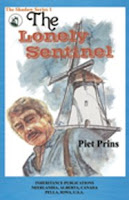
The Lonely Sentinel

The Lonely Sentinel, by Piet Prins
The Shadow Series, volume 1
(Inheritance Publications, 2006), pb., 140 pp.
Ages 6+

Since we had previously enjoyed the Struggle for Freedom series by Prins, I eagerly anticipated this book as well. This book is set in the Netherlands during World War II following the efforts of the Dutch resistance. The main characters are the Mulders family, particularly Frans (a sixth grader) and Dirk (a fourth grader). Their father runs a mill with the help of their older brother Dries. The family stumbles into the work of the Dutch resistance and begins helping Jews and others escape the Nazis. Eventually Dries also engages in a raid with other members of the resistance.

The action and suspense is seen primarily from the perspective of the young boys, which makes it all the more appealing to my young boys! It also helps the reader to enter into the risk of helping people in need during this time. It is easy to sense that it would be right to help. It is more helpful to also feel how challenging this must have been knowing you were risking not only your own life, but those of your family as well.

This book shares the same strengths as the other books from Prins which we have read. The Christian faith of the characters is real and integral to their lives (not some occasional “add on”). Also there is good adventure and suspense. It also shares some of the weaknesses of the other books. It is clearly a translation and at places the wording is awkward. At other times the wording is unclear. For example the people fleeing the Nazis are repeatedly referred to as “divers” but I have no idea why.

In the end this is a good book to read while studying World War II. It is good to hear about the event from a perspective outside the US; there is good adventure; and Christian faith features well.

Raising Bible Saturated Kids!

David and Sally Michael, from Children Desiring God, recently led three breakout sessions on leading children in Bible Study as part of the “Word Within the Word” conference at Union University.

Too often the importance of teaching our children well is missed by both families and churches. The Michael’s passion is to change this. These are well worth listening to for pastors, children’s teachers, parents, grand-parents, and anyone concerned with children.

Session 1- God-Centered Bible Teaching for the Glory of God
Session 2- Raising Bible-Saturated Children
Session 3- Aiming for Application and Response in Teaching Children the Bible

Teaching the Bible to Children

As part of our “Word Within the Word” conference a week ago, David and Sally Michael from Children Desiring God, led three breakout sessions on leading children in Bible Study. The Michaels were gracious enough to come even though their national conference was just this weekend. Their breakout sessions were packed and they did an excellent job.

Too often the importance of teaching our children well is missed by both families and churches. The Michael’s passion is to change this. These are well worth listening to for pastors, children’s teachers, parents, grand-parents, and anyone concerned with children.

Session 1- God-Centered Bible Teaching for the Glory of God
Session 2- Raising Bible-Saturated Children
Session 3- Aiming for Application and Response in Teaching Children the Bible

Psalm 29 Versification

This past week my friend and co-pastor, Chad Davis sent me his versification of Psalm 29. Having heard Don Whitney teach about using the “Psalm of the day,” Chad was reading, meditating on and praying from Psalm 29 on April 29th. As he did so, Chad employed his poetic gifts to versify this psalm in a 87.87.D meter. Chad had the tune for “Come Thou Fount” in mind but any tune in this meter will fit (e.g. “Joyful, Joyful We Adore Thee,” “Glorious Things of Thee are Spoken,” “Savior, Like a Shepherd Lead Us”). This is part of the beauty of metrical arrangements.

Here is Chad’s versification. I think it is very well done- faithful to the text and easily singable.

Praise the Lord, O heavenly beings
Praise His glory and His might (v. 1)
Worship all His holy splendor
Give to Him what’s His by right. (v. 2)

For His voice o’er waters thunders,
Over many waters roars (v. 3)
Full of majesty and power
Is the voice of our great Lord. (v. 4)

That great voice has such deep power
Mighty cedars it can break (v. 5)
Like a calf or wild oxen
It can make this whole world shake. (v. 6)

This voice makes the wild to tremble (v. 8)
From it flash forth fire and flame (v. 7)
This Lord brings both life and judgment
In His house all praise His name (v. 9)

O’er the flood our God is reigning
And His reign will never cease (v. 10)
May He give strength to His people
May He bless us with His peace (v. 11).

Reformation Heroes

Reformation Heroes, by Diana Kleyn with Joel Beeke
(Reformation Heritage Books, 2007), hb., 240 pp.
Ages 6+

I have been meaning to comment on this book for some time. It is an amazing resource- the most thorough book for children on this topic that I know of. It is based on a 19th century book, The Reformation and Its Heroes, by Richard Newton. I have commented on a number of books on characters from the Reformation here because the Reformation is one key area of history with which I want my children to be well acquainted. If you feel the same, this book is a must have.

It is not difficult to find books on Luther or Calvin, or even Wycliffe, but the comprehensiveness of this book is amazing. It covers precursors to the Reformation, English, German, French, and Dutch Reformers Anabaptists and the Catholic response. Here is a list of the people and events discussed in the book:

Peter Waldo
John Wycliffe
Anne of Bohemia
John Huss
Martin Luther
Philip Melanchthon
The Protest at Speyer
Martin Bucer
Ulrich Zwingli
Heinrich Bullinger
William Tyndale
Edward VI
Thomas Cranmer
Hugh Latimer
Nicholas Ridley
John Foxe
John Knox
Guido de Bres
The Heidelberg Catechism
Caspar Olevianus
Zacharias Ursinus
Frederick III
Peter Martyr Vermigli
John Calvin
Theodore Beza
Jan Laski
The Duke of Alva
William, Prince of Orange
Petrus Dathenus
Quenn Marguerite of Navarre
Queen Jeanne d’Albret of Navarre
Admiral Coligny & the tragedy of St. Bartholomew’s Day
Charlotte, the Nun of Jouarre
William Perkins
William Ames
William Teelnick
Konrad Grebel
Felix Manz
Ludwig Ha’tzer
Gerog Blaurock
Thomas Muntzer
Jan Mattjis
Jan Beukelssen
Melchior Hoffman
Jakob Hutter
Balthasar Hubmaier
Menno Simons
The Counter Reformation

I consider myself fairly well informed on the Reformation, but there are names on this list that I did now know before this book! The stories are well told and nicely illustrated. I heartily recommend this book.

Carson on Use of OT in Hebrews

Our Ryan Center Conference this last weekend, “Word Within the Word,” went very well. It was a delight to see old friends and former students as about 230 registrants along with many students packed into the Grant Center.

Dr. D. A. Carson’s plenary addresses were excellent, and I commend them to you as examples for understanding how the NT uses the Old Testament. This is an important and sometimes difficult issue. As Dr. Carson stated in the first session:

“If you’ve never been troubled by the way the New Testament quotes the Old, you’ve never read the New Testament and looked up the texts it actually quotes.”

He dealt with three texts in Hebrews where OT texts are quoted. Links will take you to the audio of each lecture.
Plenary 1– Psalm 2:7 and 2 Samuel 7:14 in Hebrews 1
Plenary 2-Psalm 95 in Heb 3-4
Plenary 3– Gen 14 and Psalm 110 in Heb 7

In these lectures Carson not only demonstrates the way to understand the use of the Old Testament but also makes valuable observations on theology and pastoral application. Listening to these lectures will be a valuable investment of time.