The most recent Kairos Journal updated included an article by this title. You can view it here. This is a well done succinct piece on the decline of discipline in the church.
KJ is a great resource for pastors. For registration (free) go here.
The most recent Kairos Journal updated included an article by this title. You can view it here. This is a well done succinct piece on the decline of discipline in the church.
KJ is a great resource for pastors. For registration (free) go here.
Too often when people join these two words they mean something speculative, preaching about things we don’t really know. That is not what I am talking about. I have in mind preaching in such a way that you draw your hearers into the biblical world so that they see, feel, experience it anew so that the text impacts them powerfully. I found this well expressed in a collection of sermons by James S. Stewart entitled Walking With God (Edinburgh: St. Andrew Press, 1996; recently republished by Regent College). The memoir of Stewart contained at the beginning of the book quotes John McIntyre describing Stewart’s preaching. This is a good description of what we ought to aim for in preaching.
“At a conference in the Pollock Halls, attended by members of the Presbytery of San Francisco, he gave an address of Jesus’ use of imagination in his life and teaching as we encounter them in the Gospels. Here for me was the clue to his own preaching and teaching that I had missed all these years. For I have known expository preaching which was dull in excess, being little more than flat commentary; as I have known pastorally-oriented preaching which did not rise above counseling. But, by the use of imagination, Dr. Stewart gave exposition and pastoral perception new power and relevance. As he described so graphically the situation of the biblical passage, he gradually incorporated his hearers in the situation. They so became part of it that they identified with the persons of whom, or to whom, Jesus was speaking. The nearest analogy I know is the ability of a great artist to draw the viewer into the action he is portraying.
But there was more. It was not merely an exercise in empathy. Embodied in the situation, the hearers could not escape the urgency of the words of Jesus directed to them. The Gospel appeal, or challenge, or invitation, was not a codicil [i.e., supplement] to the descriptive passages going before. Each one of them was an integral – an inescapable – part of the whole presentation, directed at each listener.” (7)
Several weeks ago on a shopping trip to Wal-Mart, my boys and I were able to do one of our favorite things on such trips- slip away to the book aisles! On this occasion I had the opportunity to thumb through Walter Isaacson’s new biography of Einstein. I was particularly intrigued to find a chapter titled, “Einstein’s God.” I later checked out the book from a library and read with much interest this chapter. Einstein was of course a Jew and never professed faith in Christ. However, he was convinced that the orderliness of the universe demonstrated the design of a deity. Isaacson wrote of the impact on Einstein of this belief in God:
“For Einstein, as for most people, a belief in something larger than himself became a defining sentiment. It produced in him an admixture of confidence and humility that was leavened by a sweet simplicity. Given his proclivity toward being self-centered, these were welcome graces. Along with his humor and self-awareness, they helped him to avoid the pretense and pomposity that could have afflicted the most famous mind in the world.” 385
If the belief in a fairly impersonal, deistic concept of God had such a humbling effect on an incredibly gifted, non-Christian scientist, why doesn’t knowledge of the redeeming work of Christ produce more humility in less brilliant, Christian pastors like us? Far too often pastors are marked by more knowledge of God but less evidence of His grace than is suggested in this quote. Far too often “pretense and pomposity” are words associated with Christian leaders. Let us ponder the greatness of God that we might see his glory and our smallness, and find joy in both.
“no church is anything more than a pathetic pietistic backwater unless it is first and fundamentally and all the time a world missionary church.”
Denny Burk (Criswell College) and I have been working on a proposal to amend the constitution of the Evangelical Theological Society (ETS). Recently I commented on my proposal from 2001 for a more “evangelical” doctrinal statement. Denny has taken this suggestion and has done the lion share of the work in putting together a formal proposal we plan to submit at the annual meeting in November. We have launched a website (www.amendets.com) with the proposal, our rationale, FAQ’s and a blog where we will continue the conversation. We want to further the conversation, invite response and hopefully gather support for the amendment.
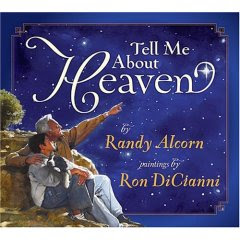
This is a great book about heaven. It is well written, nicely illustrated and theologically sound. Alcorn really does a good job in demonstrating the “tangibleness” of heaven. Too often people think of heaven as something ethereal, with clouds and disembodied spirits. This is not what the Bible teaches us. We await new bodies on a new earth. Alcorn does a great job of showing this corporeal, physical element of heaven. This of course leads to speculative questions (like “Will there be animals?”, “What about my pets?, etc.). Some may be dismissive about such questions, but these are the questions that come up. If you are going to write for children you ought to address questions they ask, so this is well done. Alcorn is clear about areas where the Bible does not give a specific answer and then is willing to venture his best guess.
The way the story is told is well done also. A young boy, Jake, is making his regular 2 week summer visit to his grandparents in Oregon. However, this year he is a bit apprehensive since his grandmother had died in the last year and he does not know what it will be like. However, his grandfather is a godly man who knows his Bible well, and they have numerous conversations over the two weeks as they enjoy the wonderful scenes of Oregon, eat together and gaze at the stars. So the discussions about heaven are not abstract but arise naturally within the believable relationship between a grandfather and grandson. This led to good discussions wit my boys. Along the way the point is clearly made that only those who repent and believe go to heaven. Thus, this is a good evangelistic tool as well.
Lastly, there is another side benefit to this book. It provides a nice picture of a grandfather who is intentional about being involved in his grandson’s life enjoying life with him and teaching him about God along the way. Such examples are always a good challenge to me as I seek to be intentional in parenting.
This is a great book and we warmly recommend it.
One of the important things we must do in pastoral ministry is to encourage gospel-driven parenting. Churches know that families around us are in shambles, and people are looking for help. Sadly, though, people are too often looking for a magic silver bullet, “5 Steps to Change Everything.” What is needed, and what we must provide, is the demonstration of how the gospel speaks to and must shape all areas of life. But again, people too often think of the gospel simply as what you believe to be saved. This is the result of defective teaching over the years. The whole of our pastoral labors is showing ourselves and our people how the gospel is to shape everything we do. Much could be said here, but for now let me just mention two resources.
First, I have recently commented at my blog on Children’s literature on a book entitled Hints for Parents which embodies this gospel oriented approach. You can see the comments here and here.
Second, one summer at our church we took our Wednesday nights to watch the Shepherding Your Child’s Heart video series and to discuss it (the book is also excellent). All our adults are together on Wednesday nights in the summer so we showed it to the whole group. Some in that group have children, some have children who are grown and gone, some have never had children and quite a few were unmarried. However, we (pastors) made the point that if we were really to engage in one another’s lives we all needed to think through an issue like this whether we applied it as a parent, grandparent, nursery worker, future parent or an encourager to parents. The material is excellent, and I would highly recommend it. Our experience as a community was also excellent and I would commend this idea to you as well.
Here are just a few more quotes from the great little book Hints for Parents. From these you can see the theological awareness and pastoral earnestness of the book.
“To the religious character of our children, everything else ought to be made subservient. Our high privilege is to ‘bring up children in the nurture and admonition of the Lord.’ Whatever others may say or do, Christian parents should choose for their children that ‘good part which shall not be taken from them.’ To them, everything else should be like dust.” 27
“Now, you must recognize a mournful fact: Your child is depraved. You will fail utterly to educate him if you don’t recognize this sad reality.” 35
“What a man ought to know, he ought to begin to know very early. The great moral principles, which enlighten his adult conscience and character, ought to penetrate and work on his dark mind in childhood.” 35
“Depraved humans have sacrificed their children to false gods, burning them on the white hot hands of Moloch. Would you do ten thousand times worse by neglecting the heart of your child?” 57
“[quote from Tedd Tripp] Nothing will provide your children with an understanding of the power of the gospel like your love and dependence on God.” 57
This is a great little book for all parents. Spring was a 19th century Presbyterian pastor who was highly regarded. His comments to parents have been edited (language updated) and Tedd Tripp has inserted comments and encouragements along the way. Much can and needs to be said about parenting, but this little book distills much of the pure gold about the general goals and procedures of raising children to know and love God. A brief piece by Archibald Alexander on teaching children using catechisms is also appended. I would encourage all parents to get this book.
Here are a few quotes to catch the flavor of the book:
“Many a child has been lost to himself, to his family, to the world, and to God, because he had little else to do but indulge himself.” 15
“If a child cannot be temperate, there is little hope that he will be holy or respectable as an adult.” 17
“A child’s mind is the door to his heart, and our children must think, feel, and consider clearly, before they will repent, pray, and love.” 17
“[quote from Tedd Tripp] Do whatever you must to give yourself to relationships that make home and family attractive to your children.” 19
“This means that parents may need to deny themselves some creature comforts. Is this unthinkable in our current affluence? If by a few sacrifices you could purchase for your children the habit of loving their home, is any price too high? Those families are best educated, and exhibit the most moral feeling, which are most tenderly attached to home. Soon enough, our children will be extending their borders beyond it.” 19-20
I’ll post a few more quotes in another post.
Here are some things that I think are new since the last edition I saw (at least). First, Dever now divides his 9 marks into essential (expositional preaching, biblical theology, biblical understanding of the good news) and important marks. This is helpful. There are also to “Quick Tips” pages titled “If You’re thinking about leaving a Church” and “How to find a good church.” These are very helpful brief application points. I think there is even more in this edition about not seeking personal preferences but looking for biblical essentials.
This is a great tool and I am grateful for Dever and Crossway for making it available.