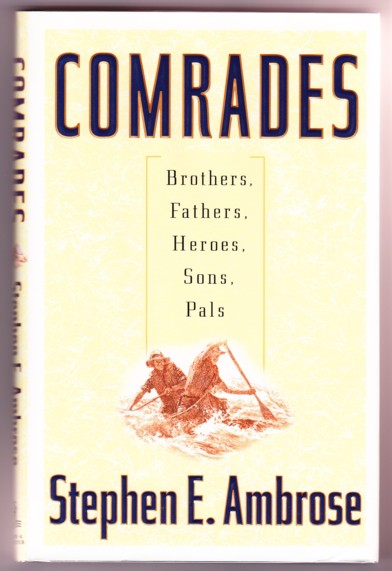
 I recently read Stephen Ambrose’s little book, Comrades Brothers, Fathers, Heroes, Sons, Pals, (Simon & Schuster, 1999) and thoroughly enjoyed his celebration of male friendships. He pursues the theme of friendship by examining his own life (brothers, father, and other friends) and friendships of men he’s already written significant volumes about (Eisenhower, Custer, Crazy Horse, Lewis and Clark, and Easy Company). He also has a chapter on Nixon, “Nary a Friend.” Ouch. I have no idea where Ambrose was coming from theologically, but he captures a number of things about men, friendship, and the humility required and blessings received from sharing life with like-minded, devoted friends.
Perhaps the best way to briefly mention some of the insights and provide a feel of the book is to list some key quotes.
The natural rough and tumble of boys:
Edgar Eisenhower describing growing up in the Eisenhower household with four other brothers including the future president:
“There was no animosity in our fights. We fought for the sheer joy of slugging one another. We had to get rid of our energy and I think that when a fight was over we probably thought more of one another than we did before it began”- (24)
On his own father:
Ambrose says his father was firm and busy, an anchor of stability though he was not able to spend much “play” time with the boys and was not free with compliments.
“But if we wanted to be big men- honest, trustworthy, capable of doing what we said we were going to do- why, we imitated him” (131).
The importance of character and virtue, despite any other gifting:
A man’s character is his fate, according to the Greek philosopher Heraclitus. Nixon had gifts in abundance- brains, acceptably nice looks, good health, a marvelous memory, knowledge, superb acting ability and stage presence, a faithful family and awesome willpower, among others. Indeed, he had nearly every gift that the gods could bestow. The one he most lacked was character. Virtue comes from character. That is why Nixon despised virtue and railed against it” (70).
What man does not long to face a significant challenge and be able to say to a friend the sort of things Lewis and Clark communicate here (in correspondence where Lewis invites Clark to join him on his great expedition):
“Thus my friend, you have a summary view of the plan, the means and the objects of this expedition. If therefore there is anything under those circumstances, in this enterprise, which would induce you to participate with me in it’s fatiegues, it’s dangers and it’s honors, believe me there is no man on earth with whom I should feel equal pleasure in sharing them as with yourself” (100, Lewis to Clark).
“This is an undertaking fraited with many difeculties, but my friend I do assure you that no man lives with whome I wuld perfur to undertake Such a Trip &c. as yourself” (101, Clark back to Lewis, original spelling in both quotes)
The quotes could go on. Ambrose notes that the maintenance of friendships can be difficult, but describes how much we need them and how investment in one another leads to flourishing (or the lack of it, e.g. Nixon, leads to withering). The story of Lewis and Clark, how Lewis was given sole command by President Jefferson but chose a shared command with Clark (told more fully in Ambrose’s Undaunted Courage which is well worth reading), is a powerful example of friendship in a day enamored with solo leadership. Ambrose writes, “What Lewis and Clark had done, first of all, was to demonstrate that there is nothing that men cannot do if they get themselves together and act as a team” (105).
Regarding the benefits of friendship Ambrose frankly discusses how friends helped him and his wife through troubles with drinking and how he helped some of them through marital difficulties. He also describes the intellectual and professional growth which has come through interaction with friends, as each one did not simply pursue his own purposes in isolation but instead gave time and energy to each other, finding themselves enhanced in the process. He wrote, “Sharing your knowledge with someone who will appreciate it and take advantage of it is just about the best thing to come out of friendship” (93).
Ambrose singles out a colleague, Gordon “Nick” Mueller in the category of “Dearest Friend.” He mentions how Nick suggested the approach he should (and did) take on a number of his most popular books (e.g., D-Day as an epic, re-reading Homer on the Trojan War; Lewis and Clark as an odyssey, re-reading The Odyssey). Interestingly, from the suggestions he mentions that came from Nick, I think you can see his influence on this book as well. Of this friend Ambrose writes:
I love Nick and he loves me. He would die for me and I for him. We have no secrets. Next to my wife and children and grandchildren, he is the most important person in my life and the one who is dearest to me. Our trust in each other is complete. And we still have projects and fantasies that will go on for as long as we live [at this point they had already accomplished numerous things together including the establishment of the National D-Day Museum in New Orleans]. Our relationship has been a joy and a privilege, indeed an ecstasy. I can’t imagine life without Nick.
This is what friendship could, should, might be. Growing together, supporting one another, keeping the other guy’s dreams alive. It is not like the competition of youth. There is no element of struggle in it, no pushing, only lifting, drawing the other guy on, teaching, working in partnership without ever having to ask for help” (96-97).
This is a powerful portrait of the brotherly love which is supposed to flourish in the soil of the gospel. By common grace this flower appears in the wild sometimes. The church ought to be a greenhouse full of such flowers and in that way drawing humanity to this richness for which people long.
 It has been fairly common in our family for the youngest child to delight in saying the blessing before meals. So for the last while, Timothy, our 4 year old, has often eagerly asked to say the blessing. His prayers have developed of course, moving first from unintelligible to intelligible and then adding and substituting topics. In the last few days a new item has appeared in his prayers. He has begun, in his list of things for which he gives thanks, saying, “Thank you for tomorrow.”
 “Those are also false shepherds who in no way act as parents and do not let the pre-occupations and anxieties of the sheep be their own concerns but look only to their own matters, saying, ‘I want that which is mine.’ “ (The Shepherd, March 1524, pp 115)