Shepherding and Church Size

This past week in preparing to preach on Ezekiel 34 I came across this provocative comment in Ian Duguid’s helpful commentary:

“If we are to return to truly being shepherds, perhaps we need to reconsider our love affair with big churches.  It is possible to lord it over a flock of thousands; it is possible to herd a flock of hundreds; but is it really possible to pastor a congregation of more than about two hundred?  At the very least, within larger churches we need consciously to create subcongregations of this size or smaller, in which real shepherding takes place, where loving concern and care is expressed and strong, scriptural accountability is exercised.” (400)

The Pastoral Epistles, “An Unwelcome Testimony”

Much of my work has been on the Pastoral Epistles, and I have written in a couple of places on the fact of their neglect in various settings. In the foreword to the recent book, Called to Lead: Paul’s Letters to Timothy for a New Day, by Anthony Robinson and Robert Wall, Walter Brueggemann comments frankly on the fact of and reasons for the neglect of these letters in his own circles:

“The books of 1 and 2 Timothy are not much read, especially among the “main-line, progressive” churches that this book addresses. These books are regarded as later and non-Pauline; the continuing critical paradigm, moreover, reflected in popular thought, is that these books portray “early catholicism” (not of the Roman variety) that transposed a movement into an institution. (It is clear that in more conservative circles, which do not fear authoritative institutions, these books of the Bible do get a better read.) Thus the books reflect growing institutional self-awareness with a fixed body of doctrinal formulation, a fixed canon, as in “all scripture,” and “orders and offices” of ministry that serve the beginning of a hierarchical ordering that seems remote from an earlier church that was propelled by the spirit. As a result, we may, it has been tacitly agreed, safely disregard these Pastoral Epistles, which do not strike many readers as contemporary or imaginative. (x)

In the context it is clear that Brueggemann does not approve of this neglect, though it seems something needs to be done to these letters to render them useful.  Otherwise, “the Epistles, taken alone, turn out to be an unwelcome testimony to which attention need not be paid” (x).

This is a significant comment about how many groups approach these letters. Brueggemann and the books authors are right that the neglect of these letters is unhealthy. But I disagree with the embarrassment about the straightforward meaning of the text. We must be careful about adjusting the text to ourselves rather than ourselves to the text.

Endorsements for KJV400 book

I have previously mentioned here the forthcoming book, KJV400: The Legacy & Impact of the King James Version, which I have edited, and I am now pleased to be able to say that the book is at the final stages of production and should be available soon.

I have been encouraged by the warm endorsements we have received by the book so I have pasted them in below.

“Ray Van Neste has assembled an all-star cast of scholars for comment on the history and the significance of the KJV. The publication is timely in its celebration of the 400th anniversary of the publication of the KJV, but, even more importantly, is enormously valuable for its tracing of the great text’s composition and impact, emphases which do justice to the theological and cultural forces that produced it and reflect simultaneously upon its unique place today in the world of English translations. The editor and authors are to be commended for producing a collection of studies that is both wonderfully readable and historically sound.”

– Robert Sloan, President, Houston Baptist University

“Forged in the fire of religious reformation, the King James Bible has been preached, taught and memorized by Christians of all denominations for the past 400 years. This collection of essays captures the romance of its history and the significance of its influence in shaping the culture we have inherited and proclaiming the faith which alone can save. Those who know only modern translations will have their eyes opened by this book, which should be read by everyone interested in the way in which the Bible has come down to us today.”

– Gerald Bray, Research Professor of Divinity, Beeson Divinity School; author, Translating the Bible: from William Tyndale to King James

“The King James Version of the Bible stands as one of the greatest literary achievements in the history of the English language. Furthermore, its cherished and honored place in Christian history is amplified by the fact that so many contemporary Christians continue to love the translation, Indeed, the cadence and beauty of the King James translation continues to shape our Christian memory, worship, and confession. No other expression of the English language has had such a profound and continuing effect on the way Christians believe and worship. I heartily commend to you this volume of essays celebrating the enduring legacy and impact of the King James Version of the Bible.”

– R. Albert Mohler, Jr., President, The Southern Baptist Theological Seminary

“In eighteen eloquent essays, scholars representing religion, literature, philosophy, science, political science, and the arts have brilliantly demonstrated how the King James Bible remains to this day the single greatest glory of the English language.  They show how, after 400 years, this magnificent treasure continues to light up both the ceilings and the corners of our lives.  They show how even today, the surprise is not that the King James shines less luminous than it once did but that it still shines at all, that it retains the power to direct our wandering barks through the darkness of secularism, that it remains to this day our lode star in an ever-expanding constellation of newer translations inspired by its singular greatness but never equaling it.”

– Al Elmore, Professor and Chair of the English Department, Athens State University, Author of Lincoln’s Gettysburg Address:  Echoes of the Bible and Book of Common Prayer (SIU Press, 2009)

“There has been a spate of recent books on the venerable King James Bible, especially focusing on its unparalleled impact upon the English language and English Bible translations. This collection of eighteen competent essays extends the discussion both backward and forward in showing the context from which this great event occurred, and in looking at some of the major ripple effects it produced in science and art, politics and culture, fiction and poetry, and more. Readers will be exposed to a fascinating introduction to one of the landmark achievements of the Western world and a great gift from the gracious providence of God!”

Justin Taylor, Managing Editor, ESV Study Bible; blogger, “Between Two Worlds”

“KJV400: Legacy and Impact is a treasure trove of information and reflection on the King James Bible’s history and impact. Providing rich political and religious background to the King James Bible, the collected essays also explore the rich literary, artistic, political, and cultural heritage we have in this most published of all Bible translations.”

– Diana Severance, Director, Dunham Bible Museum, Houston Baptist University

“The four hundredth anniversary celebration of the King James Bible has reminded the English speaking world of the vast influence the KJB has had on our cultural and literary history. While there have been a plethora of books published on the KJB to celebrate this momentous occasion, KJV400: Legacy & Impact includes provocative essays on the history, literary, and political facets not included in many of the recent books. Written by a number of well qualified scholars, its provocative approach to the many and varied themes will reinforce the breadth of the influence of the KJB. It has influenced novelists, politicians, poets, scientists, musicians, historians, the religious faithful, critics, KJV only zealots, secular atheists, and modern scholars. The book deserves to be read widely.”

– Donald L. Brake, Dean Emeritus, Multnomah Biblical Seminary; Author: A Visual History of the English Bible: The Tumultuous Tale of The World’s Bestselling Book Baker Books, 2008; A Visual History of the King James Bible: The Dramatic Tale of the World’s Best-Known Translation, Baker Books, 2011

“The King James Bible is undoubtedly the most influential book that has ever been published in the English language. As these essays demonstrate, that influence stretches far beyond English-speaking churches and denominations. Of the many books published to commemorate the 400th anniversary of the KJV, this is one stands out because of the interdisciplinary nature of the essays. Scholars in multiple fields and all lovers of the KJV should be thankful to Union University for hosting this conference and to BorderStone Press for making the published proceedings available.”
– Nathan A. Finn, Associate Professor of Historical Theology and Baptist Studies, Southeastern Baptist Theological Seminary

“This collection of essays stands as a written monument to the greatest literary achievement of the English language – the King James Bible – and I am delighted to see it erected. I commend it to you as a worthy tribute to the KJV’s lasting influence on both Church and culture. And regardless of what English version of the Scriptures you opt for today, reading these pages will leave you rejoicing and thanking God, saying: ‘The grass withereth, and the flower falleth away. But the word of the Lord endureth for ever.'”

-Justin Wainscott, Pastor, First Baptist Church, Jackson, Tennessee
Pride, A Disqualifier for Ministry

Years ago, when I was a teenager, a seasoned, well-intentioned Baptist deacon gave me an explanation.  I was bothered by the apparent arrogance of a pastor, directed towards this deacon and not me. The deacon explained, “Well, you have to expect a certain amount of arrogance from preachers. That’s just the way they are.”  Without any intended malice, this man gave a stinging indictment which has rung in my ears as later I became a preacher.

Sadly, sinful pride it often an expected or excused sin of those in leadership. This is not how the Scriptures portray pride. Calvin, in his exposition of 1 Timothy 6:4, hit this point squarely noting that pride here is seen as a distinguishing mark of the false teacher.

And thus shall a man never be a good scholar of God’s, unless he is humble and lowly.  And how can they who are puffed up with pride, lead us into the right way when they are far from it themselves, yes, and go completely another way?  Therefore let us shun them all who are led away with pride and ambition, for it is certain that they can only cast us headlong with themselves like the devil governs them, who is the father of pride, and so shall we be plunged head over ears, in the selfsame confusion that they are.  Let us learn therefore to pull back from them, and keep away, that they who walk after this sort in all vanity, guide us not, that we be not carried this way and that way, (as it were) by the noses.  For this cause Saint Paul set down here first of all, Pride, not only to give a mark of infamy to them that pervert the word of God, to disguise and mar it, but that men may detest them, and know that we cannot profit by them, but rather be hurt and marred.

We will do well to heed this warning and loathe this soul-killing, hell-worthy, God-obscuring sin which grows so easily in our own hearts.

Packer & the Human Element in Preaching

At Desiring God recently Tony Reinke posted a video of J. I. Packer giving advice to aspiring writers. Also included was a transcribed portion quoted below. Though Packer is talking about writing, his comments apply very well to preaching and capture a concern of mine about preaching.

There are writers who think that simply by crisp, orthodox formulations of Bible truth and wisdom, without any searching application to the reader, they are fulfilling the full role of a Christian writer and that nothing more is required of them. That I do not believe to be so. There are enough people around already who can verbalize orthodoxy on paper. What we haven’t got is writers who can join truth and wisdom about God from the Scriptures with personal communication – communication that hits the heart, that makes you realize that this writer is a person talking to other persons, that this writer is trying to search me in order to help me, and I must let him do it. There is a certain art and craft in writing in such a way that it gets to the reader’s heart. I think sometimes God has enabled me to do that in things that I have written. It isn’t accident, it is something that I have been trying to do, and shall go on trying to do. So I would say to my budding writer, this is a craft you must learn.”

We must not be less than orthodox in our preaching but we must be more.  Good preaching requires such searching, “getting to the heart,” application and the sense that this “is a person talking to other persons.”  This takes work, just like exegesis does, and it requires awareness of the struggles, joys, fears and yearnings of the human soul. You cannot preach (or write) like this unless you pay attention to your own soul and get your hands messy helping others as they wrestle with their own souls. From this pastoral context, then, will arise such preaching. God grant us to preach so.

Calvin, “It is Not Enough to Preach”

A common theme at this site is the importance of extra-pulpit ministry. While upholding the crucial importance of preaching, we also need to uphold the crucial importance of direct, individual ministry to our people. I have pointed to various historical examples who have made this point, and recently I came across a great comment on this point from John Calvin, from his sermon on 1 Timothy 5:1.

we who have charge to teach the people must not only see what is profitable for them all in general, but we must also deal with everyone according to his age.

But we must mark also therewithal, that it is not enough for a man who is a shepherd in the Church of God, to preach, and cast abroad the word into the air, we must have private admonitions also. And this is a point that many deceive themselves in. For they think that the order of the Church was made for no other end and purpose but that they should come to Church one hour in the week, or certain days, and there hear a man speak, and when he has come out of the pulpit, he should hold his peace. Those who think so, show themselves sufficiently, that they never knew, either what Christianity, or God’s order, meant.

For as we see in this passage, and it has been shown us already before, when he who has preached the word has taught the people, he must have an eye to those who have need to be warned of their faults privately. As we see also, that in Ezekiel it is not only said that God has set the Shepherd to lead his flock out to feeding, but his office is to help the weak, and to heal the sick, and to remedy all infirmities that are among them (Ez. 34:4). And therefore, if we want to do our duty toward God, and to those who are committed to our charge, it is not enough for us to offer them the doctrine generally, but when we see any of them go astray, we must labor to bring him to the right way, when we see another in grief and sorrow, we must go about to comfort him, when we see anyone who is dull of the spirit, we must prick him and spur him, as his nature will bear.

Graphic Novel on How We Got the Bible

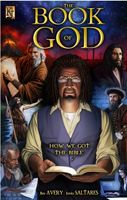
The Book of God: How We Got the Bible,
by Ben Avery & Javier Saltares

(Kingstone Comics, 2012), pp.

Ages 8+

A graphic novel on the production and preservation of the Bible? Brilliant!
I had no previous awareness of KingstoneComics until I happened to see this book in Sam’s. I was intrigued by the idea and bought it, curious to see how faithful it would be. I really liked what I found inside.

With nicely done comic book graphics this book is divided into four parts:
         1-The Production of the Bible: How the Bible Was Written
2-The Process of the Bible: How the Bible Was Selected (Why these books and not others?)
3-The Preservation of the Bible- How the Bible Was Spread
4-The Proof of the Bible- How the Bible Has Survived and is Trustworthy
In each part the authors demonstrate an awareness of the issues and scholarship. They provide solid conservative answers affirming
the full truthfulness of the Bible. Many portions handle these issues exactly as I do in my college survey courses. Serious information is handled here in an accessible way. They do not gloss over challenges but face them head on. There are a few places where I would handle things a bit differently, but they are not major.

This is a great resource for a wide range of settings.  I know one family who enjoyed it with their elementary age child and my older teen boys have enjoyed it. I think it would fit well with my class for college freshmen.

I am excited to see these important questions answered well in such an engaging format. From their website I noticed Kingstone Comics has quite a number of graphic novels and comic books covering bible stories and fiction relating biblical themes. I will be eager to see more of their work.
[previously posted at my children’s lit blog, The Children’s Hour]

“Thank You for Tomorrow”

It has been fairly common in our family for the youngest child to delight in saying the blessing before meals. So for the last while, Timothy, our 4 year old, has often eagerly asked to say the blessing. His prayers have developed of course, moving first from unintelligible to intelligible and then adding and substituting topics. In the last few days a new item has appeared in his prayers. He has begun, in his list of things for which he gives thanks, saying, “Thank you for tomorrow.”

This was striking to me the first time I heard it and I am not sure what exactly he means by it. Most likely he has melded in a humorous way some different things he has heard us pray. But I have not corrected him. It is good theology whether he realizes it or not.

As I have pondered this little prayer it has prompted some edifying thinking on my part.  It might seem presumptuous at first to thank God for what has not yet been given (perhaps contrary to James 4:13-16). And yet, such a prayer, intentionally stated, is not presumption but the confidence of hope. For tomorrow is already promised to all those who are in Christ. This tomorrow may occur in this life or the next, but it is sure. And no matter what hardship tomorrow may bring, God is there. To give thanks for what God is yet to do is to act in faith.

I find welling up within me, as Timothy prays, a joyful certainty and I am thankful because this day is not the end. There is a future and we give thanks to God for it because it comes from him.  This is a proper prayer for those who believe in the resurrection.

I’m finding myself praying these words learned from my little boy.

The Sufficiency & Perfection of Ministers of the Word of God

Expounding 1 Timothy 4:12-13 Calvin has much valuable to say about the preaching ministry. Here is just one key quote:

This is the sufficiency, yes, and perfection of the ministers of the word of God, namely, that they be of good understanding in Holy Scripture, and be faithful expounders of it. If they have this, they have everything. But if they wander up and down, now here now there, there is nothing but vanity in them, as we see in those who seek to be esteemed greatly as subtle and fine witted fellows. It is true that they will use much display, and the world will be in a fool’s Paradise with them. But yet there is no encouragement in them, to edify those who hear them. By reading the Scripture, we shall be sufficiently furnished with what we shall want to edify the Church of God with, as is necessary.

Don’t miss that there are two key things here. First, we must be well trained in the Scriptures and stick to what they say. This is Calvin’s main point here. However, at the end (and in what follows in his sermon) he mentions the second point, edification. Our being faithful to “say what the text says” is not an end in itself. It is crucial and honorable. However, the aim is to edify those who hear us. Do not use “I was faithful to the text” as an excuse for failing to engage the people before you in the fullness of life and humanity. To be faithful to the text also requires bringing home the truths contained there in a way the people can grasp, pressing the application so that people tremble before God’s holiness, revile the ugliness of sin, taste the sweetness of forgiveness, and feel the love for God and his people well up within them.

Update:
After posting the above I came across the following in the same sermon:
“a shepherd, if he will do his duty well, and execute his charge faithfully, must not simply propose the doctrine, to say, “This is the meaning,” but must exhort as well. And therefore, there are two things required, namely, that we give good and sound understanding of what is required for the salvation of the faithful, and then that we also add vehemence, to the end that the doctrine may touch their hearts deeply, so that they not only know what is good, but are moved to follow it.”

Calvin on God’s Provision & Joy

Preaching on 1 Timothy 4 (esp. vv. 7-10) Calvin repeatedly stresses the importance of the eternal perspective and the reality of the resurrection for our perseverance. Things often go badly for Christians and the wicked seem to escape (believers were being executed in his day). He also warns against the folly of seeking our ultimate fulfillment in the things of this life. In this context the following excerpt is found. I found the mention of our true goal and confidence in God’s goodness helpful so I pass it along to you.

if a man gives himself to serve God, and seeks nothing but to end the course of his life with a pure conscience, he has all that man can desire. And why? For God will look after him in this world, and however it fares with him, yet he shall find out in the end that he has a good patron and a good defender in heaven. And the best thing is that we know where our inheritance and everlasting rest is. (Sermon 33)