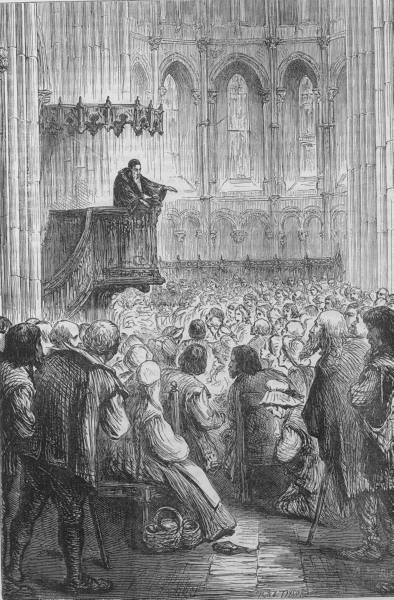
John Calvin & Evangelism

A main reason some people are adverse to John Calvin is that all they know of him is his teaching on predestination, and they fear this teaching destroys evangelism. But, whether or not one agrees with Calvin, it is only fair to note that he did not see predestination as an impediment to or negation of evangelistic fervor. I have written previously on Calvin’s teaching on and engagement in missionary endeavors, and will not rehearse that information here.

However, just today I came across more of Calvin’s teaching on evangelism. I am currently reading through Calvin’s sermons on 1-2 Timothy & Titus preparing a new edition of these sermons for publication (the only English version currently available is a facsimile of the 1579 translation with spellings and type face [e.g., an “s” looks like an “f”] which make it difficult to read). These sermons always end with a prayer and often the prayer includes a petition for God’s grace “not to us only, but to all people and nations of the world.”  Then, the 12th sermon, expounding 1 Timothy 2:1-2 is especially good, with helpful discussion of the importance of government, the importance of community in the church and the importance of evangelism and missions.

As Calvin expounds Paul’s call to pray “for all men” he applies this to our missionary responsibility to the world. Here are some excerpts:

“if we want to rightly make our prayers to God for all men, we must begin with those whom we are joined together with in faith and obeying the gospel; for they are, as it were, household servants in God’s house.  Yet in addition to praying for the faithful, we should also have pity and compassion on the poor unbelievers, asking God to draw them unto us so that all of us may be of one accord.

Thus we see what Saint Paul’s meaning is in this place: namely, to show us what the children of God ought to employ themselves in doing, and it is this, that we should not travail unprofitably, but instead call upon God and ask him to work toward the salvation of the whole world, and that we give ourselves to this work both night and day.”

“he wanted to show that we must not only pray for the faithful, who are our brothers already, but for those who are very far off, those poor unbelievers.  Even though there seems to be a great distance and a thick wall between both, nevertheless we must have pity for their coming destruction, to the end that me may pray to God that he would draw them unto him.”

the greatest pleasure we can do to men is to pray to God for them, and call upon him for their salvation.” [following sentences show he has in view here the “infidels”]

“And according to this doctrine [‘pray for all men’], let us have pity on the poor wandering sheep who go on to destruction, even though they are not worthy, even though they are enemies to the Church, and scatter themselves far from us.”

This is strong pastoral exhortation, calling on his congregants to be people of missionary prayer, burdened by the coming fate of those who do not believe, driven by pity and compassion to “call upon God” for “the salvation of the whole world” and to labor to that end “both night and day”! These are not the words of a careless ivory tower academician. This is the passionate pleading of a pastor yearning for the good of mankind and the glory of God. Calvin was not perfect, and I have my disagreements with him. But this area is not one of his errors, nor is it one of my disagreements!

Rather than slandering a brother from the past, let us carry on in this worldwide mission endeavor in which he too labored in obedience to our common Lord.

Pride: The Source of Heresy

“This is the beginning and root of all heresy, which has been in all times: even this, that those who understood the Gospel would show themselves as men full of ambition and pride, and instead of dedicating themselves to God.”

–  John Calvin, Sermon on 1 Timothy 1:18-19

Pastors’ Conference in Edinburgh, Feb 25

February 25 I will have the privilege of participating in a conference for church leaders at Charlotte’s Chapel in Edinburgh, Scotland. “The Call: Leadership Conference” will have as its theme “The Leader as Shepherd” and will take place from 9:30am to 4:00pm. The cost is just £15 which includes lunch and over 10 books on church life (a reduced price of £10 is available for students, retirees, etc.). Full details for booking can be found here.

The speakers and topics are as follows (taken from the website):

The Shepherd’s Soul: Jeremy Walker (video)
This session focuses on the leader’s spiritual condition realizing the necessity of any leader to daily and intimately walk with God to be a qualified, effective leader in the church.

The Shepherd’s Ministry to the Church: Brian Croft (video)
This session discusses the practicality of ministry within the church in areas such as visiting the sick, facing death, caring for widows, discipleship, prayer, accountability and others and how to be most faithful and biblical as we labor in those tasks.

The Shepherd’s Ministry beyond the Church:  Matthew Spandler-Davison (video)
This session discusses the Christian leader’s practical ministry outside of the church in areas such as evangelism, mercy ministry, training and sending pastors and missionaries, pastoral networking, local church association, and how to be a faithful display of the gospel as we engage with other churches and the world.

The Shepherd’s Call:  Dr. Ray Van Neste (video)
This lesson looks at the call of the shepherd to faithfully love the Lord and love the Lord’s people.  We will be challenged to lead with the heart of a shepherd.  We will focus on the call of God for Christian leaders to faithfully feed, lead and protect the people of God.

Breakout Sessions:

  • Shepherding the family:  Liam Garvie (video)
    Liam will lead this discussion on the trials, challenges and joys of shepherding your family.
  • Feeding the Sheep:  Dr. Ray Van Neste and Jeremy Walker
    The shepherd is primarily tasked with feeding the sheep.  This session will discuss the nature, joy and challenge of preaching.
  • Test, Train and Affirm:  Brian Croft and Matthew Spandler-Davison
    The church is to be a training ground for pastors, elders and church leaders.  Brian and Matthew will share their experience of developing an internship program at their churches.

You can get further information including bios of the speakers and commendations of the conference at the conference website http://thecallconference.org/.

If you are in the area I hope to see you there.

New Festschrift for Howard Marshall

Over the holidays the new festschrift for Howard Marshall became available through Amazon. It is titled New Testament Theology in Light of the Church’s Mission: Essays in Honor of I. Howard Marshall, and I had the pleasure of co-editing it with Jon Laansma and Grant Osborne. In light of Howard’s profound influence on New Testament studies and his bolstering of evangelical scholarship, through his writing, teaching and mentoring, we thought it appropriate that a second festschrift be presented to him. The title reflects an emphasis in Howard’s work- the exposition of the New Testament ought to advance the missionary endeavor of Christ’s kingdom.

Though Howard and I differ on any number of topics, I have had the pleasure of observing his love for the church, his humility, and his passion for evangelism. He has been a helpful example to me, and it was a pleasure to write a biographical sketch for this volume.

We were pleased to have such a gathering of respected scholars contribute to this volume. I have pasted in here the table of contents so you can see the essays and contributors to the volume.

I. Howard Marshall: An Appreciation
Ray F. Van Neste

A Bibliography of I. Howard Marshall

The Gospel for All Peoples: Method, Integrity, Translation

Chapter 1 – Methodology of Evangelism in the New Testament: Some Preliminary Reflections
James D. G. Dunn

Chapter 2 – Freedom from the Law Only for Gentiles?  A Non-Supersessionist Alternative to Mark Kinzer’s “Postmissionary Messianic Judaism”
Craig L. Blomberg

Chapter 3 – Hearing Voices: The Foreign Voice of Paul under the Stress of Contemporary English Localization
Philip H. Towner

Chapter 4 – The Son of Man in Hebrews 2:6: A Dilemma for Bible Translators
Richard T. France

Gospels and Acts

Chapter 5 – The Gospel before the Gospels: The Preached Core Narrative
Darrell L. Bock

Chapter 6 – Matthew 5:17-20 and “A Tale of Two Missions”?
Esther Yue L. Ng

Chapter 7 – Revisiting the Johannine Water Motif: Jesus, Ritual Cleansing and Two Purification Pools in Jerusalem
Gary M. Burge

Chapter 8 – The Purpose of Luke-Acts: Reaching a Consensus
Mark L. Strauss

Chapter 9 – Neglecting Widows and Serving the Word? Acts 6:1-7 as a Test Case for a Missional Hermeneutic
Joel B. Green

Chapter 10 – Luke: Historian, Rhetor, and Theologian. Historiography and the Theology of the Speeches in Acts
Gene L. Green

Paul

Chapter 11 – The Missionary Character of 1 Corinthians
Brian S. Rosner

Chapter 12 – Church Membership and the idiwthV in the Early Corinthian Community
Andrew D. Clarke

Chapter 13 – Old Testament Paradoxes in Galatians: Rethinking the Theology of Galatians
Maureen W. Yeung

Chapter 14 – Missio Dei and Imitatio Dei in Ephesians
Roy E. Ciampa

Chapter 15 – An Ideal Missionary Prayer Letter: Reflections on Paul’s Mission Theology as Expressed in Philippians
Alistair I. Wilson

Chapter 16 – Paul’s Missionary Preaching in 1 Thessalonians 2:1-16, with an Apocalyptic Addition from 2 Thessalonians
Anthony C. Thiselton

Chapter 17 – “Prayer” and the Public Square: 1 Timothy 2:1-7 and Christian Political Engagement
Greg A. Couser

Chapter 18 – Schlatter on the Pastorals: Mission in the Academy
Robert W. Yarbrough

Chapter 19 – “Nobody knows de trouble I seen”: Hardship Lists in Paul and Elsewhere
Paul Ellingworth

Hebrews and Revelation

Chapter 20 – Hebrews and the Mission of the Earliest Church
Jon C. Laansma

Chapter 21 – The Mission to the Nations in the Book of Revelation
Grant R. Osborne

Chapter 22 – Early Christian Mission and Christian Identity in the Context of the Ethnic, Social, and Political Affiliations in Revelation
Eckhard J. Schnabel

Majesty & Preaching

“God does not want temples here to play around and laugh in, as in a theater; but there must be a majesty in one’s words by which we may be moved and touched and receive profitable instruction which leads to salvation.”

– John Calvin, sermon on 1 Tim 1:3-4

Quotes from The Rage Against God

To illustrate some of the insight and good writing to be found in Peter Hitchens’ book, The Rage Against God, I have simply pasted in some of my favorite quotes from the book. This book is to put on your list for reading this year.

“…enormous and intrusive totalitarian state power, especially combined with militant egalitarianism, is an enemy of civility, of consideration, and even of enlightened self-interest. . . . I have seen public discourtesy and incivility spreading rapidly in my own country as Christianity is forgotten.” 91

“Together with the experience of Soviet society, this venture convinced me that my own civilization was infinitely precious and utterly vulnerable and that I was obliged to try to protect it.  When you have seen a place from which the whole apparatus of trust, civility, and peace has been stripped, you are conscious as never before of the value of these things and more curious than ever about their origins, not in wealth or power, but in the mind of man and in the better angels of his nature.” 98

“No doubt I should be ashamed to confess that fear played a part in my return to religion. . . .But I should be even more ashamed to pretend that fear did not.” 103

“But the most important time was when I stood in front of Rogier van der Weyden’s great altarpiece and trembled for the things of which my conscience was afraid (and is afraid).  Fear is good for us and helps us to escape from great dangers.  Those who do not feel it are in permanent peril because they cannot see the risks that lie at their feet.” 104

“Those who blame religion for wars tend to do so only when it suits them to do so, and without paying much attention to the details.” 133

“The current intellectual assault on God in Europe and North America is in fact a specific attack on Christianity – the faith that stubbornly persists in the morality, laws, and government of the major Western countries. . . .The God they fight is the Christian God, because he is their own God. . . .God is the leftists’ chief rival.  Christian belief, by subjecting all men to divine authority and by asserting in the words ‘My kingdom is not of this world’ that the ideal society does not exist in this life, is the most coherent and potent obstacle to secular utopianism. . . . the Bible angers and frustrates those who believe that the pursuit of a perfect society justifies the quest for absolute power.

The concepts of sin, of conscience, of eternal life, and of divine justice under an unalterable law are the ultimate defense against the utopian’s belief that ends justify means and that morality is relative.” 134-135

“…when it comes to the millions of small and tedious good deeds that are needed for a society to function with charity, honesty, and kindness, a shortage of believing Christians will lead to that society’s decay.” 144-145

“In their utter reverence for oaths, men of More’s era were in my view as superior to us as the builders of Chartres Cathedral were to the builders of shopping malls.  Our ancestors’ undisturbed faith gave them a far closer, healthier relation to the truth – and so to beauty – than we have.” 146-147

“Even unbelievers have to recognize that God, whether he exists or not, predates earthly dictators and tends to survive them. . . . This may seem trivial to us in our secularized societies still benefiting from the freedoms that flowed from centuries of Christianity.  We have forgotten how we arrived at our civilized state.” 211-212

Poetry and Beauty as Apologetics

I have already listed Peter Hitchens’ book, The Rage Against God, as one of the best books I read last year. I had meant to comment much more on the books contents which are rich on a variety of topics and levels.

One point made often in the book is the power of poetry and beauty, particularly their apologetic power. People wanted to see him lock intellectual horns with his outspoken, atheistic (and now recently deceased) brother Christopher. However, Peter eschewed bare academic argument. Rather he stated:

“It is my belief that passions as strong as his [Christopher Hitchens’] are more likely to be countered by the unexpected force of poetry, which can ambush the human heart at any time.” (12)

This was true in his own conversion as he related how a medieval painting gripped him and then how the beauty of the Anglican worship services he had grown up with began to draw him back. He told how after years of avoiding church he found himself slipping into several services of Christmas music. He also stated:

“…I can certainly recall the way the words of the Church of England’s marriage service awakened thoughts in me that I had long suppressed.” (105)

As a result he has worked in his own denomination to preserve beauty and grandeur in their worship, referring to this as his “small, private battle for poetry and beauty” (112).

In an era which has largely lost its appreciation of the poetic, being far more interested in the common and the comfortable than the grand and the challenging, we would do well to ponder this.

Growing Up Practically Pagan

Writing in 1937, in a book subtitled, A Study of Some Pressing Tasks and Problems of Present-Day Protestantism, William Adams Brown listed as one of the key problems this:

“The fact remains that great numbers of our children are growing up practically pagan with not even a bowing acquaintance with that greatest of all our treasures, not only as religion but as literature, the English Bible” (The Minster: His World And His Work, 164).

In 75 years this problem has only gotten worse. What steps will you and your church take this year to begin changing this? Some helps using the Read the Bible for Life material can be found here. A multitude of steps are available to us. We must act to point people to the Scriptures.

Best Reads of 2011

Several years ago I began keeping an annotated list of every book I read each year. It has been a very useful discipline and resource for later. As part of my own review of this past year I will post here what have been the best books I have read this past year. Included in this list are only books I read all the way through. I am not addressing here commentaries or other reference books which might be consulted (my thoughts on the best new Bible reference works published in the last year can be found here). I have also listed our favorites of books read to my children this year at my blog on children’s literature.

Here then are my favorites from the year in general categories.
History/Politics
1. An Autobiography, R. G. Collingwood- A fascinating little book. I got lost some in the philosophical debate chapters but much challenging and rousing stuff on childhood, education and politics (completed in 1938).
2. Hitler in the Crosshairs: A GI’s Story of Courage and Faith, Maurice Possley and John Woodbridge (audio)- This is a fascinating story covering spiritual biography, World War II history, and intrigue. I suggested to Dr. Woodbridge it would work well as a movie and he hinted there was some discussion in that direction.
3. Forgotten Founder, Drunken Prophet: The Life of Luther Martin, Bill Kauffman- Kauffmann does not know how to be boring, and he clearly warms to his topic here.This is a well written biography and powerful argument for Anti-Federalist views. Since the Anti-Federalists are so often unknown today and when they are recognized they are maligned and misunderstood, this book ought to be read. Thanks to Eric Smith for loaning me this book!
4. The Revolution: A Manifesto, Ron Paul (audio)- Very good! Paul’s candor and adherence to the constitution is refereshing. He is knowledgeable on the issues so this book would be useful to any US citizen.
5. Pursuit: The Chase, Capture, Persecution, and Surprising Release of Confederate President Jefferson Davis, Clint Johnson- I have not seen much on this part of history and Johnson tells the story well. There were some surprising grammar errors, but Johnson writes in a balanced manner neither vilifying nor excusing. Shows stubbornness and other negatives of Davis but also his honor & perseverance. He corrects some common historical misunderstandings.

Fiction
6. The Year Of The Warrior, Lars Walker- This is a Viking story mixed with fantasy. I would never have known of it or probably paid it serious attention if Hunter Baker had not so warmly and consistently commended it. I was hooked right away with this tale of a priest in training who is captured by marauding Vikings eventually becoming the priest for a Christian Viking leader. Walker takes historical facts known of the time and era and weaves them into a powerful story. This becomes a powerful tale of pastoral ministry.
I also read his Blood and Judgment, which is a fascinating, well-informed fantasy take on Hamlet. Thanks Hunter!
7. Hannah Coulter, Wendell Berry (audio)- Classic Wendell Berry, this novel really appealed to me. The story is a wonderful vehicle for extolling the value of family, community, place and tradition. There are good examples for various aspects of life. Interestingly, the Okinawa chapter was very “preachy”, even protruding from the narrative. I gave copies to my mom and my wife and daughter for Christmas.
8. Noah Primeval: Chronicles of the Nephilim Book I, Brian Godawa- I mentioned this in more detail in a recent post, so here I will simply say it was nicely done. Another book in biblical fiction I appreciated was Day of War (Lion of War Series) by Cliff Graham. David’s “mighty men” sound like modern special ops with ninja moves, but it was a good read and brought to life some of the biblical characters.

Theology/Pastoral
9. Psalms: The Prayer Book of the Bible, Dietrich Bonhoeffer- A real gem, powerful on prayer and the use of the Psalms.

10. The Rage Against God: How Atheism Led Me to Faith, Peter Hitchens (audio)- Excellent! You have probably heard recently about what a good writer his recently deceased writer his brother was. Peter Hitchens is also a very gifted writer. He reminded me of C. S. Lewis often both in his content and in the fact that like Lewis Hitchens was a delight to read not only because of the truth he wrote but simply for the sheer delight of how well he writes.
This book could have been listed under politics/history as well because it is a sharp analysis/critique of culture as well. Thanks to Phil Eyster for insisting I make time to read this book!
11. The Orthodox Pastor: A Guide to Pastoral Theology, Archbishop John Shahovsky- I stumbled across this book at a conference and read it on my plane ride home. It embodies Eastern Orthodox so there are obviously places where I differ, but it was also rich with wisdom and insight. I hope to post more on this book later.
12. The Mighty Weakness of John Knox, Douglas Bond- This is a brief introduction to Knox which does a great job of introducing the man and his relevance for us today. In his engaging way Bond brings Knox to life.

Noah, Action Hero

Brian Godawa, screenwriter of To End All Wars, has written a “speculative retelling” of the Noah story titled, Noah Primeval: Chronicles of the Nephilim Book I. I was contacted about reviewing the book and at first was not interested. “Hollywood re-envisions a Bible story” did not sound interesting. However, when I noticed Godawa has a book on faith and film published by IVP and saw endorsements ranging from Ralph Winter (X-Men) to Marvin Olasky, I decided to give it a chance.

I was pleasantly surprised by this book- both the theological depth and strength of writing. This is a really fun read! I was impressed by how the author built biblical plausibility into so much of the story. Of course, it is quite speculative in many areas, but overall it works. Then, the words put into the mouths of the characters are often theologically weighty and profound. One powerful scene provides a moving expression of courage rooted in trust in God’s sovereignty. Often scriptural truths, which show up after Genesis, are stated by characters in the story.

The basic idea is that Noah would have been part of a tribe. Thus, in this retelling Noah leads a tribe who remains faithful to Yahweh resisting the lure of the “city dwellers” who have been drawn into the worship of the fallen angels who have set themselves up as gods on the earth. Here Godawa draws in the creation stories from the Ancient Near East as the alternative stories created by these fallen angles to draw people away from Elohim. Noah also is struggling with trusting God in light of the sufferings he and his people have endured. This sets up a good lesson on how people sometimes struggle with faith but in the end must trust God.

Godawa has done his homework on the Nephilim (which seems to be the central interest in the series), other creation and flood stories from the Ancient Near East, the Book of Enoch and intertestamental Jewish literature as he weaves ideas from all of these into a fantasy tale. He provides several appendixes explaining his understanding of various issues which underlie the story (Nephilim, Leviathan, etc.). I am not convinced by all his interpretation, but the story still works well. He is careful to state that he is not trying to suggest this is how the Noah story even might have happened. Here are his words:

“This novel seeks to remain true to the sparse facts presented in Genesis (with admittedly significant embellishments) interwoven with theological images and metaphors come to life. Where I engage in flights of fancy, such as a journey into Sheol, I seek to use figurative imagery from the Bible … and bring them to life” (4).

I think Godawa succeeds overall (a couple of lapses) and tells a great story. I enjoyed the story immensely and was encouraged by it. This book would make great holiday reading.