“Time was when the Psalms were not only rehearsed in all the churches from day to day, but they were so universally sung that the common people knew them, even if they did not know the letters in which they were written. Time was when bishops would ordain no man to the ministry unless he knew “David” from end to end, and could repeat each psalm correctly; even Councils of the Church have decreed that none should hold ecclesiastical office unless they knew the whole psalter by heart. Other practices of those ages had better be forgotten, but to this memory accords an honourable record. Then as Jerome tells us, the labourer, while he held the plough, sang Hallelujah; the tired reaper refreshed himself with the psalms, and the vinedresser, while trimming the vines with his curved hook, sang something of David.”
Spurgeon, Preface to vol. 6 of The Treasury of David
Reformation Day 2011
“Come, let us sing a Psalm, and drive away the devil.” (Luther)
I have been duly urged on for a Reformation Day post for this year, so let me get this in before the day concludes!
My family does make a big deal each year about Reformation Day, and I always take time at the beginning of Greek class on this day to note how Luther’s breakthrough came through contemplating the Greek text. There is so much for us to remember and give thanks for stemming from the Reformation.
I have been delayed in commenting today because I am just at the end of completing a book on the Psalms and how they should inform and shape our worship. This is a central Reformation theme. One thing the Reformation reclaimed was the importance of congregational singing. Rather than listening to professionals “worship” in a language unknown to the congregation, the Reformers sought to bring the people once again into the act of worship. If we allow our worship today to become an “act” to be watched from the pew then we have reverted and lost our Reformation birthright.
Central in this effort to re-shape worship was the use of the Psalms. Luther’s most famous hymn, “A Mighty Fortress,” is drawn from Psalm 46. Calvin worked himself on putting the Psalms directly into metered forms for singing and enlisted Theodore Beza and Clement Marot (one of the best musicians of the day) in this task. As pastors they knew the importance of their people knowing the Psalms that they might shape and inform both praying and singing. It was Luther who said, “Come, let us sing a Psalm, and drive away the devil.”
Below are comments from Luther and Calvin on the value of the Psalms. Let us consider whether we value the Psalms in this way today. How might we begin to incorporate the Psalms into our own, personal praying each day, into our singing as a family & a church. This use of the Psalms is one of the treasures of the church, appreciated in the early church and returned to common people in the Reformation.
“How varied and how splendid the wealth which this treasure contains it is difficult to describe in words; whatever I shall say, I know full well, must fall far short of its worth. . . . This book, not unreasonably, am I wont to style an anatomy of all parts of the soul, for no one will discover in himself a single feeling whereof the image is not reflected in this mirror. . . . The rest of Holy Scripture contains the commands which God gave to his servants to be delivered unto us; but here the prophets themselves, holding converse with God, inasmuch as they lay bare all their inmost feelings, invite or impel every one of us to self-examination, that of all the infirmities to which we are liable and all the sins of which we are so full, none may remain hidden.”
– John Calvin, preface to Commentary on the Psalms of David
“In the Psalms, we look into the heart of all the saints, and, we seem to gaze into fair pleasure-gardens; into heaven itself, indeed; where bloom the sweet, refreshing, gladdening flowers of holy and happy thoughts about God and all His benefits. On the other hand, where will you find deeper, sadder, more piteous words of mourning than in the Psalms? In these again, we look into the heart of the saints, and we seem to be looking into death, yea, into hell itself. How gloomy, how dark it is there, because of the many sad visions of the wrath of God!”
– Martin Luther
Sing a Psalm with your family and have a happy Reformation Day!
Matthew Henry on the Use of the Psalms
In the preface to his commentary on the Psalms, Matthew Henry has a helpful & instructive section on the proper use of the Psalms. There are many gems in this excerpt (the numbering is Henry’s though I have broken the paragraphs in places and added bold & italics).
All scripture, being given by inspiration of God, is profitable to convey divine light into our understandings; but this book is of singular use with that to convey divine life and power, and a holy warmth, into our affections. There is no one book of scripture that is more helpful to the devotions of the saints than this, and it has been so in all ages of the church, ever since it was written and the several parts of it were delivered to the chief musician for the service of the church.
1. It is of use to be sung. Further than David’s psalms we may go, but we need not, for hymns and spiritual songs. What the rules of the Hebrew metre were even the learned are not certain. But these psalms ought to be rendered according to the metre of every language, at least so as that they may be sung for the edification of the church. And methinks it is a great comfort to us, when we are singing David’s psalms, that we are offering the very same praises to God that were offered to him in the days of David and the other godly kings of Judah. So rich, so well made, are these divine poems, that they can never be exhausted, can never be worn thread-bare.
2. It is of use to be read and opened by the ministers of Christ, as containing great and excellent truths, and rules concerning good and evil. Our Lord Jesus expounded the psalms to his disciples, the gospel psalms, and opened their understandings (for he had the key of David) to understand them, Luke xxiv. 44.
3. It is of use to be read and meditated upon by all good people. It is a full fountain, out of which we may all be drawing water with joy. (1.) The Psalmist’s experiences are of great use for our direction, caution, and encouragement. … (2.) Even the Psalmist’s expressions too are of great use; and by them the Spirit helps our praying infirmities, because we know not what to pray for as we ought. In all our approaches to God, as well as in our first returns to God, we are directed to take with us words (Hos. xiv. 2), these word, words which the Holy Ghost teaches. If we make David’s psalms familiar to us, as we ought to do, whatever errand we have at the throne of grace, by way of confession, petition, or thanksgiving, we may thence be assisted in the delivery of it; whatever devout affection is working in us, holy desire or hope, sorrow or joy, we may there find apt words wherewith to clothe it, sound speech which cannot be condemned. It will be good to collect the most proper and lively expressions of devotion which we find here, and to methodize them, and reduce them to the several heads of prayer, that they may be the more ready to us. Or we may take sometimes one choice psalm and sometimes another, and pray it over, that is, enlarge upon each verse in our own thoughts, and offer up our meditations to God as they arise from the expressions we find there. … If, as St. Austin advises, we form our spirit by the affection of the psalm, we may then be sure of acceptance with God in using the language of it…”
The Psalms were thus serviceable to the Old-Testament church, but to us Christians they may be of more use than they could be to those who lived before the coming of Christ; for, as Moses’s sacrifices, so David’s songs, are expounded and made more intelligible by the gospel of Christ, which lets us within the veil; so that if to David’s prayers and praises we all St. Paul’s prayers in his epistles, and the new songs in the Revelation, we shall be thoroughly furnished for this good work; for the scripture, perfected, makes the man of God perfect.
Luther on the Preciousness of the Psalter
Throughout the history of the church, key leaders have extolled the value of the Psalms, even its unique value within the canon, typically because it summarizes the whole of scripture and teaches us to worship. Here is Luther echoing this sentiment:
“The Psalter ought to be a precious and beloved book, if for no other reason than this: it promises Christ’s death and resurrection so clearly – and pictures his kingdom and the condition and nature of all Christendom – that it might well be called a little Bible. In it is comprehended most beautifully and briefly everything that is in the entire Bible. It is really a fine enchiridion or handbook. In fact, I have a notion that the Holy Spirit wanted to take the trouble himself to compile a short Bible and book of examples of all Christendom or all saints, so that anyone who could not read the whole Bible would here have anyway almost an entire summary of it, comprised in one little book.”
Martin Luther, “Preface to the Psalter,” LW, 35, p. 254. Cited in Paul Westermeyer, Te Deum: The Church and Music (Minneapolis: Fortress Press, 1998) 35
If we do not sense this value in the Psalms, we are the exception in the history of the church.
Another Children’s Book Giveaway
At my blog on children’s literature I am giving away a copy of Thea Van Halsema’s This Was John Calvin. You can read my positive review and see how to sign up for the giveaway here. This book would be a great resource for Reformation Day which is coming up soon.
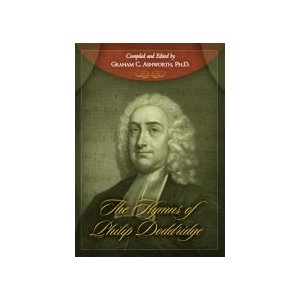
The Hymns of Philip Doddridge
Just last night my copy of The Hymns of Philip Doddridge came in the mail, and I was straightway taken in. Doddridge (1702-1751) was mentored by Watts and was a prominent Dissenting minister in England. This volume is a reprint of the posthumously published volume of Doddridge’s hymns with a brief biographical sketch added. The hymns are arranged canonically according to the texts from which each hymn was drawn.
The are rich poems very valuable for meditation (not to mention singing). Here is one where Doddridge contemplates 2 Timothy 2:19:
But God’s firm foundation stands, bearing this seal: “The Lord knows those who are his,” and, “Let everyone who names the name of the Lord depart from iniquity.”
The Stability of the Divine Foundation, and Its Double Inscription
(2 Timothy 2:19)
To THEE, great Architect on high,
Immortal thanks be paid,
Who, to support Thy sinking saints,
This firm foundation laid.
2. Fix’d on a Rock Thy gospel stands,
And braves the rage of hell;
And, while the Saviour’s hand protects,
His blood cements it well.
3. Here will I build my final hope;
Here rest my weary soul;
Majestic shall the fabric rise,
Till glory crown the whole.
4. Deep on my heart, all-gracious Lord,
Engrave its double seal;
Which, while it speaks Thy honor’d name,
Its sacred use may tell.
5. Dear by a thousand tender bonds,
Thy saints to Thee are known;
And, conscious what a name they bear,
Iniquity they shun.
This is a great book and wonderful devotional resource.
Make Me Thy Fuel, Amy Carmichael
Each Monday I try to post a new “Poem of the Week” on my office door and for some time I have thought I should post that poem here as well. So finally, I am doing so!
This is a poem of Amy Carmichael’s which I first encountered through the writings of Elisabeth Elliot. I kept it taped to my dorm room wall in college, and its words still echo through my soul. It is a strong challenge but does not call us to look to ourselves to meet the challenge; rather, it points us to Christ.
Make Me Thy Fuel
From prayer that asks that I may be
Sheltered from winds that beat on Thee,
From fearing when I should aspire,
From faltering when I should climb higher,
From silken self, O Captain, free
Thy soldier who would follow Thee.From subtle love of softening things,
From easy choices, weakenings,
Not thus are spirits fortified,
Not this way went the Crucified,
From all that dims Thy Calvary,
O Lamb of God, deliver me.Give me the love that leads the way,
The faith that nothing can dismay,
The hope no disappointments tire,
The passion that will burn like fire,
Let me not sink to be a clod:
Make me Thy fuel, Flame of God.-taken from Toward Jerusalem
, by Amy Carmichael
“The Story for Little Ones” Misses the Mark
Here is the latest review from my blog on children’s books, The Children’s Hour:

The Story for Little Ones: Discover the Bible in Pictures
Westerholm- The Pastorals Negate the New Perspective
The latest from PastoralEpistles.com:
I have previously mentioned here the new section at the Evangelical Theological Society meeting devoted to the Pastoral Epistles. This section came into being due to the conviction (shared by myself and others) that the exclusion of the Pastorals from our thinking about Paul has skewed our understanding of Pauline theology. Specifically, I have become convinced that if the Pastoral Epistles were taken seriously as Pauline, the “New Perspective on Paul” would never have taken off. Stephen Westerhom in 2004 made this very point, stating:
No study that took Ephesians and the Pastorals into account could conclude, what proponents of the new perspective have sometimes claimed, that the Pelagian crisis or sixteenth-century controversies are the source of the “misreading” of Paul that sees him excluding human works from salvation rather than particular works from the terms for Gentile admission to the people of God. (Perspectives Old and New on Paul: The “Lutheran” Paul and His Critics
, 406)
Some of our papers next month will speak to this issue. I hope to see you there.
Bede, the Pastor
The Ancient Christian Texts series from IVP is a real treasure, as it provides access to writings of the Patristic era. I have been recently thumbing through the new volume, Commentaries on Genesis 1-3, which contains writings from several men including Bede the Venerable.
In the introduction to Bede’s commentary, the following quote struck me as an appropriate description of a pastor:
Bede was “a scholar on the brink between two worlds, an ancient one he knew only from books but which he still loved dearly, and a modern one, which he frequently criticized, but whose inhabitants, the English, the newest of God’s elect peoples, he also loved dearly.” (xvi) [quoting Joseph F. Kelly, “1996 NAPS Presidential Address on the Brink: Bede,” Journal of Early Christian Studies 5 (1997): 85]
This should be true of all pastors. If we live in only the ancient world we will be merely nostalgic, not very helpful to our people and perhaps irritable with them for not being like the world we really love. If we live only in the current world we will not have a standard by which to point out the errors of our world and by which to guide our people carefully. May we stand faithfully “on the brink” proclaiming God’s word our people, whom we love dearly.