P. D. James and the “restless desire for change”

Brad Green recently posted this significant quote from P. D. James, the famous British novelist. James takes aim at our society’s “restless desire for change.” It reminded me of Paul’s warning against “youthful desires” (2 Timothy 2:22), which several scholars suggest may refer to a penchant for the novel.

This quote is worth contemplating:

“We live in an age notable for a kind of fashionable silliness and imbued with a restless desire for change. It sometimes seems that nothing old, nothing well-established, nothing which has evolved through centuries of experience and loving use escapes our urge to diminish, revise or abolish it. Above all every organisation has to be relevant – a very fashionable word – to the needs of modern life, as if human beings in the twenty-first century are somehow fundamentally different in their needs and aspirations from all previous generations. A country which ceases to value and learn from its history, neglects its language and literature, despises its traditions and is unified only by a common frenetic drive for getting and spending and for material wealth, will lose more than its nationhood; it will lose its soul. Let us cherish and use what we still precariously hold. Let us strive to ensure that what has been handed down to us is not lost to generations to come.” [The Book of Common Prayer, ed. Prudence Dailey (Continuum, 2011)]

Athanasius Book Giveaway

At my blog on children’s literature I recently posted a review commending Simonetta Carr’s book, Athanasius. This is the latest book in Mrs. Carr’s wonderful series on key leaders in church history.

You can grasp the heart of the book by watching this trailer:

Today I have announced the opportunity to enter a drawing for a free copy of the Athanasius book. Instructions for entering can be found here. The drawing for the winner will take place Wednesday, October 5.

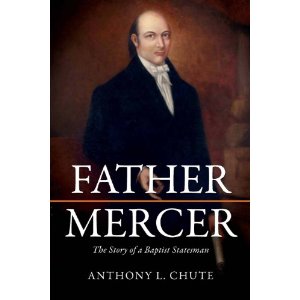
Father Mercer: The Story of a Baptist Statesman

Just today I received my copy of Tony Chute’s new book, Father Mercer: The Story of a Baptist Statesman (Mercer University Press).  Tony’s doctoral work and first book (A Piety Above the Common Standard) were on Mercer, and I have previously discussed here (and here) my appreciation of the previous book. Tony is a good scholar and writer so am I keen to read the book.

So far I have only had a chance to look through the book, but I like what I see. The first part of the book is an overview of Mercer’s life. The second part is a selection of Mercer’s writings including letters, newspaper essays, and addresses.

I particularly liked the way the story of Mercer’s life is framed by the description on the cover:

Yet, rather than telling the story of a larger-than-life pastor with whom few “ordinary” pastors can identity, Father Mercer reveals how one who is faithful in small things can, over time, bear much fruit for the Lord. Pastors who have been wounded by church members by their neglect of Christian duties will strike a friendship with Jesse Mercer who handled more than his share of opposition. College students who have left home for the first time will discover how God used the twists and turns in Mercer’s life to prepare him for opportunities he never foresaw.

We need examples of faithful people, “subject to like passions as we are”, who have persevered and been used of God. This looks like a great book.

Serious, Lively Teaching

I was struck by the following quote which I came across in Bartholomew and Dowd’s Old Testament Wisdom Literature: Theological Introduction.  The original quote seems to have in view primarily classroom teaching. Bartholomew and Dowd use it in well drawing out the implications of biblical wisdom. The truths here apply well to those of us who preach and teach the Bible. Let us not be “amiable gravediggers” diminishing our hearers to our “own level of indifferent fatigue.” There is life in God’s Word and if it animates us, life in the teaching will be unavoidable.

To teach seriously is to lay hands on what is most vital in a human being….Poor teaching, pedagogic routine, a style of instruction which is, consciously or not, cynical in its mere utilitarian aims, are ruinous.  They tear up hope by its roots.  Bad teaching is, almost literally, murderous and metaphorically, a sin.  It diminishes the student, it reduces to gray inanity the subject being presented.  It drips into the child’s or adult’s sensibility that most corrosive of acids, boredom, the marsh gas of ennui.  Millions have had mathematics, poetry, logical thinking, killed for them by dead teaching, by the perhaps subconsciously vengeful mediocrity of frustrated pedagogues….The majority of those to whom we entrust our children in secondary education…are amiable gravediggers.  They labour to diminish their students to their own level of indifferent fatigue. (300) [quoting George Steiner Lessons of the Masters.  Cambridge, Mass.: Harvard University Press, 2003.  p 18.]

The Reformers & Paul the Pastor


Yesterday I received my copy of Gerald Bray’s inaugural volume on Galatians and Ephesians in the Reformation Commentary on Scripture Series. It looks great!

In his introduction Bray makes the point of the pastoral emphasis of the Reformers and how Paul was a key example to them.

“They [the Reformers] were also determined to imitate the apostle in showing concern for the spiritual welfare of the churches under their care.  To them Paul was a pastor as much as an evangelist, and his epistles reveal his pastoral role more than anything else.  They knew from their own experience how easily a church could fall away from the preaching of the gospel if it lacked good teaching and sustained discipline, and much of their interest in Paul focused on this.  They also knew from experience that a faithful minister of the gospel will suffer persecution for his efforts, and here again Paul provided an obvious model, not the least because he did not let his chains stop him from proclaiming the message and caring for the churches he had founded and nurtured.” (xli-xlii).

We still need to see these lessons in Paul today.

T. S. Eliot on Wisdom and Our Lack

“…the values which we most ignore, the recognition of which we most seldom find in writings on education, are those of Wisdom and Holiness, the values of the sage and the saint….Our tendency has been to identify wisdom with knowledge, saintliness with natural goodness, to minimize not only the operation of grace but self-training, to divorce holiness from education.  Education has come to mean education of the mind only; and an education which is only of the mind…can lead to scholarship, to efficiency, to worldly achievement and to power, but not to wisdom.

–  T.S. Eliot. The Idea of a Christian Society and Other Writings (London: Faber and Faver, 1982),  p 142, cited by Craig Bartholomew & Ryan Dowd, Old Testament Wisdom Literature: A Theological Introduction, 293

Melvyn Bragg, The Book of Books: Biography of the King James Bible

KJV400: Legacy & Impact, the King James festival hosted by the Center for Biblical Studies at Union University will get underway tomorrow with viewing of the Bible exhibit in the afternoon and the actual program beginning in the evening with bagpipes, dinner and an address from Timothy George.

Here is what I thought was a well put tribute to the impact of the KJV from Melvyn Bragg’s TThe Book of Books: A Biography of the King James Bible, 1611-2011:

The King James Bible has been called the Book of Books. It has a good claim to this title. It consists of sixty-six different “books”. It has sold more than any other single book since its publication in 1611. It has carried the Protestant faith around the globe. And, by the law of unexpected consequences, its impact, alongside and often outside its vital role in spreading the Word, has been radical and amazingly wide-ranging. This Bible is one of the fundamental makers of the modern world. It has set free not only its readers and its preachers but those who have used it as a springboard to achieve gains and enrichment in our world never before enjoyed by so many. This book walks with us in our life today…

It stands still as a book of great language and beauty. There has never been a book to match it. It has a fair claim to be the most pivotal book ever written, a claim made by poets and statesmen and supported by tens of millions of readers and congregations.

When we “put words into someone’s mouth” and “see the writing on the wall” or “cast the first stone”, when we say “you are the salt of the earth”, or “a thorn in the flesh”, when we “fight the good fight” or “go from strength to strength” or “when the blind lead the blind”, or are “sick unto death” or “broken-hearted”, or “clear-eyed”, or talk of “the powers that be”…  in these and literally thousands more ways we talk the language of the 400-year-old King James Bible. And “beautiful”, that too makes its first appearance in the translation which became the keystone of the Bible. “It is,” wrote American journalist and satirist H.L. Mencken “the most beautiful piece of writing in any language.”

Andrew Blackwood on the Public Reading of Scripture

In my last post I mentioned Andrew Blackwood’s book, The Fine Art of Public Worship.  He has a good chapter on the public reading of Scripture, a historic part of Christian worship rooted in Scripture which is sorely neglected today. Much needs to be said on this aspect of worship, but here I will simply provide a few quotes from Blackwood’s discussion:

The reading of the Scriptures is perhaps the most important part of public worship. (128)

…if the minister knows how to read [publicly], he is likely to be in demand by the congregation which believes what the Book says about its own inspiration. (128)

The reading of the Scriptures ought always to be set in the centre of the service, where the light falls directly upon it.  Compared to it, our own poor bits of sermons are a very trivial affair, a mere footnote in small print.” (132)  [quoting In Christ’s Stead, Warrack Lectures, Doran, 1925, p45.]

In the Christian Church the minister is the man behind the Book. (133)

What a fine art is the worthy reading of the Scriptures! (135)

One need not argue about it [the Bible], or defend it, as though it were in danger of being condemned to death.  One need only interpret, illuminate, and enforce what it says about itself… (137)

Andrew Blackwood on Singing the Psalms

One of the voices from the past which I have come to appreciate is Andrew Blackwood (1882-1966), pastor and professor for many years at Princeton. He wrote much on pastoral ministry which remains quite helpful today. Because he wrote in a different day some of his points are dated, but also he often exposes blind spots of today.

In his helpful book, The Fine Art of Public Worship (Abingdon Press, 1939), he wrote this about the place of the singing the Psalms:

Many of our noblest hymns are from the Book of Psalms.  “Jesus shall reign where’er the sun” is a modern version of the seventy-second psalm, and “our God, our help in ages past” is a paraphrase of the ninetieth.  In the United Presbyterian book of praise are a hundred and fifty selections from the Psalms, with an equal number of classic hymns.  Perhaps our other denominations would have greater love for the Bible if we sang from the Psalms as often as our fathers did after the Reformation.  Many of those songs came out of the fiery furnace, and so they brought our fathers a mighty sense of God’s holiness, as well as a keen awareness of his laws. (110)

The Psalms as Christian Worship, by Waltke & Houston

My copy of this book, The Psalms as Christian Worship: A Historical Commentary by Brucke Watlke and James Houston, just came today, and already I am hooked. This is a significant book in so many ways.  In general Waltke provides exegesis of key psalms and Houston provides a history of reception and interpretation. Together they seek to persuade the church to attend again to the rich spiritual resources of the Psalms.

They describe how the Psalms have been so central to Christian (as well as Jewish) worship and spirituality.

“The Psalms were and are of key importance in the daily life of the Christian and in Christian community worship.” (2)

“As ‘the Bible in miniature,’ the Psalms have been uniquely central to the history of the church’s devotion, right up until the eighteenth century.” (13)

They also lament how the Psalter has been drained by overly technical analysis and has been lost to our contemporary worship, both private and corporate.

So we deplore the confessional reductionism in much contemporary Biblical scholarship, which overlooks two thousand years of Christian devotion and orthodoxy or ‘right worship,’ in the use of the Book of Psalms. It ignores the historical continuity of tradition in the communion of saints. It is like studying the activities of a seaport, and yet ignoring the existence of its hinterland…

“With the loss of their continuity and ‘historical hinterland,’ the psalms then lose their spirituality, and the whole heritage of devotion becomes ignored for both Jews and Christians. As the Jewish scholar James L. Kugel, Harvard professor of Hebrew, has observed: ‘it would not be unfair to say that research into the Psalms in this century has had a largely negative effect on the Psalter’s reputation as the natural focus of Israelite spirituality, and much that was heretofore prized in this domain has undergone a somewhat reluctant re-evaluation.’ Rather than being inspired by the spirituality of the Psalter, critical ‘moderns’ despiritualize the Psalms.” (3)

Waltke and Houston go on to state three of their goals as (10-11) :

1)  To restore the unique role of the Psalms in worship

2)  To restore the role of the Psalms in spiritual formation

3)  To restore the holistic use of a Psalm

On the last point they state:

Our purpose, therefore, is to recover these losses through accredited exegesis and hearing afresh the rich devotional response of the true church. We are heirs of all the ages, and we are the poorer for our failure to hear and embrace that rich heritage” (11).

I am encouraged by this book so far. While quite different, it resonates with the essential aims of the forthcoming book, Forgotten Songs: Reclaiming the Psalms for Worship (B&H), which Richard Wells and I are editing. May these efforts contribute to a re-embracing of the Psalms.