“The Singing Savior,” by Edmund Clowney

I recently came across the article by this title written by Clowney for Moody Monthly back in 1979. It is a wonderful, powerful piece (only 3 pages) on the importance of singing in the Christian life, the Psalms and Christ. It is primarily a meditation on the fact the New Testament shows us Jesus singing the Psalms.  He explores Jesus singing the songs of lament as he bore our curse and the resulting singing of praise for His victory. Here are a few quotes:

Where Christ comes, song comes, for Jesus Christ is a singing savior. “I will declare thy name unto my brethren, in the midst of the congregation, will I sing they praise” (Heb. 2:12).

If you would open a new experience of worship, meditate on the Psalms as the Psalms of Jesus.

You needn’t hum a hymn to begin your personal witness to a neighbor, but if your heart is singing praise, then your witness will ring true. And a praising church, full of gospel singing, is a church in which visitors will say, “God is among you, indeed!” (1 Cor. 14:25).

Quotes can capture the full piece. I encourage you to check it out.

Bible Exhibit at KJV Festival, Sept. 15-17

One wonderful development with the upcoming King James Bible Festival at Union University is that a significant portion of the Green Collection will be on display. This will be the first time this amazing collection has visited the Southeast. Listed below are some of the items which will be on display during our festival with links to further information or photos on several items. This will be a wonderful opportunity to experience part of the story of the Bible’s preservation through the years. You can register for the festival here.

1.  Pictographic Cuneiform text

2.  Borders of Shara Cuneiform Text

3.  Dedication Nail

4. Student Cuneiform Tablet

5.  Multiplication Table

6.  Cuneiform Lexicon

7.  Mummy Mask with Cartonage

8.  Papyrus Roll

9.  Gold Incantation Text with Facsimile Picture of the Silver Incantation Text

10.  Incantation Bowl

11.  Select Styli

12.  A Dead Sea Scroll ms and an identical vellum facsimile of the Great Isaiah Scroll

13.  Bodmer Papyrus XXIV: Psalm 23

14.  1 Cor 10 Papyrus

Codex Climaci Rescriptus Leaves

15.  Codex Climaci Rescriptus Leaves– view a video describing the significance of this item

16.  Santi Cecelia Biblia Latina, 1 Volume

17.  Carolingian Homolies

18.  Greek minuscule Gospels

19.  Latin English Psalter

20.  Latin English Bible

21.  Coptic and Arabic Scripture

22.  Syriac, NT

23.  Armenian, NT

Ethipoc manuscript

24.  Ethiopic ms

25.  German, Biblia Historiale (Facsimile Volume)

26.  Wycliffe NT Leaf Book

27.  Latin/German Bible

Inquisition Torah

28.  Inquisition Torah

29.  Megillah Scroll

Megillah Scroll

30.  Genizah ms

31.  Block Book (Facsimile)

32.  Gutenberg Leaf

33.  Koberger 9th German Bible

34.  Golden Legend, Julian Notary, 1503

35.  Complutensian Polyglot

36.  Erasmus, Greek NT, 1516

37.  Bomberg, Biblia Hebraica

38.  Luther NT, 1524

Luther NT, 1524

39.  A COMPENDIOUS OLDE TREATYSE, 1530

40.  Tyndale NT, 1535

41.  Coverdale Bible, 1535

42.  Matthews Bible, 1537

43.  Coverdale, Diglot, 1538

44.  Taverner, Bible, 1539

45.  Biblia Latina, London

46.  Great Bible, 1539

47.  Erasmus NT Paraphrase, 1548/1549

48.  Hans Holbein, 1549 (Facsimile of notes)

49.  Stephanus, Greek NT, 1551

50.  Great Bible, 1553

51.  Geneva Bible, 1560

52.  Foxe, Actes and Monuments, 1563 (Facsimiles of Wycliffe and Tyndale woodcuts)

53.  Bishop’s Bible, 1568

54.  Bishop’s, NT, 1568

55.  Anglo-Saxon, Diglot, 1571

56.  Rheims, NT, 1582

57.  Fulke, 1589

58.  Beza, NT, 1598

59.  Bishop’s, 1602 and facsimile notes

60.  Douay, OT, 1609

61.   KJV Folio 1611 HE

KJV Folio 1611 “HE Bible”

62.  KJV 1613/11

63.  The Works of King James including his Paraphrase of the Apocalypse

Psalms translated by King James

The Psalms translated by King James

64.  The Psalms translated by King James

65.  KJV with Geneva notes

66.  KJV 1631 Wicked Bible

67.  Elzevir Greek New Testament, 1633

68.  KJV, 1769 Revision

69.  Chalners, Catholic Bible

70.  Aitken, KJV, 1782

Spurgeon on Gospel Preaching

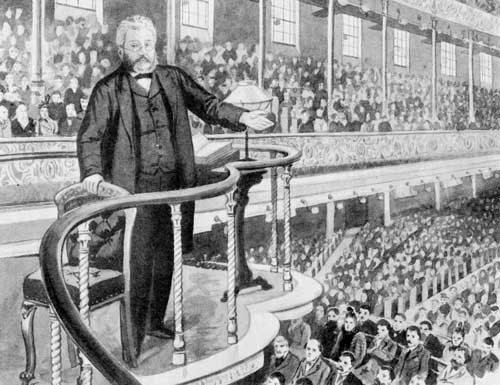
Spurgeon is a great example of gospel preaching always bringing the great truths to bear on the minds and hearts of his hearers. This is a great quote.

“I may not have many more opportunities of preaching, and I make up my mind to this one thing, that I will waste no time upon secondary themes, but when I do preach it shall be the gospel or something closely bearing upon it.  I will endeavour each time to strike under the fifth rib, and never beat the air.  Those who have a taste for superfluities may take their fill of them, it is for me to keep to the great necessary truths by which men’s souls are saved.  My work is to preach Christ crucified and the gospel, which gives men salvation through faith.  I hear every now and then of very taking sermons about some bright new nothing or another.  Some preachers remind me of the emperor who had a wonderful skill in carving men’s heads upon cherry stones.  What a multitude of preachers we have who can make wonderfully fine discourses out of a mere passing thought, of no consequence to anyone.  But we want the gospel.  We have to live and die, and we must have the gospel.  Certain of us may be cold in our graves before many weeks are over, and we cannot afford to toy and trifle: we want to see the bearings of all teachings upon our eternal destinies, and upon the gospel which sheds its light over our future.”
(Sermons by Rev. C. H. Spurgeon, ed. Sir W. Robertson Nicoll [Thomas Nelson and Sons, nd.]),388; preached April 9, 1882.  Spurgeon actually did live and preach for 10 more years).

The Cultural Impact of the Church

“Only one reliable force stands in the way of the power of the strong over the weak. Only one reliable force forms the foundation of the concept of the rule of law. Only one reliable force restrains the hand of the man of power. And, in an age of power-worship, the Christian religion has become the principal obstacle to the desire of earthly utopians for absolute power (Peter Hitchens, The Rage Against God: How Atheism Led Me to Faith, 113).

This is a key point, demonstrated powerfully by Hitchens, which is often forgotten or ignored. The evidence is available around the world and increasingly at home. Let us, then, be the Church resisting the siren call of compromise with the powers of the world.

The Gospel, The Cure of Cowardice

“…cowardice would seem to be a sort of fearful yielding of the soul” (Theophrastus, Characters [371-287 BC])

Cowardice “is a disease graver than any that affects the body since it destroys the faculties of the soul. Diseases of the body flourish but for a short time, but cowardice is an inbred evil, as closely inherent or more so than any part of the bodily system from the earliest years to extreme old age, unless it is healed by God. For all things are possible to Him” (Philo, On the Virtues, 26; 1st century AD).

“For God did not give us a spirit of cowardice but of power, love and self-control.

Therefore do not be ashamed of the testimony about our Lord, nor of me his prisoner, but share in suffering for the gospel by the power of God, who saved us and called us to a holy calling, not because of our works but because of his own purpose and grace, which he gave us in Christ Jesus before the ages began, and which now has been manifested through the appearing of our Savior Christ Jesus, who abolished death and brought life and immortality to light through the gospel, for which I was appointed a preacher and apostle and teacher, which is why I suffer as I do. But I am not ashamed, for I know whom I have believed, and I am convinced that he is able to guard until that Day what has been entrusted to me. Follow the pattern of the sound words that you have heard from me, in the faith and love that are in Christ Jesus. By the Holy Spirit who dwells within us, guard the good deposit entrusted to you.” (Paul, 2 Timothy 1:7-14; 1st century AD [ESV, altered])

Considering Bible Translation, Two Recent Essays

The method or theory of bible translation is an important and, at times, a complicated issue. It is something pastors need to consider. I have made clear elsewhere that I favor a more literal translation, rather than a dynamic equivalence approach. I don’t think dynamic equivalence translations are evil, but I think there is much to be gained in as literal a translation as possible.

Two recent essays have discussed this issue in significant detail, saying better than I could things I have wanted to say. So, I will point you to them.

The first essay is from Alan Jacobs, professor of English at Wheaton (I have previously commended his book on C. S. Lewis). This is a fairly lengthy post but a very valuable one. The issue in translation often hinges on what English today does or should sound/look like, so this analysis from a prominent English professor is significant. After referring to “an assertively egalitarian, democratizing, and anti-elitist culture like our own today,” Jacobs begins to describe how such a culture shapes approaches to translation.

Only in such a culture would something like “dynamic equivalence” models of translation be developed, because dynamic equivalence – which encourages translators to ask how we in our time and place might say whatever the Bible is taken to say – allows one to deal with difficult passages in the original text not by translating them but by interpreting their obscurities out of existence. Such passages must be cleared away, whenever possible, in order to make the crooked places straight and the rough places plain. The simple and problem-free translation then offers itself as evidence of the simplicity and problem-freeness of the biblical text itself. The translators thus stand to their readers in loco parentis: The “little children” never have to know what struggles their scholarly fathers undertook in order to protect them from the agonies of interpretive confusion.

I encourage you to read the whole of Jacobs’ essay.

Second, Jim Hamilton, professor at Southern Seminary, has written an important critique titled, “Dynamic Equivalence: The Method is the Problem.” Jim gives several good examples of the difference between dynamic equivalence translation and a more literal translation. Contrasting the way the NET Bible translates John 9:24, Hamilton writes:

People may have to give some thought to the phrase “give glory to God.” Human beings are made in the image of God. They have enormous capacity. Give them a literal, wooden translation, and they might be forced to slow down and think as they read. They might ponder. They might begin to recognize certain Johannine styles of phrasing things – if translators would give them John’s actual words.

“Promise before God to tell the truth” sounds like something we would say. It doesn’t sound like John. That is the problem.

Hamilton’s essay is balanced and well argued.

I encourage you to take time to read both essays and consider this important issue.

Ordination sermon from 1 Thess 2:1-3:10

I was honored last week to preach the ordination sermon for Corey Cummings, a former student. I recently posted his prayer of dedication. The audio of the sermon has now been posted as well. I took up 1 Thessalonians 2:1-3:10 where Paul describes his ministry among the Thessalonians, using his practice as an example of gospel ministry. Paul describes a bold, pure ministry with great affection for the people rooted in the gospel. May we too serve in this way.

The Bible- Moralisms or Gospel

While reading on the King James I recently found an interesting quote from Bruno Bettelheim’s book, The Uses of Enchantment: The Meaning and Importance of Fairy Tales (Alfred A. Knopf, 1976). The portion cited was the following:

“As long as parents fully believed that Biblical stories solved the riddle of our existence and its purpose, it was easy to make a child feel secure.  The Bible was felt to contain the answers to all pressing questions: the Bible told man all he needed to know to understand the world, how it came into being, and how to behave in it.  In the Western world the Bible also provided prototypes for man’s imagination.”

This caught my attention as I agreed with its point, and I was intrigued that it arose in a book on the value of fairy tales (the value of which I have also commended several times at my blog on children’s literature).  However, once I found a copy of Bettelheim’s book, I discovered the rest of the quotation. Immediately following the portion cited above was this:

But rich as the Bible is in stories, not even during the most religious of times were these stories sufficient for meeting all the psychic needs of man.

Part of the reason for this is that while the Old and New Testaments and the histories of the saints provided answers to the crucial questions of how to live the good life, they did not offer solutions for the problems posed by the dark sides of our personalities.  The Biblical stories suggest essentially only one solution for the asocial aspects of the unconscious: repression of these (unacceptable) strivings.  But children, not having their ids in conscious control, need stories which permit at least fantasy satisfaction of these “bad” tendencies, and specific models for their sublimation.

Explicitly and implicitly, the Bible tells of God’s demands on man.  While we are told that there is greater rejoicing about a sinner who reformed than about the man who never erred, the message is still that we ought to live the good life, and not, for example, take cruel revenge on those whom we hate.  As the story of Cain and Able shows, there is no sympathy in the Bible for the agonies of sibling rivalry – only a warning that acting upon it has devastating consequences.

But what a child needs most, when beset by jealously of his sibling, is the permission to feel that what he experiences is justified by the situation he is in.  To bear up under the pangs of his envy, the child needs to be encouraged to engage in fantasies of getting even someday; then he will be able to manage at the moment, because of the conviction that the future will set things aright.  Most of all, the child wants support of his still very tenuous belief that through growing up, working hard, and maturing he will one day be the victorious one.  If his present sufferings will be rewarded in the future, he need not act on his jealousy of the moment, the way Cain did.” (52)

This is a very significant comment which possesses real insight while also betraying a sadly common misconception about the Bible- a misconception found not just in the culture in general but in the church as well.

The major problem is that the author sees the Bible simply as demands for good behavior, in story and precept. The Bible is simply a set of morals. Sadly, this is often how it is preached. And, if this is how you see the Bible, it is certainly not “sufficient for meeting all the psychic needs of man.” But the author, and far too many preachers, misses the Gospel which is the center of the Biblical story! Yes, God’s demands and the negative consequences of disobedience are made clear. But the recurring theme is God’s rescue and redemption of His failing people. The Bible’s answer for “asocial” behavior and feelings is not “repression” but redemption. This is the point of the cross which is the center of the Biblical story.

Bettelheim is on to something when he states children- and adults as well- need to be assured that things will be made right someday. The key to endurance is the hope that the wrongs endured now will be made right and that injustices will be dealt with. However, Bettleheim points us simply to fantasies of getting even ourselves. The gospel points us to the resurrection where our sufferings will be removed and justice will be vindicated, not by our own getting even but by God’s intervention. This, then, is not simply fantasy but a real promise and a steady ground for hope.

Let us make sure as we preach, that we do not stop simply with call to proper behavior but we get to the central point of grace which pardons and empowers (e.g. Titus 2:11-14). Let us also regularly point people to the hope of the resurrection which grounds our perseverance (1 Cor 15:58).

KJV Anniversary & the Waning Influence of the Bible in American Culture

Robert Alter, in his fascinating book, Pen of Iron: American Prose and the King James Bible, makes this observation about the difference seen in American culture from the 300th anniversary of the KJV (1911) to today.

“As I assemble these reflections on the presence of the King James Version in American writing, the fourth centennial of the 1611 translation stands on the horizon.  A great deal has changed in American culture since the third centennial was celebrated in 1911.  At that juncture, the King James Version was extolled by leading public figures such as Theodore Roosevelt and Woodrow Wilson as America’s national book and as the text that more than any other had affected the life of English-speaking peoples.  My guess is that the 2011 milestone will be marked more in academic circles than in the public domain.  In the century since the previous centennial was celebrated, two major shifts have taken place; the practice of reading the Bible aloud, of reading the Bible at all, and of memorizing passages from the Bible has drastically diminished; and the King James Bible has ceased to be the almost universally used translation as readers have been encouraged to use more ‘accessible’ versions, which also happen to be stylistically inferior in virtually all respects.

The decline of the role of the King James Version in American culture has taken place more or less simultaneously with a general erosion of a sense of literary language, although I am not suggesting a causal link.  The reasons for this latter development have often been noted, and hence the briefest summary will suffice for the purpose of the present argument: Americans read less, and reads with less comprehension; hours once devoted to books from childhood on are more likely to be spent in front of a television set or a computer screen; epistolary English, once a proving ground for style, has been widely displaced by the high-speed short-cut language of e-mail and text-messaging.” (9-10)

The issue here is larger than a translation. At our King James Bible festival, September 15-17, we will seek to address these and other issues pertinent to the church today.