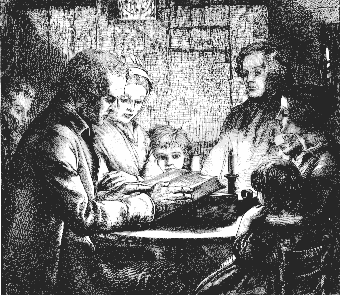
“…within the last generation the Bible reading which used to be traditional in England has lapsed. It is quite common to meet with young people who do not know the Bible stories even as stories.”
– George Orwell, “The English People,” 1944
“…within the last generation the Bible reading which used to be traditional in England has lapsed. It is quite common to meet with young people who do not know the Bible stories even as stories.”
– George Orwell, “The English People,” 1944
While reading on the King James I recently found an interesting quote from Bruno Bettelheim’s book, The Uses of Enchantment: The Meaning and Importance of Fairy Tales
“As long as parents fully believed that Biblical stories solved the riddle of our existence and its purpose, it was easy to make a child feel secure. The Bible was felt to contain the answers to all pressing questions: the Bible told man all he needed to know to understand the world, how it came into being, and how to behave in it. In the Western world the Bible also provided prototypes for man’s imagination.”
This caught my attention as I agreed with its point, and I was intrigued that it arose in a book on the value of fairy tales (the value of which I have also commended several times at my blog on children’s literature). However, once I found a copy of Bettelheim’s book, I discovered the rest of the quotation. Immediately following the portion cited above was this:
But rich as the Bible is in stories, not even during the most religious of times were these stories sufficient for meeting all the psychic needs of man.
Part of the reason for this is that while the Old and New Testaments and the histories of the saints provided answers to the crucial questions of how to live the good life, they did not offer solutions for the problems posed by the dark sides of our personalities. The Biblical stories suggest essentially only one solution for the asocial aspects of the unconscious: repression of these (unacceptable) strivings. But children, not having their ids in conscious control, need stories which permit at least fantasy satisfaction of these “bad” tendencies, and specific models for their sublimation.
Explicitly and implicitly, the Bible tells of God’s demands on man. While we are told that there is greater rejoicing about a sinner who reformed than about the man who never erred, the message is still that we ought to live the good life, and not, for example, take cruel revenge on those whom we hate. As the story of Cain and Able shows, there is no sympathy in the Bible for the agonies of sibling rivalry – only a warning that acting upon it has devastating consequences.
But what a child needs most, when beset by jealously of his sibling, is the permission to feel that what he experiences is justified by the situation he is in. To bear up under the pangs of his envy, the child needs to be encouraged to engage in fantasies of getting even someday; then he will be able to manage at the moment, because of the conviction that the future will set things aright. Most of all, the child wants support of his still very tenuous belief that through growing up, working hard, and maturing he will one day be the victorious one. If his present sufferings will be rewarded in the future, he need not act on his jealousy of the moment, the way Cain did.” (52)
This is a very significant comment which possesses real insight while also betraying a sadly common misconception about the Bible- a misconception found not just in the culture in general but in the church as well.
The major problem is that the author sees the Bible simply as demands for good behavior, in story and precept. The Bible is simply a set of morals. Sadly, this is often how it is preached. And, if this is how you see the Bible, it is certainly not “sufficient for meeting all the psychic needs of man.” But the author, and far too many preachers, misses the Gospel which is the center of the Biblical story! Yes, God’s demands and the negative consequences of disobedience are made clear. But the recurring theme is God’s rescue and redemption of His failing people. The Bible’s answer for “asocial” behavior and feelings is not “repression” but redemption. This is the point of the cross which is the center of the Biblical story.
Bettelheim is on to something when he states children- and adults as well- need to be assured that things will be made right someday. The key to endurance is the hope that the wrongs endured now will be made right and that injustices will be dealt with. However, Bettleheim points us simply to fantasies of getting even ourselves. The gospel points us to the resurrection where our sufferings will be removed and justice will be vindicated, not by our own getting even but by God’s intervention. This, then, is not simply fantasy but a real promise and a steady ground for hope.
Let us make sure as we preach, that we do not stop simply with call to proper behavior but we get to the central point of grace which pardons and empowers (e.g. Titus 2:11-14). Let us also regularly point people to the hope of the resurrection which grounds our perseverance (1 Cor 15:58).
Robert Alter, in his fascinating book, Pen of Iron: American Prose and the King James Bible
“As I assemble these reflections on the presence of the King James Version in American writing, the fourth centennial of the 1611 translation stands on the horizon. A great deal has changed in American culture since the third centennial was celebrated in 1911. At that juncture, the King James Version was extolled by leading public figures such as Theodore Roosevelt and Woodrow Wilson as America’s national book and as the text that more than any other had affected the life of English-speaking peoples. My guess is that the 2011 milestone will be marked more in academic circles than in the public domain. In the century since the previous centennial was celebrated, two major shifts have taken place; the practice of reading the Bible aloud, of reading the Bible at all, and of memorizing passages from the Bible has drastically diminished; and the King James Bible has ceased to be the almost universally used translation as readers have been encouraged to use more ‘accessible’ versions, which also happen to be stylistically inferior in virtually all respects.
The decline of the role of the King James Version in American culture has taken place more or less simultaneously with a general erosion of a sense of literary language, although I am not suggesting a causal link. The reasons for this latter development have often been noted, and hence the briefest summary will suffice for the purpose of the present argument: Americans read less, and reads with less comprehension; hours once devoted to books from childhood on are more likely to be spent in front of a television set or a computer screen; epistolary English, once a proving ground for style, has been widely displaced by the high-speed short-cut language of e-mail and text-messaging.” (9-10)
The issue here is larger than a translation. At our King James Bible festival, September 15-17, we will seek to address these and other issues pertinent to the church today.
It was my privilege yesterday to preach at the ordination of Corey Cummings, a former student of mine. As part of the service, a prayer of dedication was given which Corey had written. Because I thought this prayer expressed well the sort of things a pastor ought to desire to have prayed for him, I obtained Corey’s permission to post the prayer here. A church leader prayed the prayer with the ordinand responding with the words in parentheses.
Almighty Father, we have gathered to dedicate one of your own to your service. We ask that you grant to your servant those gifts which will aid and sustain him in your ministry.
(I am the Lord’s servant)
Grant to this servant the gift of faith that you gave to your servant Abraham. Give him a faith which holds nothing in reserve. Give him the courage to pursue your calling on his life, even if that means leaving behind security, comfort, familiar surroundings and personal dreams.
(I am the Lord’s servant)
Grant to your servant the gift of abundant wisdom. Guide him by right paths to right ends. Let him offer personal counsel, spiritual guidance, and ecclesiastical leadership with the deep wisdom that comes only from you.
(I am the Lord’s servant)
Grant to this servant the blessing on his work that you gave your servant Joseph. Grant that whatever he puts his hand to will be blessed, that his work will bear fruit to your glory, and that even those moments which appear to him and us to be setbacks will in fact be your preparations for greater service.
(I am the Lord’s servant)
Grant to your servant the gift of humility. Let the gaze of his heart rest always on you, and never on himself. In this way, shield him from the evils of pride and vanity in times of success, and from despair in times of adversity. Let him say with your servant Job, “The Lord gives, and the Lord takes away. Blessed be the name of the Lord.”
(I am the Lord’s servant)
Finally, grant to your servant the gift of self-sacrifice that you gave to your servant Stephen, and to all your martyrs. Give this servant the deep desire to honor and glorify you with his life, and if necessary, his death. Let his heart say, “If by my life or my death I may give you glory, I am yours.”
(I am the Lord’s servant. May it be to me as you have said.)
I recently came across this poem and appreciated it. It can apply to various situations, and the field of pastoral ministry is certainly one of them. Many faithful brothers never win the world or the church’s applause or even appreciation. Sometimes a faithful work fails. And every faithful work has it share of failures- and too often the failures loom larger in our minds than the successes. Here, then, is a fitting poem reminding us to pursue faithfulness, walking by faith and not by sight, “knowing that your labor in the Lord is not in vain” (1 Cor 15:58).
To the Men Who Lose
Here’s to the men who lose!
What though their work be e’er so nobly planned,
And watched with zealous care,
No glorious halo crowns their efforts grand,
Contempt is failure’s share.
Here’s to the men who lose!
If triumph’s easy smile our struggles greet,
Courage is easy then;
The king is he who, after fierce defeat,
Can up and fight again.
Here’s to the men who lose!
The ready plaudits of a fawning world
Ring sweet in victor’s ears;
The vanquished’s banners never are unfurled-
For them there sound no cheers.
Here’s to the men who lose!
The touchstone of true worth is not success;
There is a higher test-
Though fate may darkly frown, onward to press,
And bravely do one’s best.
Here’s to the men who lose!
It is the vanquished’s praises that I sing,
And this is the toast I choose:
“A hard-fought failure is a noble thing;
Here’s to the men who lose!”
–Anonymous
Scott T. Brown, editor. It Can Be Done: Poems for Hardship, Sacrifice and Dominion (Wake Forest, NC: Merchant Adventurers, 2009), p. 85.
I have had the privielge of reading through the draft of Nathan Finn’s new edition of Robert Hall’s Help to Zion’s Travellers soon to be published by Borderstone Press. This book was orignially published in 1781, and had significant influence on William Carey and others involved in the renewed mission efforts of that day. Finn has edited the book with some additional notes, and most significantly provides an introductory essay which does a great job explaining the setting in which this book emerged and its influence.
Here is the blurb I have written for the book:
Nathan Finn has done pastors as well as historians a great service in providing thsi new edition of Robert Hall’s Help to Zion’s Travellers. Finn’s historical introduction itself is insightful and edifying. It is a joy to discover a lesser known, faithful servant, to see his impact and to learn from him. Help’s to Zion’s Travellers is a helpful volume, particularly the “Experimental Difficulties” section which contains much helpful, sound pastoral direction on matters of the soul. Hall was no mere theoretician, but a pastor experienced in the dealings of the soul pasing on what he has learned to those willing to listen. May the Lord use this new edition to encourage a multitude of pastors who may not garner fame but will be faithful in the care of souls.
Latest from PastoralEpistles.com:
I previously announced the creation of a new consultation of the Pastorals at the Evangelical Theological Society to begin meeting this Fall. As stated before, the overall goal of this consultation is to explore the ways that the exclusion of the Pastoral Epistles has impacted the work of Pauline theology and how the inclusion of the Pastorals would inform the same work.
Now, I am pleased to announce the presenters and paper titles for this inaugural session. Here are the details of the session:
Session Title: “The Place of the Pastoral Epistles in Pauline Theology”
Moderator: Ray Van Neste
Robert Yarbrough: “The Pastoral Epistles in New Testament Theologies from Tubingen to Thielman”
Timothy Swinson: “The Pastoral Epistles and Perspectives, Old and New”
Greg Couser: “‘Life on Life’: Explorations in Paul’s Understanding of Eschatological Life”
Frank Thielman: The Pedagogy of Grace: Soteriology, Ethics, and Mission in Titus 2:11-14
We are pleased to have each of these scholars participating. Bob Yarbrough’s paper will open the discussion by surveying how the Pastorals have been treated or ignored. Tim Swinson’s paper will examine what the Pastorals might contribute to one of the major discussions in Pauline theology, the New Perspective. Greg Couser will examine “life” terminology in 1 Timothy in comparison with the wider Pauline usage seeking to discern how 1 Timothy would contribute to Pauline theology in this area. Frank Thielman will investigate soteriological themes in Titus 2-3 in comparison with those themes elsewhere in Paul.
This promises to be a very beneficial discussion. I hope to see you there.
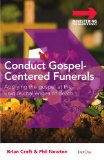 This week my fellow pastors & I discussed the pastor’s role at funerals with our pastoral apprentices, and I was glad to be able to commend this new book by Brian Croft and Phil Newton– Conduct Gospel-centered Funerals: Applying the gospel at the unique challenges of death
This book is an excellent resource for pastors. It gets to the “nitty-gritty” of funeral planning, pastoral care, and other areas associated with shepherding people through death. Years of experience provide so much helpful information down to walking carefully around the graveside! Also, I have heard some younger pastors, over-reacting to man-centered funerals, swing to the other extreme resulting in a situation where nothing at all is said about the person who has died. Since we believe people are made in the image of God, a proper funeral ought to honor the dignity of human life and the gravity of death, and in that context hold forth the gospel. This book demonstrates this holistic approach well.
If you are a pastor, you would do well to get a copy of this small, readable, practical, immensely helpful book.
I am currently reading to my children Douglas Jones’ little book, Huguenot Garden
The churches had been banned from meeting so the church attended by the main characters had met in the woods on a Sunday. In the middle of the service a boy, who had been positioned as a watchman, came running in to say the dragoons were coming. The pastor encouraged the people to flee into the woods.
“But Pastor De Laune, his wife, and two children stood firm.
Father and Uncle Philippe paused to listen and offer help, and the two elders spoke hurriedly to the Pastor.
‘But you must go. You will be imprisoned if you stay,’ stressed Elder Pasquier.
With a quick, authoritative whisper, Pastor De Laune declared to both elders, ‘But a hireling who is not the shepherd, one who does not own the sheep, sees the wolf coming and flees; and the wolf catches the sheep and scatters them.’ I am not a hireling. Please brethren, take my wife and children and go now.’
Elder Pasquier, in exasperation, turned to the Pastor’s wife, ‘Dear Hannah, please plead for your husband’s life. Persuade him to leave. He may be separated from you and your children forever.’
Hannah gently touched the elder’s cheek and smiled. ‘He is a faithful watchman, called and under duty to Christ to protect these sheep. I would expect nothing less from him.’
‘You see,’ added the Pastor, ‘I may fail like Adam, but my wife is no Eve. Go now, I will keep the dragoons’ attention here. Care for my wife and children, if need be.’ After a quick embrace of her husband, Hannah and all the others ran into the forest.
No one looked back at the Pastor, but if they had, they would have seen him calling the dragoons over to himself.
‘Over here, over here. I am the one you want,’ he called out.” (pp. 103-104)
Though this account is fictional there are many historical accounts which are quite similar. In the story, the pastor is never seen or heard from again after being drug back into town by horse.
“The good shepherd lays down his life for the sheep” (John 10:11).
Hopefully you have seen a number of the essays that have been written this year on the 400th anniversary of the King James Version. Since May is the actual anniversary of the publication of the KJV there has been a flurry of stories in the last week or so. Here is an overview of some of the main stories. Many of the stories cover common ground so I try here to highlight the particular contribution of each item.
Baptist Press has a nice story on the KJV drawing largely from Michael Haykin, professor at Southern Seminary. The story covers the history and literary influence briefly but well. It also deals with the abiding value of the KJV.
Christianity Today’s cover story in the current issue is “A World Without the King James Version, by Mark Noll. Noll treats some negative results of the predominance of the KJV.
Barton Swaim’s, “God’s English:The Making & Endurance of the King James Bible, 1611-2011″ in Touchstone Magazine summarizes the history of the making of the KJV but also (his main contribution in my opinion) discuss the power of the language and the value and propriety of having a “religious language.” He also, as others have done, notes the effort of the KJV translators to adhere to a fairly literal approach to interpretation. He states:
“It is the chief virtue of the King James Bible that its translators adhered to the original texts even at the expense of allowing ambiguities and enigmas to pass into the English translation. Their priority lay in allowing the Bible to speak for itself, in all its strangeness and mystery.”
I think Swaim is right here, and this is one of the key lessons the KJV can pass on to us today.
“Why the King James Bible Endures,” by Charles McGrath in the New York Times deals with the power of the language arguing that the elevated, antiquated language (the language was already a bit archaic in 1611) is a secret to the translation’s power. McGrath identifies himself as a “nonbeliever” stating:
“Not everyone prefers a God who talks like a pal or a guidance counselor. Even some of us who are nonbelievers want a God who speaketh like … well, God. The great achievement of the King James translators is to have arrived at a language that is both ordinary and heightened, that rings in the ear and lingers in the mind.”
These essays provide good food for thought as we look back in order to look ahead. These and other issues will be addressed at the upcoming festival, KJV400: Legacy and Impact at Union University. Registration opened this week, and it promises to be an enlightening and entertaining event.