Anthony Esolen on Masculinity and Pastoral Ministry

Anthony Esolen is a particularly gifted writer. If he wrote a phone book it would be interesting and quotable. His 2003 Touchstone essay “What Sports Illustrate: The Obvious Truth About Young Men & Religion” is an insightful discussion of culture, masculinity, sports and pastoral ministry. His introduction alone is full of valuable truths, but as he moves to his conclusion he applies his point particularly to the role of the pastor (or priest as he would say). He calls for pastors to be men, not just males, and then poses these challenging questions to those who aspire to the pastorate.

Can you be not only a teacher, but a teacher who rebukes, loves, lays down the law, and naturally draws the most recalcitrant to you? For you are sent to the pagan and the prodigal, to the enemy and the atheist.

Will the young men listen to a word you are saying when you are telling them they are wrong? Will they obey when you require from them sacrifice that their friends would consider absurd? No one can do that, you retort? Football coaches do that for a living. Can you be, not den mother to emotional dependents, not archsongster of a liturgical club, but a master, a colonel, a vice-gerent, a father who can eschew the moment of truce because he sees, for the hosts he loves and leads, a distant glory?

Can you give men the courage to suffer and obey and restore their lives to order, as did the stern, soft-spoken, Christian coach of the Dallas Cowboys, Tom Landry? Can you be the head,as Christ is the Head of the Church? Is that the aspiration you believe the Lord has placed in your heart?

Of course we can do nothing apart from grace, but this does not negate the reality of our own pursuit and growth. Read the whole article. It is well worth it. Let us pursue, by God’s grace to be such men.

(NB: By the way, Touchstone Magazine commonly contains powerful essays like this. It is a regular part of my reading as I look forward to each new issue. It is well worth the subscription.)

Pastoral Epistles at ETS

We will have the second meeting of our Pastoral Epistles study group at the Evangelical Theological Society this week. I have included below the information on date, time and place as well as the presenters and paper titles. I hope some of you will join us for what I think will be a significant conversation.

Some have asked about the site PastoralEpistles.com. We have had difficulties with the site so that I have not been able to post updates there. The nice folks at Logos are at work creating a new site for us which we hope will launch soon.

11/15/2012
8:30 AM-11:40 AM
Frontier Airlines Center  202 C

Moderator
Ray Van Neste, Union University

8:30 AM – 9:10 AM
Benjamin L. Merkle, Southeastern Baptist Theological Seminary
Are the Qualifications for Elders or Overseers Negotiable?

9:20 AM – 10:00 AM
L. Timothy Swinson, Liberty University
“Saved by Means of Childbearing”: 1 Tim 2:15 as a Reflection of Paul’s Reading of Gen 3-4

10:10 AM – 10:50 AM
Gregory S. MaGee, Taylor University
Anchored in Israel’s Faith: Paul and the Old Testament in 2 Timothy

11:00 AM – 11:40 AM
Gregory A. Couser, Cedarville University
Paul and the Conscience

The Sort of Men We Need as Pastors

“There is no place for a weak spine in the ministry of a leader.  Men who stand up for the truth, who bow down to only God, who praise only godliness and rebuke all unrighteousness; these are the men we need.  Men who will not snap under the pressure of rebellion from their people, who will not give in to the mass plea for iniquity, who will not aid the devil in making the people fall; these are the men we need.  We need men like Moses who, though being angered with the iniquity of his people, felt such great compassion on them that he begged for mercy instead of fire and brimstone.  Even at the expense of his own soul, Moses was prepared to shepherd his people toward God’s loving hand.  Aaron, on the other hand, was prepared to give the people’s souls over to Satan, in order that all but God and Moses would approve of him.”

This is an excerpt from a student’s response to my message “Shepherding a Rebellious People” which examines Moses and Aaron as examples (positive and negative) for leading God’s people in the golden calf incident in Exodus.

Sola Scriptura Preaching

This portion from the Diet of Speyer (1529) powerfully articulates the idea of sola scriptura and what it means for preaching. May we continue to have, nurture and celebrate such preaching.

There is, we affirm, no sure preaching or doctrine but that which abides by the word of God. According to God’s command, no other doctrine should be preached. Each text of the holy and divine Scriptures should be elucidated and explained by other texts.  This holy book is in all things necessary for the Christian; it shines clearly in its own light, and is found to enlighten the darkness. We are determined by God’s grace and aid to abide in God’s Word alone, the holy gospel contained in the biblical books of the Old and New Testaments. This world alone should be preached, and nothing that is contrary to it. It is the only Truth. It is the sure rule of all Christian doctrine and conduct. It can never fail us or deceive us. Whosoever builds and abides on this foundation shall stand against all the gates of hell while all merely human additions and vanities set up against it must fall before the presence of God.
(cited in Timothy George, Reading Scriptures with the Reformers, 118-19).

Reformation and the Care of Souls

Happy Reformation Day!

I was privileged to speak in chapel today at Union University for our Reformation Day chapel and chose as my topic, “The Care of Souls: The Heart of the Reformation.” My main point is that the Reformation was not simply an academic or abstract discussion but arose from the pastoral care of souls. I sought to establish this point from key events and quite a few quotes (particularly from Luther, Calvin and Bucer) where the Reformers themselves spoke to the importance of soul care and evangelism.

I have posted my notes here.

Here is the introduction:

“The Reformation was a pastoral care movement growing directly out of care for the salvation of the soul” (Ronald Wallace)

Too easily people conceive of the Reformation as an academic discussion, debates about the finer points of theology, high falutin ideas of interest to some people but disconnected from real life, struggles, heart ache, “the things I deal with.” It is important for us to be rescued from such notions less this important event in our history become yet one more dusty item on the shelf, pulled out for special chapels and certain classes but otherwise forgotten.

The Reformation was a diverse movement with various pieces including excesses and unfortunate incidences. But at its center was a pulsing, yearning concern for the well-being of souls.  Its leaders were pastors at pains to lead their flock- and others from around the world- to forgiveness before God and the living hope which comes from that, the knowledge of God’s care and presence in the real hardships of this world and the certain hope of resurrection.

(Read more)

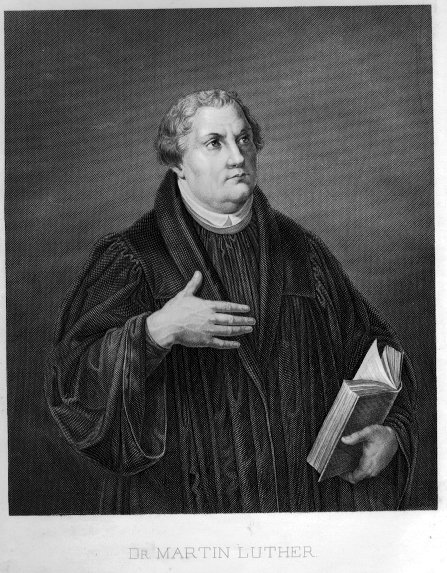
“Preacher, Don’t Be Lazy”- Martin Luther

As a lead up to Reformation Day, here is a quote from Martin Luther on the need for hard work in the preaching. I have taken the quote from John Piper’s ebook, Martin Luther: Lessons from His Life and Labor, which is currently available free.

Some pastors and preachers are lazy and no good. They do not pray; they do not read; they do not search the Scripture … The call is: watch, study attend to reading. In truth you cannot read too much in Scripture; and what you read you cannot read too carefully, and what you read carefully you cannot understand too well, and what you understand well you cannot teach too well, and what you teach well you cannot live too well … The devil … the world … and our flesh are raging and raving against us. Therefore, dear sirs and brothers, pastors and preachers, pray, read, study, be diligent … This evil, shameful time is not the season for being lazy, for sleeping and snoring.

Psalm 100 Defining Life

I had the privilege yesterday of preaching Psalm 100 at First Baptist Church here in Jackson, TN, where Justin Wainscott is pastor. I have commented here several times on this rich psalm, and I continue to be blessed by it.

Here is a quote on the command in verse 3 to “Know that the LORD is God,” which I have particularly appreciated:

That the LORD is God is not merely a theological proposition with which we reason, not mere information to garnish the desert of pious religion. It is a definition of our own life, or it is nothing. (James L.Mays, Preaching and Teaching the Psalms, 180).

I Shall Get Home Some Day

A couple of times recently I have encountered the story of Charles A. Tindley (1851-1933) and reference to some of his hymns. When Robert Smith recently spoke at Union he briefly told the story of Tindley, the son of former slaves who taught himself to read and write, put himself through school while working as a church janitor, and later became pastor of that same church. This week Russ Pflasterer led chapel in singing a song by Tindley.

It is apparent that Tindley knew what it meant to persevere, and as I searched though hymns written by Tindley I discovered that perseverance was a common theme. I particularly liked his song, “Some Day,” which I think is a powerful reflection on the necessity of perseverance and the hope which sustains us. The words are below. May the help us to persevere faithfully.

“SOME DAY”

Beams of Heaven, as I go,
Through this wilderness below,
Guide my feet in peaceful ways,
Turn my midnights into days;
When in the darkness I would grope,
Faith always sees a star of hope,
And soon from all life’s grief and danger,
I shall be free some day.

Refrain

I do not know how long ’twill be,
Nor what the future holds for me,
But this I know, if Jesus leads me,
I shall get home some day.

Oftentimes my sky is clear,
Joy abounds without a tear,
Though a day so bright begun,
Clouds may hide tomorrow’s sun;
There’ll be a day that’s always bright,
A day that never yields to night,
And in its light the streets of glory
I shall behold some day.

Refrain

Harder yet may be the fight,
Right may often yield to might,
Wickedness awhile may reign,
Satan’s cause may seem to gain,
There is a God that rules above,
With hand of power and heart of love,
If I am right, He’ll fight my battle,
I shall have peace some day.

Refrain

Burdens now may crush me down,
Disappointments all around,
Troubles speak in mournful sigh,
Sorrow through a tear stained eye;
There is a world where pleasure reigns,
No mourning soul shall roam its plains,
And to that land of peace and glory
I want to go some day.

Refrain

– Charles A. Tindley, 1906

The Importance of Ministerial Preparation, Gregory the Great

Gregory the Great, in his book, Pastoral Care (written in AD 590), speaks well to the importance of training for the significant task of guarding and guiding souls.

“No one ventured to teach any art unless he has learned it after deep thought. With what rashness, then, would the pastoral office be undertaken by the unfit, seeing that the government of souls is the art of arts! For who does not realize that the wounds of the mind are more hidden than the internal wounds of the body? Yet, although those who have no knowledge of the powers of drugs shrink from giving themselves out as physicians of the flesh, people who are utterly ignorant of spiritual precepts are often not afraid of professing themselves to be physicians of the heart, and though, by divine ordinance, those now in the highest positions are disposed to show a regard for religion, some there are who aspire to glory and esteem by an outward show of authority within the holy Church.” p.22

(I previously gave an overview of this book here)

David King, 10 Points on Pastoral Ministry

Recently David King, pastor of Concord Baptist Church in Chattanooga, visited my pastoral ministry class and shared ten key reflections on pastoral ministry. I asked David to come because he is a great example of faithful, patient ministry, holding fast to the Word and really loving his people.

We all benefited greatly from David’s comments, and he graciously agreed to type up a summary of what he said for me to post. His ten exhortations were:

1.  Get as much help as you can as early as you can for as long as you can.

2.  Don’t be naive.

3.  Fear God more than man.

4.  Enjoy people.

5.  Ditch the God-family-church pie chart.

6.  Trust God to work through the simple preaching and teaching of his word over time.

7.  Resist ministerial lust.

8.  Brace yourself for rigorous but rewarding work.

9.  Consider unreached areas.

10.  Keep your heart happy in the triune God and his glorious gospel.

I encourage you to read the whole thing here.