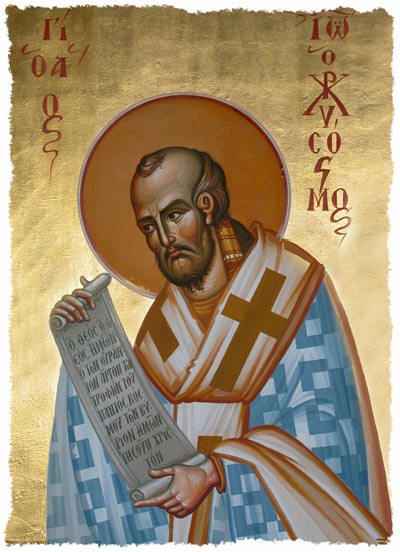
Chrysostom as a Preacher

“[John Chrysostom’s] excellence we appreciate today from an exegetical point of view, from an ethical point of view, and from a literary point of view.

The preaching of this master centers in his series of exegetical sermons on individual books of the Bible. . . . . his great authority as a preacher rested in his faithfulness to Scripture. When he preached, there was never any question but that it was the Word of God which he preached.”
(Hughes Oliphant Old, Worship Reformed According to Scripture, p. 65)

Middle TN Bible Conference, April 29

On Thursday, April 29, Greg Thornbury and I will be the speakers for a one day Bible conference with the theme, “Communicating Familiar Bible Stories in Unfamiliar Ways,” hosted by Union University, Hendersonville. We will be considering the familiar pastoral struggle of preaching texts which you feel like the people already know very well. Pastors often speak of this struggle in connection with Christmas and Easter.

We had a great time with the attendees last year as we considered the return of Christ, so we look forward to this year as well.

Registration is required, but it is free. Lunch is also provided for free.

The Making of an Atheist, by Jim Spiegel

I have previously mentioned the blog tour for this book and made some preliminary comments about it. My appreciation of the book only grew as I finished it. It has often been said- correctly I think- that we need more very well done short books on important topics. This is one of those books. In short compass, in a very readable and engaging manner, Spiegel lays out the biblical teaching on how sin blinds us.

Spiegel states that the “the ultimate point” of the book is “to encourage us to look elsewhere besides appraisal of the evidence for the real explanation of atheism” (23-24). Much of the approach of Christians toward atheists is based on the idea that what is needed is more evidence, a better rational explanation. However, Spiegel argues, the real problem is not academic or rational but moral and psychological. He notes:

“A common way of thinking about the relationship between cognition and conduct is to regard belief as always determining behavior. We have a certain belief and choose to act on it. But the above passages [Eph. 4:17-19; Rom. 1:18-24, 28-29] suggest that it works the other way around, too” (54)

“What they (such passages) do point to is a certain moral corruption that influences how they (unbelievers) use their cognitive faculties. It is not intelligence they lack so much as self-control and the right values” (52).

Speigel also points to some candid remarks by prominent atheists.

Aldous Huxley:

“For myself as, no doubt, for most of my contemporaries, the philosophy of meaninglessness was essentially an instrument of liberation. The liberation we desired was simultaneously liberation from a certain political and economic system and liberation from a certain system of morality. We objected to the morality because it interfered with our sexual freedom.” 73

“Most ignorance is vincible ignorance. We don’t know because we don’t want to know. It is our will that decides how and upon what subjects we shall use our intelligence. Those who detect no meaning in the world generally do so because, for one reason or another, it suits their books that the world should be meaningless.” 73

William James

“If your heart does not want a world of moral reality, your head will assuredly never make you believe in one.” 84

This truth, that our behavior shapes our belief and that mankind in our fallen state actively hide from God, is an important one for us to reaffirm. It will inform life an ministry in many ways. Reasoned apologetics has a place, but we must realize that rebellion is what must be cured and only God through his gospel can do this (2 Cor 4:1-6). This also means that living out the gospel has great apologetic value. Spiegel writes:

“…there is apologetic power in a life well-lived.” (116)

“Personal virtue and self-sacrifice are the most effective tools of persuasion. . . . When it comes to proving religious truth, an ounce of love is worth a ton of argument.” (116-117)

“…the more virtuously one lives, the more truth one is able to access…” (117)

“…one’s sinful commitments cause cognitive interference by the will . . . . In order to apprehend truth, which is the goal of the intellectual life, one must live a moral life.” (118)

This is a great, helpful little book and I encourage you to read it. I have already bought a copy for our church library and am planning to make it required reading for one of my courses.
Martin Bucer on the Lord’s Supper

These themes I found valuable:
– communion is a gift from God given because we need it
– frequency
– the tone of thankfulness and joyful triumph

“The Lord, therefore, out of his great and ineffable love, has ordained and appointed for us a sacred supper in which he gives us his body and blood, in order that we through him and in him may become a new and divine flesh-and-blood and ever more fully live in him and he in us, with a life truly divine. We should receive these great and precious gifts as frequently as possible with sincere devotion and utter thankfulness, and in the act of receiving commit ourselves ever more completely to him and proclaim triumphantly and declare to others by word and deed his death and our redemption.”

(Martin Bucer, “A Brief Statement or Instruction on How the Sick Should Be Visited by the Ministers of the Church and the Procedure to Be Followed in Their Homes, about 1549.” In Early Protestant Spirituality (The Classics of Western Spirituality). Edited and translated by Scott H. Hendrix.)

Whitney, “Learning to Pray Scripture”

Don Whitney will be on campus at Union University this week, Thursday, April 8, leading a seminar titled “Learning to Pray Scripture.” The public is invited. The seminar will meet from 1:00-3:00 pm in Luther Hall. It is free and refreshments will be provided.

Dr. Whitney lead a similar seminar last Spring focusing on praying the Psalms and it was very beneficial. If you are in this area this will be a great opportunity for helpful and encouraging teaching.

If you would like more information you can contact Campus Ministries at 661-5061.

Alfred the Great on the Psalms

The White Horse King: The Life of Alfred the GreatAnother striking thing from Ben Merkle’s book, The White Horse King: The Life of Alfred the Great, was the value he saw in the Psalms. Well before Wycliffe, Alfred, King of Wessex, was translating the Psalms for his people as part of his “essential books everyone should read” project.
“The translation of the Psalms was Alfred’s last project, being only one-third complete at the king’s death. These psalms, primarily the songs of King David composed throughout the king of Israel’s tumultuous reign, had always had a special place in Alfred’s heart. Having memorized many of the psalms in his youth, Alfred had used these sacred words throughout his life to embolden himself in battle, encourage himself in despondency, humble himself in his sins, and comfort himself in his forgiveness. The entire spectrum of Alfred’s personal trials and triumphs seemed to have been lived out already by the shepherd king of Israel. More than any other text, the book of Psalms had become the poetry of Alfred’s life.

Thus, it is no surprise that when searching for the ‘books most necessary for all men to know,’ Alfred’s thoughts turned to the book of Psalms. This was fit reading material for the king and for the peasant, for the warrior and for the clergyman, for the novice and for the sage. Interestingly, of all the texts Alfred translated, the king’s rendering of the Psalms remained the most consistently literal throughout, with very little of the king’s own explanatory additions to the text. Alfred felt this was a book that needed little assistance in speaking to the Anglo-Saxon heart.” (191)

The White Horse King: The Life of Alfred the Great

I recently read Benjamin Merkle’s The White Horse King: The Life of Alfred the Great (not the Ben Merkle at Southeastern Seminary). I have commented often here on the value of history reading for pastors (as well as others), and this book has much value in this realm as well. Alfred was an amazing man who accomplished much.

The first six chapters of the book primarily tell of the struggle of Alfred and his predecessors against the Viking invasions. There are compelling battle stories and reminders of the blessing of peace. Also the description of the “shield wall” formation used in battle provides a powerful picture of church unity.

The great strength of the book in my opinion, though, is chapter seven which describes Alfred’s effort to rejuvenate his country. They had resisted the foreign invader, but he realized they needed more to ensure domestic health. He believed the Vikings were only a symptom of the greater problem of his people’s turn away from Christianity and the resultant loss of learning and character. Here are a few quotes:

“The English church had grown complacent, indolent, and lethargic. Numbed by their prosperity, their love of learning grew cold, and their interest in Christian study died off altogether. . . . By neglecting the study of the great works of Christendom, the Bible in particular, the Anglo-Saxon people had lost not only the ability to read but more important, the ability to understand the wisdom of God. England, through her intellectual lethargy, was slowly devolving into a pagan nation, a people who neither knew nor served the Christian God.” (179)

“If Christian virtue were to return to England, then the Anglo-Saxons would need to return to Christian learning. With an eye toward restoring this learned piety to the people, Alfred orchestrated a tremendous revival of literacy, a revival that culminated in the greatest literary renaissance ever experienced in Anglo-Saxon Britain.” (184)

“Alfred truly was the great king of England, the one monarch who rightly understood the needs of the nation and unrelentingly gave all he had to supply those needs.
England, and the many nations descended from her, still have Alfred to thank for a substantial portion of the heritage and freedoms that they enjoy today. The title ‘Alfred the Great,’ so strangely offensive to the modern ear, was well deserved by the Anglo-Saxon warrior-king.” (233)

There is much to glean from Alfred on the work of restoring a culture, of the value of learning, and the renewal of the church.

Pastoral Ministry: Hard Work for the Salvation of Souls and the Restoration of the World

Calvin commenting on 1 Thessalonians 5:12-13 states well the importance of hard work in pastoral ministry and what our work actually is.

In the first place, he says that they labor. From this it follows, that all idle bellies are excluded from the number of pastors. Farther, he expresses the kind of labor when he adds, those that admonish, or instruct, you. It is to no purpose, therefore, that any, that do not discharge the office of an instructor, glory in the name of pastors. …

Now, this work is the edification of the Church, the everlasting salvation of souls, the restoration of the world, and, in fine, the kingdom of God and Christ. The excellence and dignity of this work are inestimable: hence those whom God makes ministers in connection with so great a matter, ought to be held by us in great esteem.

(emphasis added)
(HT: Gentry Hill)

Practical Shepherding, new blog

Brian Croft, pastor of Auburndale Baptist Church, Louisville, KY, is a faithful pastor whom I am blessed to call a friend. He has written two very helpful books on pastoral ministry (Visit the Sick, & Test, Train, Affirm, and Send into Ministry: Recovering the Local Church’s Responsibility to the External Call), so I am pleased that he has launched a blog dedicated to specific issues in pastoral ministry. It is titled Practical Shepherding. Some of his current posts deal with helping a wife who is hurt by her husband’s use of pornography, ministering to widows, and identifying men in your church who are called for ministry. This is useful material for pastors and I encourage you to give it a look.