Reformation Day 2010

As we celebrate Reformation Day again this year some may say that we simply glory in men, or revel only in historical dates, or gloss over the shortcomings of those involved.  By no means!  In celebrating the Reformation we celebrate the work of God in the recovery of the gospel, the greatest revival since Pentecost, leading to the salvation of thousands of souls, the purifying and strengthening of the church, the delivery of the Scriptures to the common man, and the greater manifestation of the glory of God.  How can we not celebrate such?  What sort of people would we be if we failed to celebrate this?  How could we hold up our heads in Christ’s church if we failed to remember and celebrate His mighty deeds of the past?

And yet, much of the church is entirely unaware of this great move of God or of its anniversary this weekend.  Is it any surprise, then, that this church is losing its grasp on the gospel and reverting to many of the medieval errors?  Let us then celebrate, remember and proclaim.  And as we remember God’s mighty work almost 500 years ago, let us also pray, “Lord, do it again.”

Previous Reformation posts:

John Gill on a Pastor Loving His People

John Gill in his commentary on Titus 1:5-9 speaks of the love a pastor should have for his people.  He writes:

“…if he is not a lover of them, their company will be disagreeable to him, and he will be of no advantage to them; and if he does not love the souls of men, he will not naturally care for their state, or be concerned for their good.”

Let us love our people.

Abraham Booth, “Pastors, Care for Your Wives”

In an ordination message preached in 1785, Baptist pastor, Abraham Booth, gave a powerful exhortation on the need of pastors to attend to their own wives and children.  He voices in first person what he fears is the cry of too many pastors’ wives and closes with an exhortation referring to one’s wife as his Second-self:

“I have indeed married a preacher of the gospel but I do not find in him the affectionate domestic instructor for either myself or my children. My husband is much esteemed among his religious acquaintance as a respectable christian character, but his example at home is far from being delightful. Affable condescending and pleasing in the parlours of religious friends but frequently either trifling and unsavoury or imperious and unsocial in his own family. Preferring the opportunity of being entertained at a plentiful table and of conversing with the wealthy the polite and the sprightly to the homely fare of his own family and the company of his wife and children, he often spends his afternoons and evenings from home until so late an hour that domestic worship is either omitted or performed in a hasty and slovenly manner with scarcely the appearance of devotion. Little caring for my soul or for the management of our growing offspring he seems concerned for hardly any thing more than keeping fair with his people relative to which I have often calmly remonstrated and submissively entreated but all in vain. Surrounded with little ones and attended with straits, destitute of the sympathies, the instructions, the consolations which might have been expected from the affectionate heart of a pious husband, connected with the gifts of an evangelical minister, I pour out my soul to God and mourn in secret.”

Such there is ground of apprehension has been the sorrowful soliloquy of many a minister’s pious dutiful and prudent wife. Take heed then to the best interests of your Second-Self .

Oh, may my wife never have to feel this way!

Buoyant Expectation of God

What essential for a pastor?  Much could be said in answer to this question.  Wayne Oates several years ago stated this:

“…the consummate requirement of him [a pastor] is that he depend devotedly upon the Chief Shepherd for his own spiritual sustenance and live in the buoyant expectation of his continual manifestation of himself.  Titus calls this being “holy” and “a lover of goodness.”  These terms of endearment of the life of a pastor lay the emphasis upon his consecration and devotion, without which all other qualifications are in vain and usually are consumed in their own vanity.  Soren Kierkegaard has called this “purity of heart,” by which he means the power “to will one thing, and that is Christ.” (The Christian Pastor, 60)

I would differ with Oates on a variety of other points, but this is well stated.  May we live in the buoyant expectation of God’s continual manifestation of Himself!

Isaac Watts’ Pastoral Poetry

I have been reading recently on Isaac Watts who has blessed the church so richly with his hymns.  Below is a good, though lesser known, example of Watts poetry (originally published in Hymns and Spiritual Songs, 1707-1709).  Many of Watt’s hymns were composed to accompany his sermons and you can see him as a pastor applying the balm of the gospel to his people’s souls.  The beautiful hope of the gospel is clear as is his Christo-centric approach to the Scripture.

May we so teach our people.

Laden with guilt, and full of fears,
I fly to Thee, my Lord,
And not a glimpse of hope appears
But in Thy written Word.

The volume of my Father’s grace
Does all my griefs assuage;
Here I behold my Savior’s face
Almost in every page.

This is the field where hidden lies
The pearl of price unknown;
That merchant is divinely wise
Who makes the pearl his own.

Here consecrated water flows
To quench my thirst of sin;
Here the fair tree of knowledge grows,
Nor danger dwells therein.

This is the Judge that ends the strife
Where wit and reason fail,
My guide to everlasting life
Through all this gloomy vale.

O may Thy counsels, mighty God,
My roving feet command;
Nor I forsake the happy road
That leads to Thy right hand.

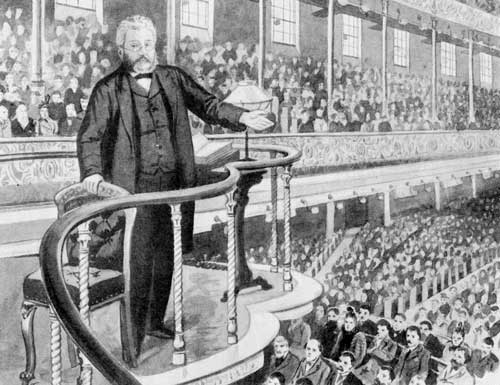
Spurgeon, The Richness and Freshness of the Bible

Here is a good, encouraging word from Spurgeon on the task of preaching and the inexhaustible richness of the Word of God.

“After preaching the gospel for forty years, and after printing the sermons I have preached for more than six-and-thirty years, reaching now to the number of 2,200 in weekly succession, I am fairly entitled to speak about the fullness and richness of the Bible, as a preacher’s book. Brethren, it is inexhaustible. No question about freshness will arise if we keep closely to the text of the sacred volume. There can be no difficulty as to finding themes totally distinct from those we have handled before; the variety is as infinite as the fullness. A long life will only suffice us to skirt the shores of this great continent of light. In the forty years of my own ministry I have only touched the hem of the garment of divine truth; but what virtue has flowed out of it! The Word is like its Author, infinite, immeasurable, without end. If you were ordained to be a preacher throughout eternity, you would have before you a theme equal to everlasting demands.”

– from The Greatest Fight in the World

The Duty of Pastors, Philadelphia 1743

In 1743 the Philadelphia Baptist Association adopted as a statement of their discipline Benjamin Griffith’s treatise, “Concerning a True and Orderly Gospel Church.”  In this treatise is the following description of the duty of pastors (emphasis added, and reformatted):

The minister being thus put upon his work, proceeds

(1.) to preach the word of God unto them, thereby to feed the flock, and therein ought to be faithful and laborious, studying to show himself a workman that needeth not to be ashamed, rightly dividing the word of truth, as he is a steward of God in the mysteries of the gospel, and therefore ought to be a man of good understanding and experience, being sound in the faith, not a novice, or a double-minded, unstable man, nor such as is light-spirited or of a shallow understanding, but one that is learned in the mysteries of the kingdom, because he is to feed the people with knowledge and understanding. He must be faithful in declaring the whole council of God. He is to instruct them in all practical godliness, laying before them their manifold duties, and to urge them upon their consciences.

(2.) He must watch over them, as one that must give an account to God. Such must have an eye upon every member to see how they behave in the house of God, where the presence of the Lord is more eminently, and where also the angels do always attend; and also their behaviour in the families they belong to, and their conversation abroad; according to their capacities, they are not to sleep under their charge.

(3.) He is to visit his flock to know their state, in order to minister suitable doctrinal relief unto them, and that he may know what disorders there may be among them, that the unruly may be reproved.

(4.) He is to administer all the ordinances of Christ, amongst them: as Baptism, and the Lord’s Supper, and herein he must be careful to follow the primitive pattern, thereby to hold forth the great end, wherefore they were ordained.

(5.) He must be instant with God, in his prayers for and with them, as opportunity may serve.

(6.) He must show them a good example in all respects, in conversation, sobriety, charity, faith, and purity, behaving himself impartial unto all, not preferring the rich before the poor, nor lording it over God’s heritage, nor assume greater power than God hath given him.

This is a great description worthy of reflection various accounts.  I bolded a few comments.  First, these brothers made it clear they expected thoughtful preaching, explicitly barring “light-spirited” men.  I appreciate humor, but too much preaching today, rather than being seasoned by humor, is swamped with a levity which belies the serious truths which are handled. Some glory in their shallowness and glibness.  This ought not be so.

Secondly, note the strong emphasis on oversight and personal knowledge of every member.  This sort of pastoral care- the burden of this blog- is not a novel or strange idea.  It was the standard in days past and our current age is the one out of step.

[The treatise contains scriptural references which are not reproduced here due to formatting difficulties]
Athanasius, It Is Not Death to Die

A very strong proof of this destruction of death and its conquest by the cross is supplied by a present fact, namely this. All the disciples of Christ despise death; they take the offensive against it and, instead of fearing it, by the sign of the cross and by faith in Christ trample on it as on something dead. Before the divine sojourn of the Savior, even the holiest of men were afraid of death, and mourned the dead as those who perish. But now that the Savior has raised His body, death is no longer terrible, but all those who believe in Christ tread it underfoot as nothing, and prefer to die rather than to deny their faith in Christ, knowing full well that when they die they do not perish, but live indeed, and become incorruptible through the resurrection. But that devil who of old wickedly exulted in death, now that the pains of death are loosed, he alone it is who remains truly dead. There is proof of this too; for men who, before they believe in Christ, think death horrible and are afraid of it, once they are converted despise it so completely that they go eagerly to meet it, and themselves become witnesses of the Savior’s resurrection from it. Even children hasten thus to die, and not men only, but women train themselves by bodily discipline to meet it. So weak has death become that even women, who used to be taken in by it, mock at it now as a dead thing robbed of all its strength. Death has become like a tyrant who has been completely conquered by the legitimate monarch; bound hand and foot the passers-by sneer at him, hitting him and abusing him, no longer afraid of his cruelty and rage, because of the king who has conquered him. So has death been conquered and branded for what it is by the Savior on the cross. It is bound hand and foot, all who are in Christ trample it as they pass and as witnesses to Him deride it, scoffing and saying, “O Death, where is thy victory? O Grave, where is thy sting?”

(On the Incarnation of the Word, chapter 5)

The Privilege of Theological Study

Today in one of my classes we discussed B. B. Warfield’s classic booklet, The Religious Life of Theological Students.  There is much wisdom in this little booklet, so if you have not read it I encourage you to do so (online here).

In one places he exhorts theological students to realize and appreciate the privilege they have in studying about God.  This privilege continues to apply to pastors.  We must not forget what a privilege is our sin giving ourselves to the study of God.

“Think of what your privilege is when your greatest danger is that the great things of religion may become common to you!  Other men, oppressed by the hard conditions of life, sunk in the daily struggle for bread perhaps, distracted at any rate by the dreadful drag of the world upon them and the awful rush of the world’s work, find it hard to get time and opportunity so much as to pause and consider whether there be such things as God, and religion, and salvation from the sin that compasses them about and holds them captive.  The very atmosphere of your life is these things; you breathe them in at every pore; they surround you, encompass you, press in upon you from every side.  It is all in danger of becoming common to you!  God forgive you, you are in danger of becoming weary of God!” (emphasis added)

Influence of the Psalms in the Renaissance

I continue to be intrigued by the wide-ranging, deep impact of the Psalms across the centuries.  This quote is just one more documenting this impact on the church and the surrounding culture.

“The Renaissance was a cultural movement founded on the enterprise of translation ….  The Earl of Surrey and Richard Stanyhurst translated Virgil’s Aeneid; Arthur Golding and George Sandys translated Ovid’s Metamorphoses; but all four translated the Psalms, as did John Milton, Sir Philip Sydney, the countess of Pembroke, Sir Thomas Wyatt, Sir Francis Bacon, Henry Vaughan, Phinehas Fletcher, and Richard Crashaw.  Virtually every author of the period (Shakespeare, Spenser, Bunyan, Donne, Herbert, and Johnson) translated, paraphrased or alluded to the Psalms in their major works.  In fact, the translation, or ‘Englishing,’ of the biblical Psalms substantially shaped the culture of sixteenth- and seventeenth-century England, resulting in creative forms as diverse as singing psalters, metrical psalm paraphrases, sophisticated poetic adaptations, meditations, sermons, commentaries, and significant allusions in poems, plays, and literary prose, by English men and women of varied social and intellectual backgrounds…

The Protestant Reformation sanctioned and even demanded vernacular translations of the Bible, but no biblical book was translated more often or more widely in the subsequent two centuries than the Psalms.”

–  Hannibal Hamlin, Psalm Culture and Early Modern English Literature (Cambridge University Press, 2004), 1